Affiliate disclosure: Some links on this page go to Amazon. If you buy something through one of them, we earn a small commission — at no extra cost to you. It never changes the price you pay, and it never decides what we recommend. As an Amazon Associate I earn from qualifying purchases.How we make money →
Well pumps and sump pumps answer to nobody — what their automatic starts mean for the generator you buy and the fuel you burn.
Your air conditioner at least waits for the thermostat. A well pump and a sump pump answer to nobody — the pressure drops or the water rises, and the motor slams on, day or night, whether your generator was ready for it or not. That is what makes them different from every other load in the house: you do not get to schedule the surge. Here is what that means for the machine you buy and the fuel you burn. And if you are past fifty — the people this site is named for — the stakes are simple: water is the difference between riding out a storm in your own house and packing a bag. Buy It At 50 exists so you set this up once, on a calm day, and never haul a bucket.
The Well Pump — No Power Means No Water
If you are on city water, an outage costs you air conditioning. If you are on a well — and a great many rural and semi-rural households are — an outage costs you water. Every flush, every faucet, every glass. The well pump is not a comfort item. It is the reason many rural households need a generator at all.
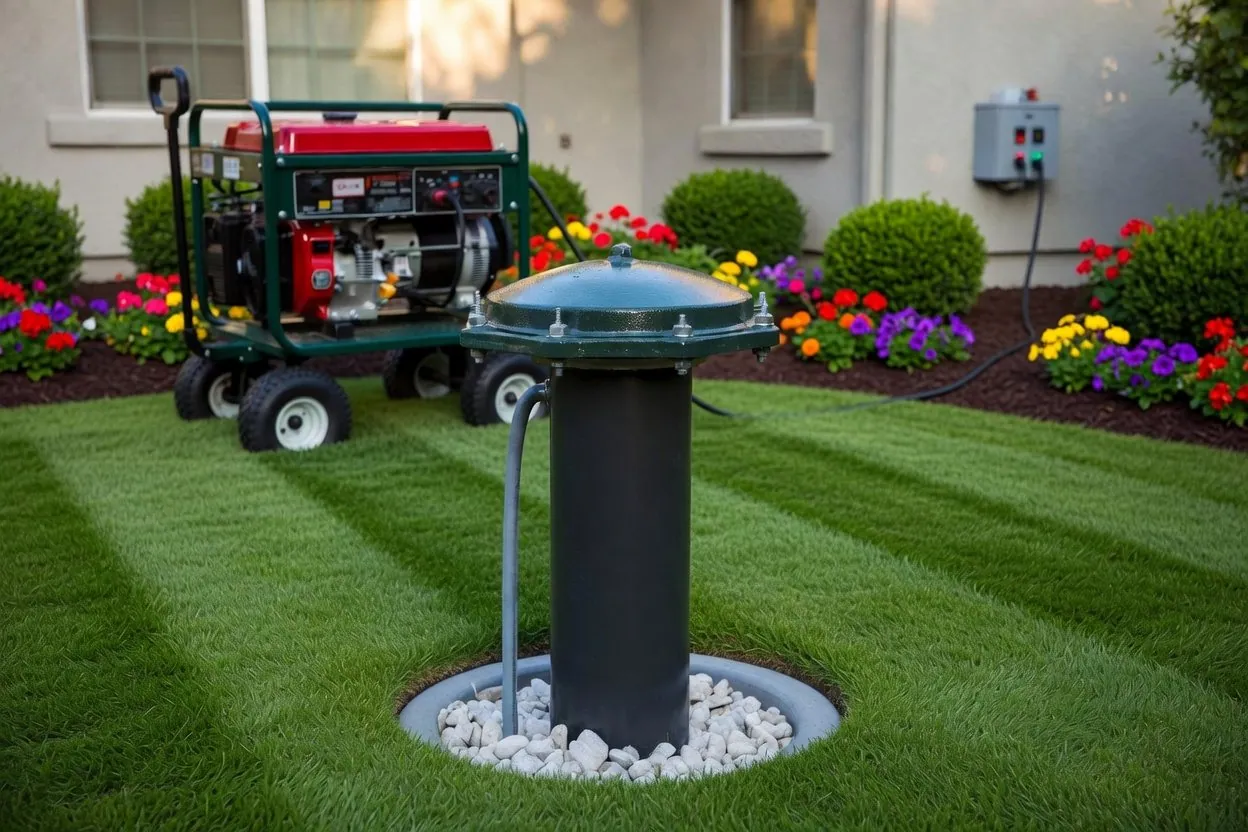
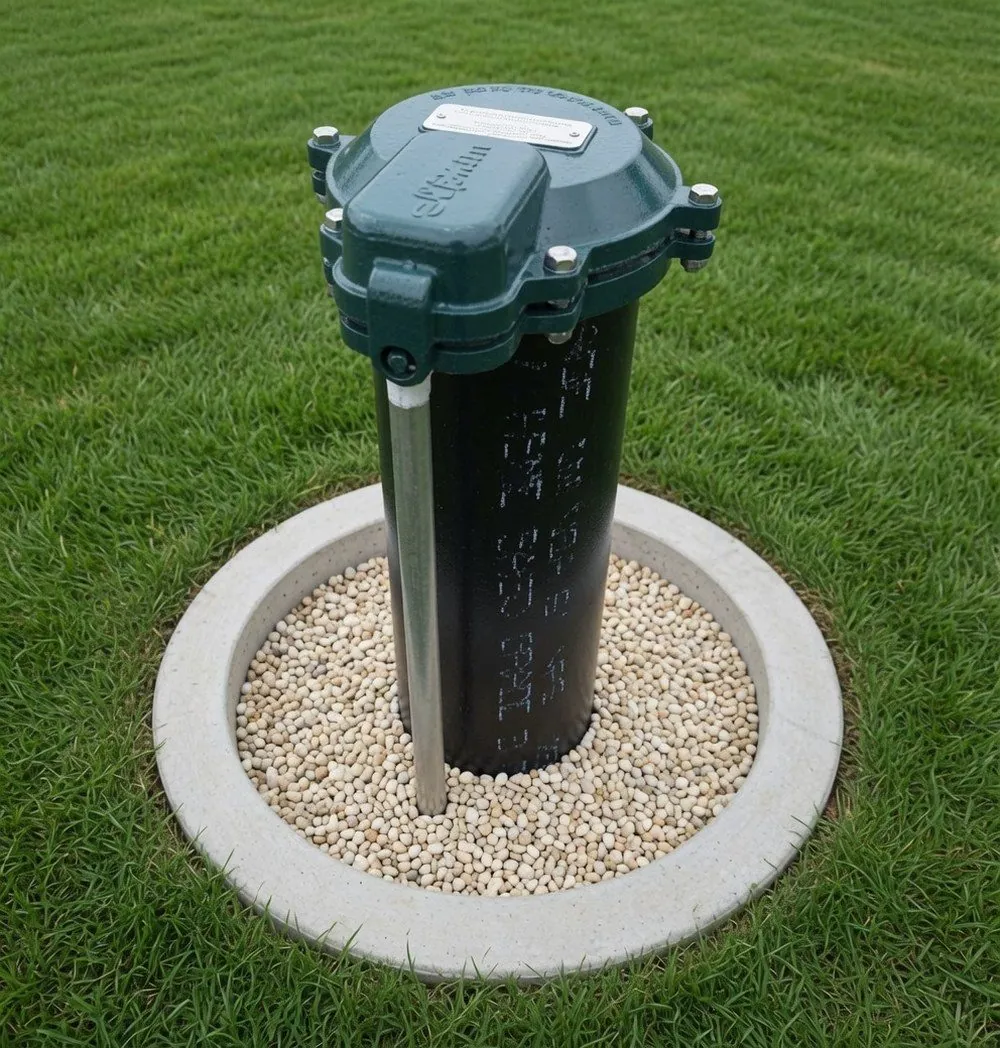
The whole waterworks, as most of us ever see it: a capped pipe in the yard. The pump itself lives far down that hole — which is why there is no cord to unplug and move, and why the panel, not an extension cord, is how a generator reaches it.
What it actually pulls
A common ¾-horsepower pump runs on roughly 1,500 watts — and starts on three to four times that. Our calculator carries it at about 4,500 starting watts, and like the air conditioner, that surge is the number your generator has to survive, not the number on the pump's box. Bigger pumps and deeper wells pull more. If your pressure switch clicks and the lights dim, you have met your surge.
Two things the box will not tell you:
Most well pumps are 240-volt. A small 120-volt-only inverter generator — the kind that is perfect for the refrigerator and the CPAP — cannot run one at any wattage. If the well is on your list, you are shopping for a unit with a 240V outlet, and that changes which shelf you are standing in front of.
The pump is usually hardwired. There is no plug to move to the generator. Connecting it safely means a transfer switch or an interlock, installed by an electrician — a few hundred dollars, done once. What it does not mean, ever, is feeding the generator back through a dryer outlet with a homemade double-ended cord. That trick energizes the utility lines outside your house and can kill the lineman working to get your neighborhood back on. There is no version of this article, this site, or this hobby where that is acceptable.
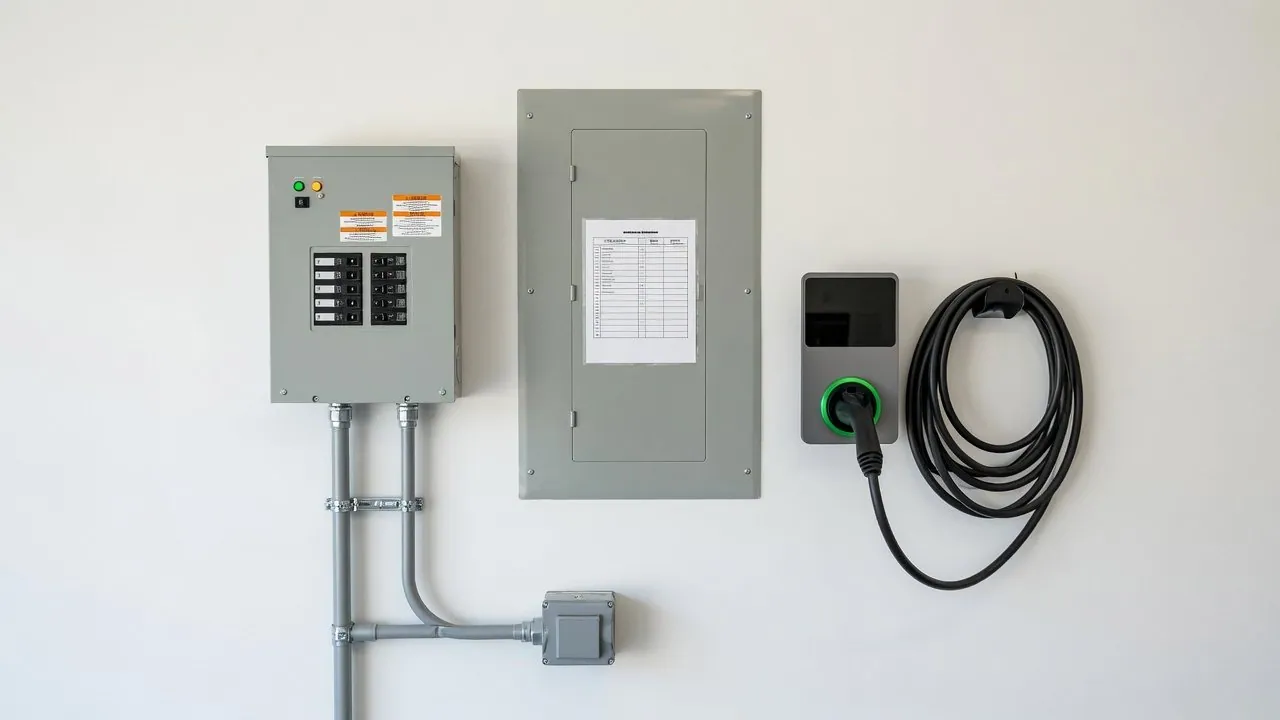
The safe handshake, on one wall: at left, the transfer switch an electrician wires once — the only doorway generator power should ever use to reach a hardwired pump — with its conduit run carrying the wiring down the wall. In the middle, the breaker panel wearing its directory card right on the door, where storm-night fingers can find it. And the charger on the right feeds the car — on generator night, that one sits the evening out.
The quiet way a small generator kills a pump
Here is the part nobody prints on the generator box. When a generator is too small for the pump it is feeding, its voltage sags under the strain — and electric motors have a mean habit: when the voltage goes down, the amps they pull go up. So the pump strains, runs hot, and slowly cooks its own motor. Not with a bang. Over minutes and starts, while everything technically “works.”
You can hear it happening. The engine lopes and groans, and the pump sounds like it is fighting instead of humming. Owners who have lived through it describe exactly that sound — and say they did not understand what it meant until the pump was dead. If you hear it, shut it down. That sound is a pump being eaten.
One well company owner put it more cheerfully than we will: he said he loves portable generators, because undersized ones send him pump-replacement business every year, like clockwork. Let some other family be that business. This is the whole reason this site sizes generators up and never down. Being a little over costs you some money, once. Being under can cost you the pump, the fuel you burned killing it, and your water — all in the same week.
One sizing footnote while we are here: if you buy a dual-fuel generator and plan to run it on propane — a fine choice, propane keeps forever — know that the same machine makes about 10% less power on propane than on gasoline. Size for the fuel you will actually burn, not the bigger number on the box.
The box that listens so you don’t have to
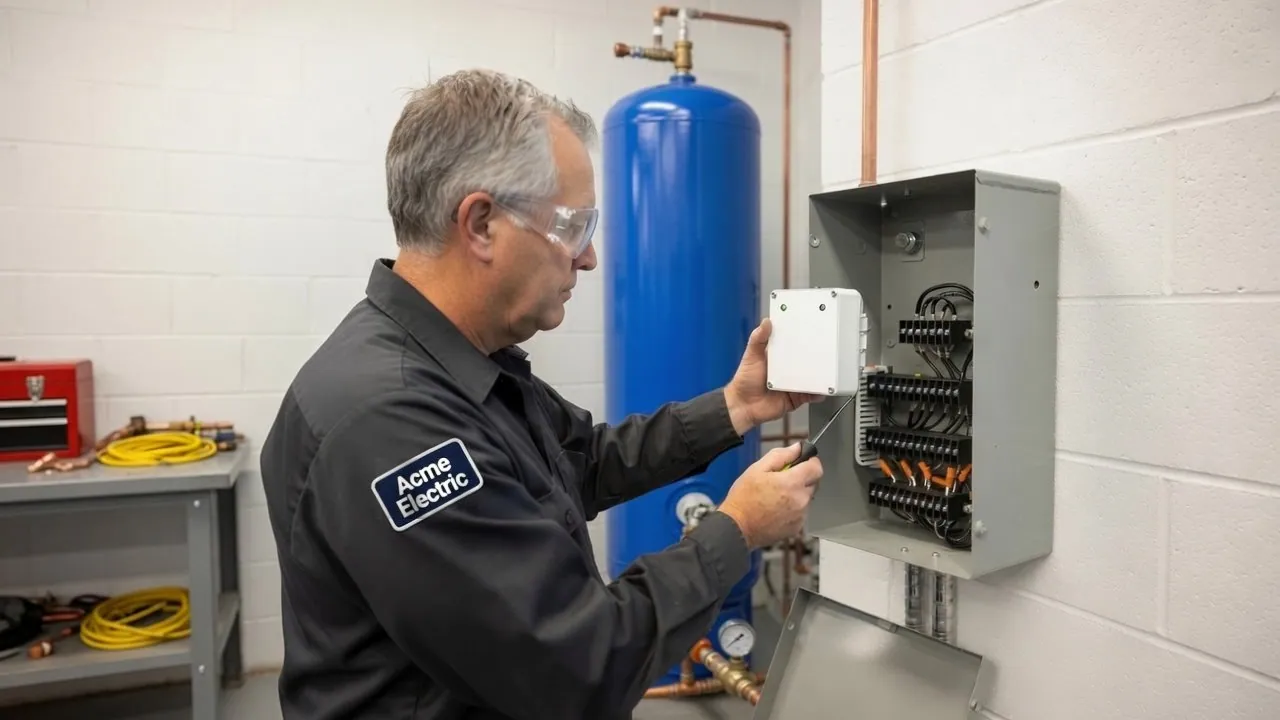
The whole install, one visit from a licensed electrician — and “licensed” is the word to insist on when you call. Power off at the breaker before that cover ever came off, and the little white guard going in beside the pump’s own wiring. This is the pro’s ten minutes, never the homeowner’s: the inside of these boxes is not do-it-yourself territory, on this site or anywhere. Your part comes after — a pump that gets watched around the clock.
The ear test above has one weakness: it only works while you are standing next to the generator. So here is the good news — there is a little box that does that listening for you, every second, all year. It is called a pump protection device: a box about the size of a paperback that gets wired in next to the pressure switch, where it watches two things at once — how hard the motor is working, and what the voltage is doing.
When something goes wrong — the voltage sagging low the way an overloaded generator sags, or spiking high, or the well running low so the pump spins with nothing to push, or a waterlogged tank making it start over and over — the box cuts the power before the damage lands, waits a spell, and tries again on its own timer. It is the ear test with no bedtime: it catches at 3am what you would have caught at 3pm.
The common models fit pumps from one-third horsepower up to five, work with both “2-wire” and “3-wire” setups — the same question you are already asking your well company — and run in the low hundreds of dollars, against the several thousand that a new pump and the crew to pull it will cost. Wiring it in happens inside the box, which on this site means one thing: a licensed electrician or your well company’s own tech does it, and for them it is a short visit.
And notice what you just bought. Storm week is the reason it goes on the wall — but a dry spell, a tired tank, or a bad day on the utility line can cook a pump in July with the grid working fine. The box does not know or care where the electricity came from. It just guards the pump, every day you own it.
The tank is your soft starter
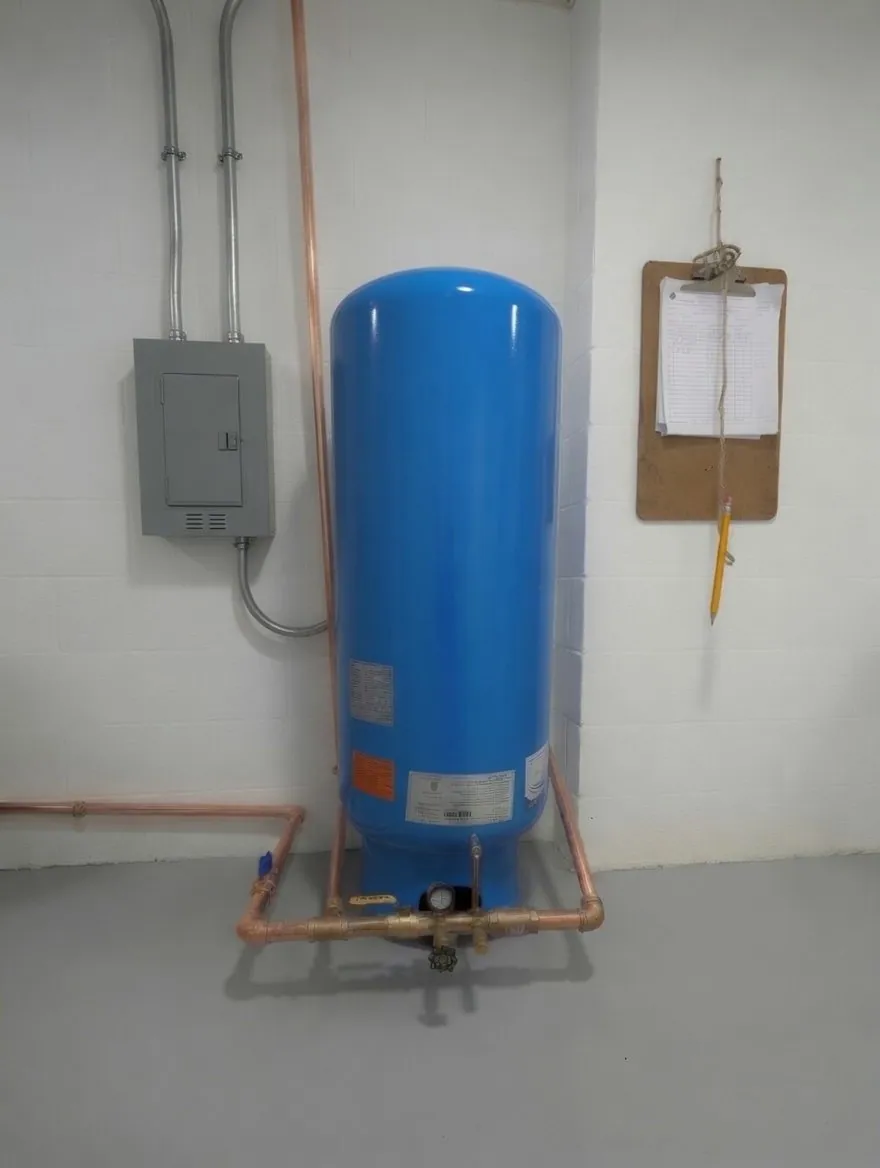
The air conditioner has a $300 part that tames its surge. The well has something better, and you may already own it: the pressure tank. The bigger the tank's drawdown, the less often the pump starts — and starts are the whole problem. If your tank is small or waterlogged, the pump short-cycles: surge after surge after surge, each one a hit on the generator and a swallow of fuel. Ask your well company what your drawdown is. A larger tank is not a small purchase, but it pays twice — easier on the pump every day of the year, and easier on the generator the week you need it.
The well’s answer to the soft starter — and you may already own it. The little gauge down on the piping reads the pressure that decides when the pump starts; the tank’s drawdown decides how often. Ask your well company for those two numbers on a sunny day, and write them on the clipboard — the one already hanging there, pencil and all. And that gray box on the wall? On a “3-wire” well, that is the control box — where the pump’s starting parts live above ground, in the same corner where the pump guard below gets wired in.
And the tank is not the well’s only trick. The $300 part from the air conditioner lesson has a cousin, and it is made for wells: soft-start devices built specifically for submersible well pumps — the common sizes cover half a horsepower up to three and a half — ease the motor up instead of slamming it, cutting the starting surge by roughly 60 to 70 percent, typically $300 to $600 installed.
Same idea, same honest arithmetic: a few hundred dollars on the pump side can be thousands off the generator side. And the same warning travels with it — you want the device whose paperwork shows the starting current going down. While you have your well company on the phone about the drawdown, ask one more question: whether your pump is “2-wire” or “3-wire.” It decides where the pump’s starting parts live and which soft-start setup fits — and it is a question that makes you sound like you have done your homework, because you have.
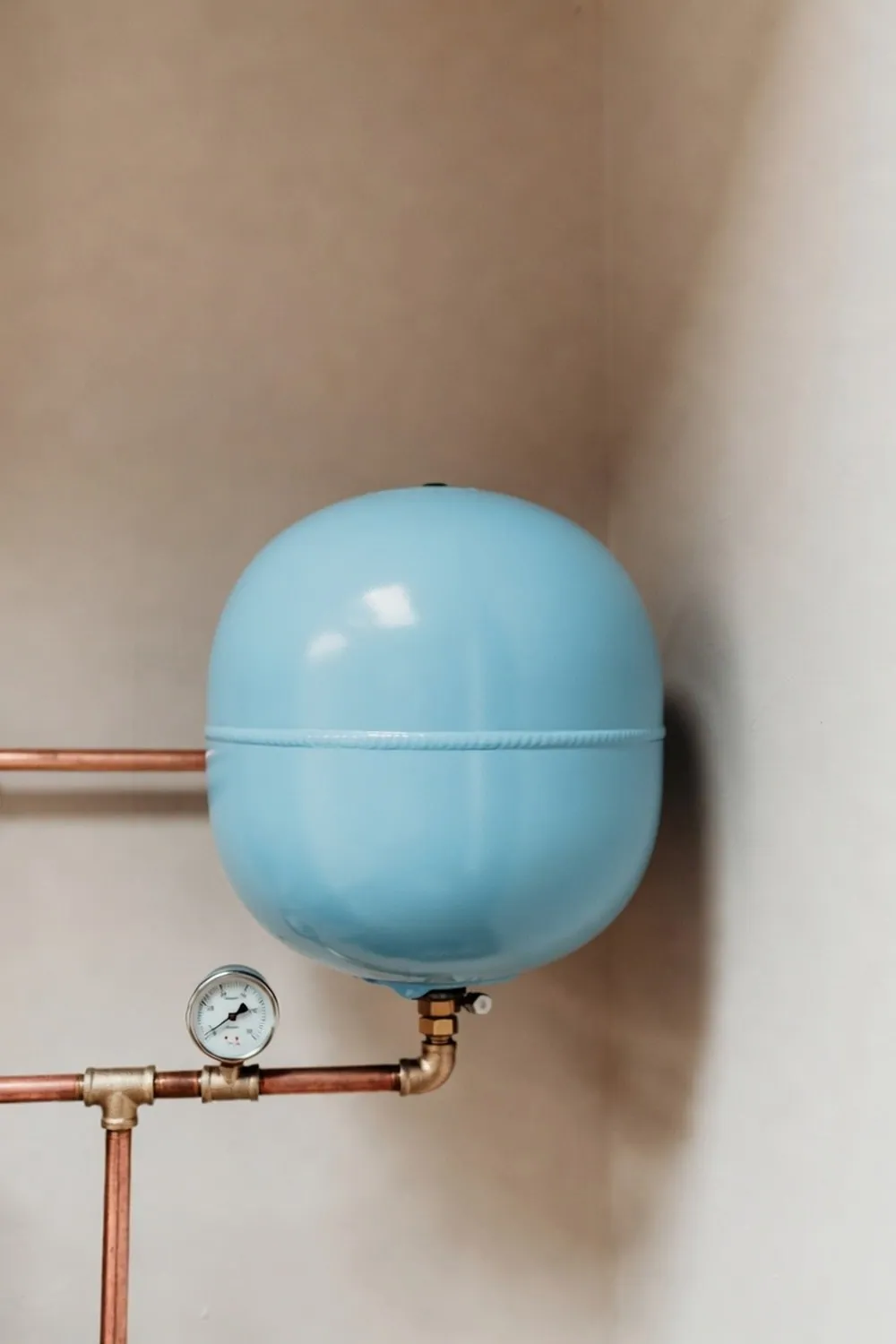
One check before you spend anything, in the same spirit as the air conditioner page: some wells already have the gentle start built in. If your big blue tank was ever replaced by a little tank the size of a soccer ball, and your shower pressure holds rock-steady no matter how many faucets are open, you likely have a constant-pressure system — a pump that ramps up to match the water you are using instead of slamming on at full force. Those systems do not have the massive starting spike, which makes them friendlier to generators right out of the box. Know what you own before you size for a surge you may not have.
The thirty-second check: a little tank like this where the big blue one used to be usually means a constant-pressure system — the well that already starts gently. If this is what your utility corner looks like, read the paragraph above before you spend a dime taming a surge you may not have.
And the free version: fill everything before the storm. The bathtub for flushing, jugs for drinking, the big stock pot for the kitchen. Every gallon you store ahead of time is a pump start that never happens. On the hill where I grew up — a mountain community with one shared well and no repairman to call — everyone sized their water storage around how long pump parts took to arrive, back when a part meant a long-distance call and a drive down the mountain. You only need to size yours around a storm.
The free fix, an hour before the weather arrives: the tub flushes toilets, the jugs drink, the stock pot cooks. Every gallon in this picture is a pump start — and a swallow of generator fuel — that never happens.
And a roughly $35 upgrade to the tub trick: a bathtub water bladder — a big food-safe bag that lines the tub before you fill it. Here is why it earns its keep: a bare tub carries soap film and dust, which is why we call tub water flushing water.
The bag keeps the same hundred gallons clean enough to drink and cook with for weeks, it fills from the faucet in about twenty minutes, and it comes with a little hand pump so you draw off a jug at a time without lifting anything heavier than the jug — which past fifty is the whole point. Bare tub, flushing water. Bag in the tub, drinking water. For thirty-five dollars, that is a promotion worth buying — and it folds flat in a drawer the other 51 weeks of the year.
Winter — The Half of the System That Is Outside
Everything above is about what the pump costs you in watts. This is about the season when it stops costing you anything at all, because it is frozen solid and nothing comes out of the tap.
A well fails differently from a city supply in the cold, and the difference is worth being clear about. On city water, a freeze usually means a burst pipe and a flood. On a well, it usually means no water at all — and the reason is that so much of a well system lives outside the heated envelope of the house.
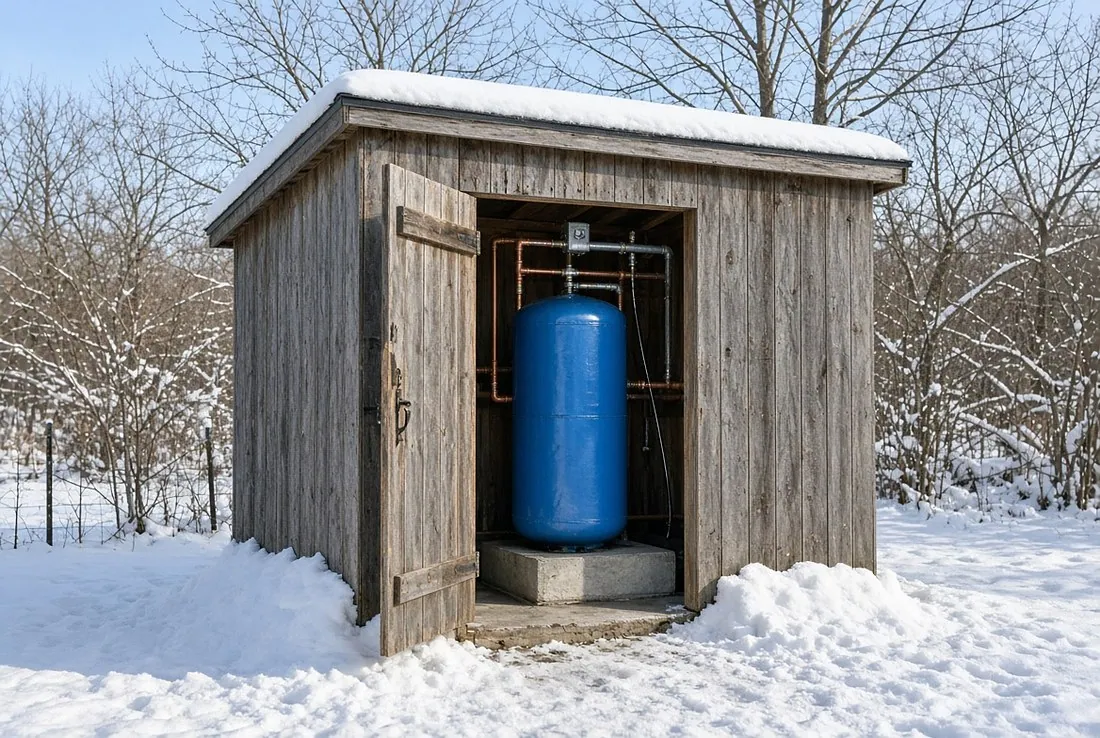
Everything that can freeze on a well system is in a building like this one, not in the house. The October job is to stand where this photograph was taken, look in, and ask two questions: is anything bare, and can I see daylight through the walls?
Run through where your own system actually sits. The wellhead, out in the yard under its cap. The buried line from the wellhead to the building, which is below frost only if whoever dug it went deep enough. The pressure tank and the pressure switch — and those two are the ones that catch people, because in a great many houses they are not in the house at all. They are in a pump house, an outbuilding, a garage, a crawlspace or a pit, and every one of those is an unheated space with pipework in it.
The pressure switch is the part that turns a cold night into a repair bill. It is a small mechanical switch reading water pressure, and ice in or around it stops it reading anything true. Frozen one way, it never calls for the pump and you have no water. Frozen the other, it can leave the pump running against a blockage, which is the situation the pump-protection device further up this page exists to prevent.
The submersible pump itself, hundreds of feet down in the water, is the one part of the system that is in no danger whatever. Everything that can freeze is between it and your kitchen.
If the power fails and stays out in winter
This is where a well and a city supply need genuinely different instructions, and Purdue University Extension's guidance on protecting plumbing during a winter power failure gives the well its own first step. Shut the water off at the main, or shut the well pump off if it is in the house — and then drain the pressure tank. It goes before opening the faucets, because a pressure tank full of water in an unheated space is one of the larger frozen objects you can arrange to own.
After that it is the same sequence as any other house, and the full order is on the frozen-pipes page: when the heat goes off and stays off. The one step that belongs to everybody, well or not, is killing the breaker to an electric water heater before anything drains, because elements that fire in an empty tank are finished in seconds.
Keeping it from happening in the first place
Published guidance from anybody neutral is thin here — most of what is written about pump houses is written by people who sell pump houses, and we are not going to dress that up as research. What is not in dispute is the shape of the problem, and the shape tells you what to look at on a mild afternoon.
Go and open the pump house, or lift the lid on the pit, and look for daylight. Gaps, missing boards, a door that no longer shuts, a vent left open from summer. An enclosure that is sealed and insulated holds a surprising amount of warmth from the ground and the pump's own running. One that whistles does not. Then look at whether anything in there is bare: the tank, the fittings, the short runs of pipe between them. Foam sleeves and a proper insulated cover cost very little and ask nothing of you afterwards.
Beyond that you are into heat — a thermostatic heat source in the enclosure, or heat tape on the lines — and heat tape is a thing this site treats with real caution, for reasons set out in full on the frozen-pipes page. Read the heat tape section before you buy any, because more than half the fires the Consumer Product Safety Commission attributed to it involved exactly this kind of installation: a cable in an outbuilding or under a floor, put in years ago and never looked at since.
The honest line about where this job belongs. A pump house in January is a cold, cramped, low-light space with water and electricity in it, and the parts you would be working on are at ankle height. If your own answer is that you are not going in there, that is a perfectly good answer — and it is an argument for having a well contractor look the enclosure over in October, when it is an hour of routine work rather than an emergency call in a week when everybody else is calling too.
The Sump Pump — The Load That Picks Its Own Moment
A sump pump runs on about 800 watts and starts on roughly 2,400 — smaller numbers than the well, but with a nastier habit: it needs to run precisely when the weather is at its worst, which is precisely when the power fails. A generator that will be running anyway can carry it easily. The planning question is the hours when the generator is not running.
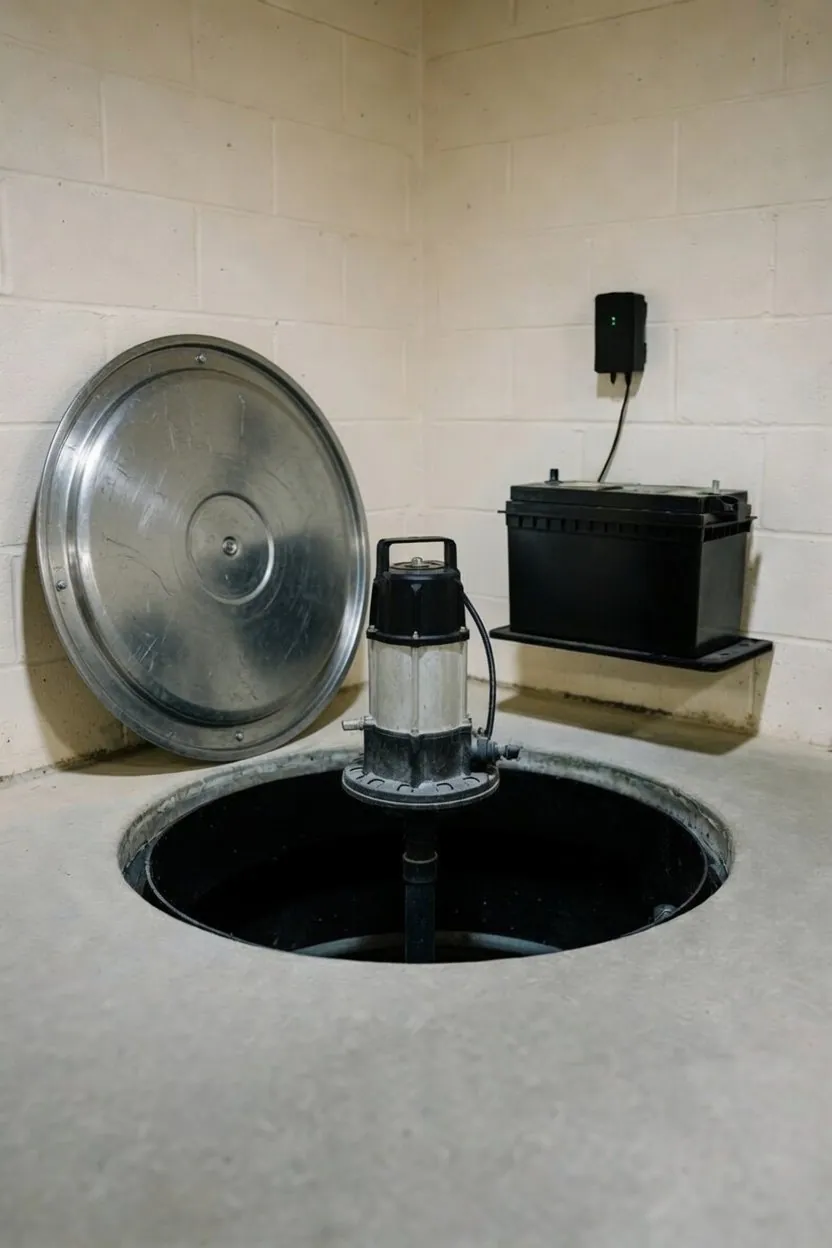
A battery-backup sump pump is a second, smaller pump with its own battery, sitting in the same pit. (Some systems skip the second pump: a battery and a power box on the wall run your main pump when the grid quits — same insurance, one machine fewer.) It bridges the gap between the lights going out and the generator coming on — and covers the night, when nobody wants to go start an engine in the rain at 3am. Know what to expect from it: a full, healthy battery gives you roughly 5 to 7 hours of nonstop pumping, or one to three days of now-and-then pumping — and hard rain shortens that fast. A battery that lasts two days at a pump-every-five-minutes pace can be down to half a day when the pump runs every minute. One more quiet fact: the battery wears out in about three to five years even if it never runs once. Test it on the same April and October dates you test everything else, and put its birthday on the card in the panel door.
A water-powered backup pump uses city water pressure to move sump water — no electricity at all. It only works if you are on municipal water, which makes it the rare storm product where being on city water is the advantage.
Check the check valve. A failed check valve makes the pump re-lift the same water over and over — more starts, more surge, more fuel, for nothing. It is a ten-dollar part and a ten-minute look.
The battery plan, laid out where you can check it: the pump in its pit, the battery on its shelf that carries the pumping through the hours the generator is off — including 3am in the rain — and the little charger on the wall keeping that battery ready between storms. The battery ages whether it ever runs or not; test it every April and October, and write its birthday on the card in the panel door.
One sizing note for the calculator: if you checked both the well pump and the sump pump, remember that surge is not additive — the calculator sizes for the biggest single start, because motors do not agree to start in unison. But two automatic pumps do raise the odds that something is starting at any given moment, which is a good argument for the safety margin the calculator already builds in, and a bad argument for shaving it.
Do It at Fifty — While the Money and the Years Are Both on Your Side
Step back and look at what this page actually asked you to buy. A transfer switch. A soft start. A pump guard. Maybe a bigger tank. Every one of them is a hire-once purchase: quality equipment in this line runs fifteen to twenty-five years and often longer, and the wiring work behind it — the transfer switch, the inlet, the panel — is effectively done once in the life of the house. Do this at fifty and you are not buying a storm gadget. You are buying water that works through your entire retirement.
Now the part nobody likes to say out loud. At fifty, most of us are still cashing a working paycheck, and a fifteen-hundred-dollar job is a decision. At seventy-five, on a fixed check, that same job can be a door that does not open. The equipment does not care when you buy it. Your budget will.
And the price of waiting is not standing still. Every job on this page leans on licensed tradespeople, and the people who track the trades report the same story from every direction: for roughly every five tradespeople retiring, about two are coming up behind them, wages in the trades have been jumping by double digits in a single year, and the waits for good work keep getting longer. Whatever this work costs in your town today is likely the cheapest it will ever be. That is not a sales pitch. That is a calendar.
Which is the whole idea hiding in this website’s name. Prepare at fifty, while the money is working and the choosing is calm — and be the one at seventy-five whose water never blinked. The story behind the name is where that lesson was learned the first time.
And if the answer turns out to be a permanently installed standby unit rather than something you wheel out, get more than one quote and know what you are being quoted for before anybody walks the property. How to get generator quotes covers what to ask.
❓ Plain Answers
The short version of this page, one question at a time — the answer is always the first line.
How many watts does a well pump need on a generator?
A common three-quarter-horsepower well pump runs on roughly 1,500 watts and starts on three to four times that, about 4,500 starting watts. The starting surge is the number the generator has to survive. Bigger pumps and deeper wells pull more.
Can a small inverter generator run a well pump?
A small 120-volt-only inverter generator cannot run most well pumps at any wattage, because most well pumps are 240-volt. If the well is on your list, you need a generator with a 240V outlet.
How do I hook a well pump up to a generator?
A hardwired well pump connects to a generator through a transfer switch or interlock installed by an electrician, a few hundred dollars, done once. Never backfeed through a dryer outlet with a double-ended cord; that energizes the utility lines and can kill a lineman.
Can a generator that is too small damage a well pump?
Yes, an undersized generator can burn out a well pump, because its voltage sags and the motor pulls more amps and slowly cooks itself. If the engine lopes and the pump sounds like it is fighting, shut it down.
How many watts does a sump pump use?
A sump pump runs on about 800 watts and starts on roughly 2,400. It needs to run when the weather is at its worst, which is when the power fails.
How long will a battery backup sump pump run?
A full, healthy battery backup sump pump gives roughly 5 to 7 hours of nonstop pumping, or one to three days of now-and-then pumping. Hard rain shortens that fast, and the battery wears out in about three to five years even if it never runs.
Now put the number to work.
The calculator turns what you just learned into a generator size and a fuel plan — and the other lessons in this series each move the number too.
General Information Disclaimer: This page is general educational information, and some links are affiliate links (we may earn a commission at no extra cost to you). Nothing here is legal, medical, engineering or trade advice. Codes and local laws vary enormously. Building codes, electrical and plumbing codes, permit requirements and local ordinances differ by state, county and town, and they change. Check with your own building department, and with your landlord, HOA or insurer where they apply, before installing, altering or removing anything described here. If a job is beyond you, or the page says it belongs to a licensed trade, that is the honest answer rather than a hedge. Do not undertake any physical effort described or implied here — lifting, pushing, pulling, carrying, climbing, kneeling, or assisting somebody else — without first discussing it with your own doctor, who alone knows your medications, your bone density, your cardiac fitness, the condition of your back and joints, your grip strength and your balance, and whether such activity is appropriate for you. A pushing or pulling task can pull a muscle or injure a joint just as a lifting task can, and nothing on this site should be read as encouragement to attempt physical work you have not cleared with your doctor first. This site does not recommend that any reader attempt to move, tip or shift any tall or top-heavy item, alone or with equipment — those tasks belong to able helpers or to professional movers. Full disclaimer →