Affiliate disclosure: Some links on this page go to Amazon. If you buy something through one of them, we earn a small commission — at no extra cost to you. It never changes the price you pay, and it never decides what we recommend. As an Amazon Associate I earn from qualifying purchases.How we make money →
Air conditioners, data plates, and the small gray box that decides how big a generator you actually need — a ten-minute read about a $300 part that can save you $8,000.
Every generator conversation eventually arrives at the same machine: your central air conditioner. It is the biggest load in the house and — more importantly — the biggest starting surge in the house, and that surge is what people are really paying for when they buy twice the generator they need. The good news: the number that decides everything is printed on a sticker outside, and there is a $300 part that can cut that starting surge — and with it, the size of the generator you have to buy — nearly in half. Here is why that one number is worth ten minutes of your time: generators are priced by their size, so half the surge means half the machine — thousands of dollars that stay in your pocket, half the fuel to buy, store, and haul out in the rain every day of an outage, and a smaller, quieter engine that an older back can actually wheel out and live beside for a week. Cut the surge and everything downstream of it shrinks with it — the price tag, the gas cans, the noise, the work. That arithmetic helps every homeowner on the street — but it was written for the people this site is named for. Past fifty, a right-sized machine is not a nicety: it is the difference between a backup plan you will actually use and one that sits in the garage because it is too much to wrestle. Getting this decision right now, while the choosing is calm and easy, is the whole idea of Buy It At 50. This page walks it in order, one step at a time. First: read the plate on your own machine, because every decision after that starts with those numbers. Second: the $300 part — what it does, how to buy it without being fooled, and when a new air conditioner beats it. Third: the people who will come knocking once you own this kind of equipment. Fourth: generator night itself, start to finish. Then the one-room shortcut, the help paying for all of it, and quick answers at the very end. No jumping around — each step stands on the one before it.
How to Read the Data Plate on Your Air Conditioner
Everything on this page is an estimate until you do this. It takes four minutes and it costs nothing, and when you're done you will know more about your own air conditioner than most of the people who will try to sell you a generator for it.
Where it is
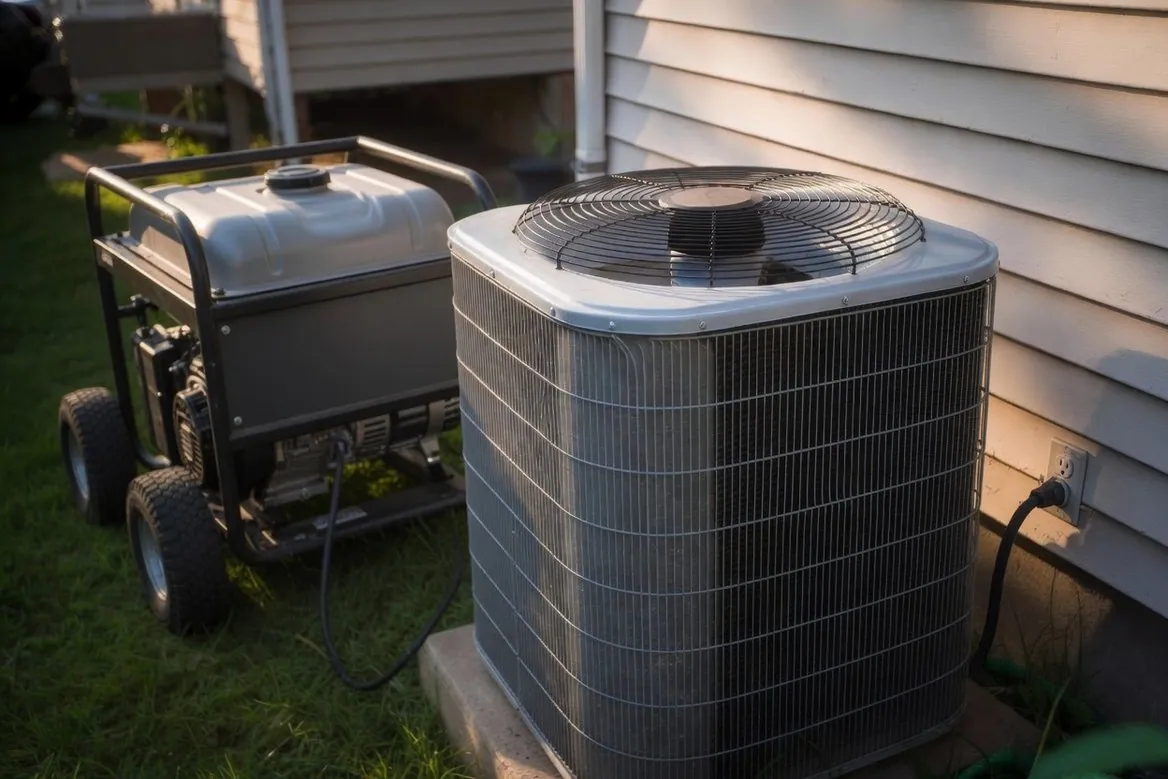
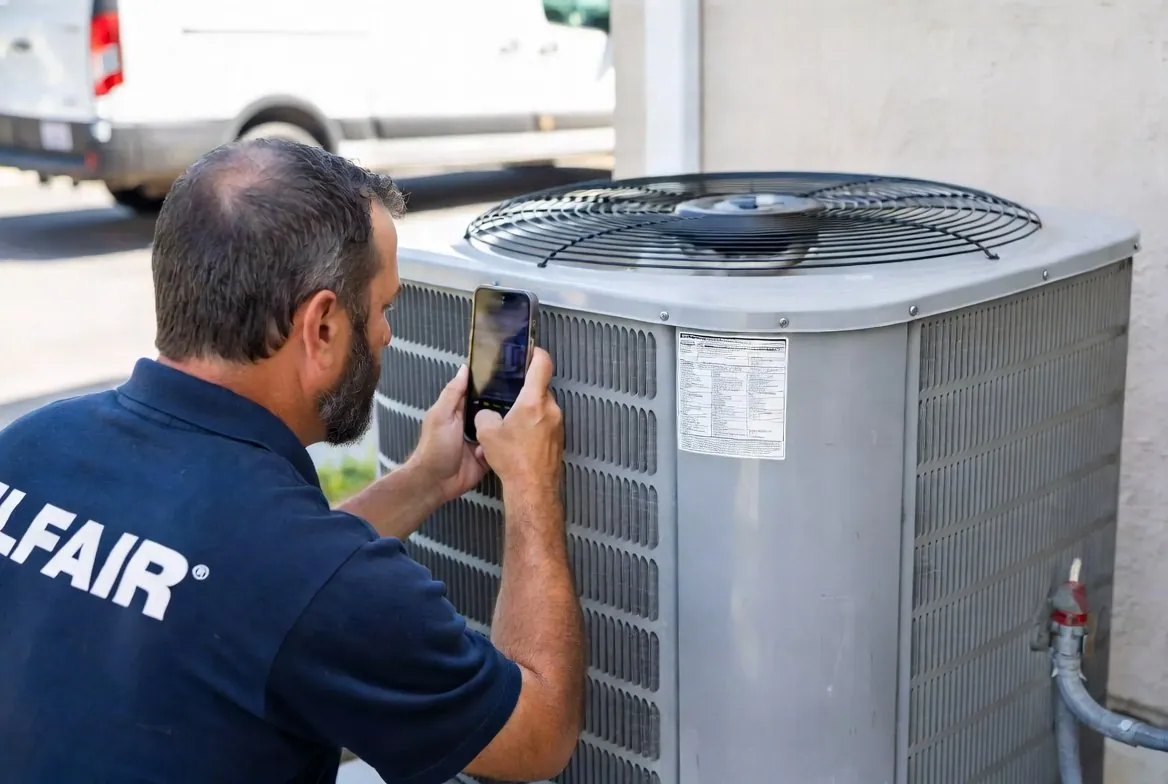
Walk outside to the condenser — the big metal box with the fan on top, usually on a concrete pad against the house. The plate is a metal or foil sticker, roughly the size of an index card, on the side of the cabinet. Sometimes it's behind the service panel; sometimes it's faded to almost nothing. Take a photo with your phone and zoom in rather than crouching in the sun trying to read it.
Do not open anything. Do not remove any panel. The plate you need is on the outside. There is 240-volt power inside that box whether the unit is running or not.
This is the whole job. On rounded cabinets like this one the plate rides the corner up near the top; on square cabinets it sits flat on a side panel. Either way: phone up, take the picture, zoom in at the kitchen table instead of squinting in the sun. And notice what is not happening here — nothing opened, nothing unscrewed, both hands where you can see them. The numbers you need are on the outside.
The lines that matter
There will be twenty things printed on it. You need three for the generator — and two more for later.
LRA — Locked Rotor Amps. This is the one. It's the current the compressor pulls in the instant it starts, before the motor is turning. It's called "locked rotor" because at that first moment the motor may as well be seized. This number is what your generator has to survive.
RLA or FLA — Running Load Amps / Full Load Amps. What it draws once it's spinning. Much smaller. This is the number people quote when they want the answer to sound easy.
VOLTS. Almost always 208/230 or 240 for a central system.
And two more — not for the generator math, but because if the next section convinces you to get a soft starter, the person you call will ask you two questions, and both answers are sitting on this same plate:
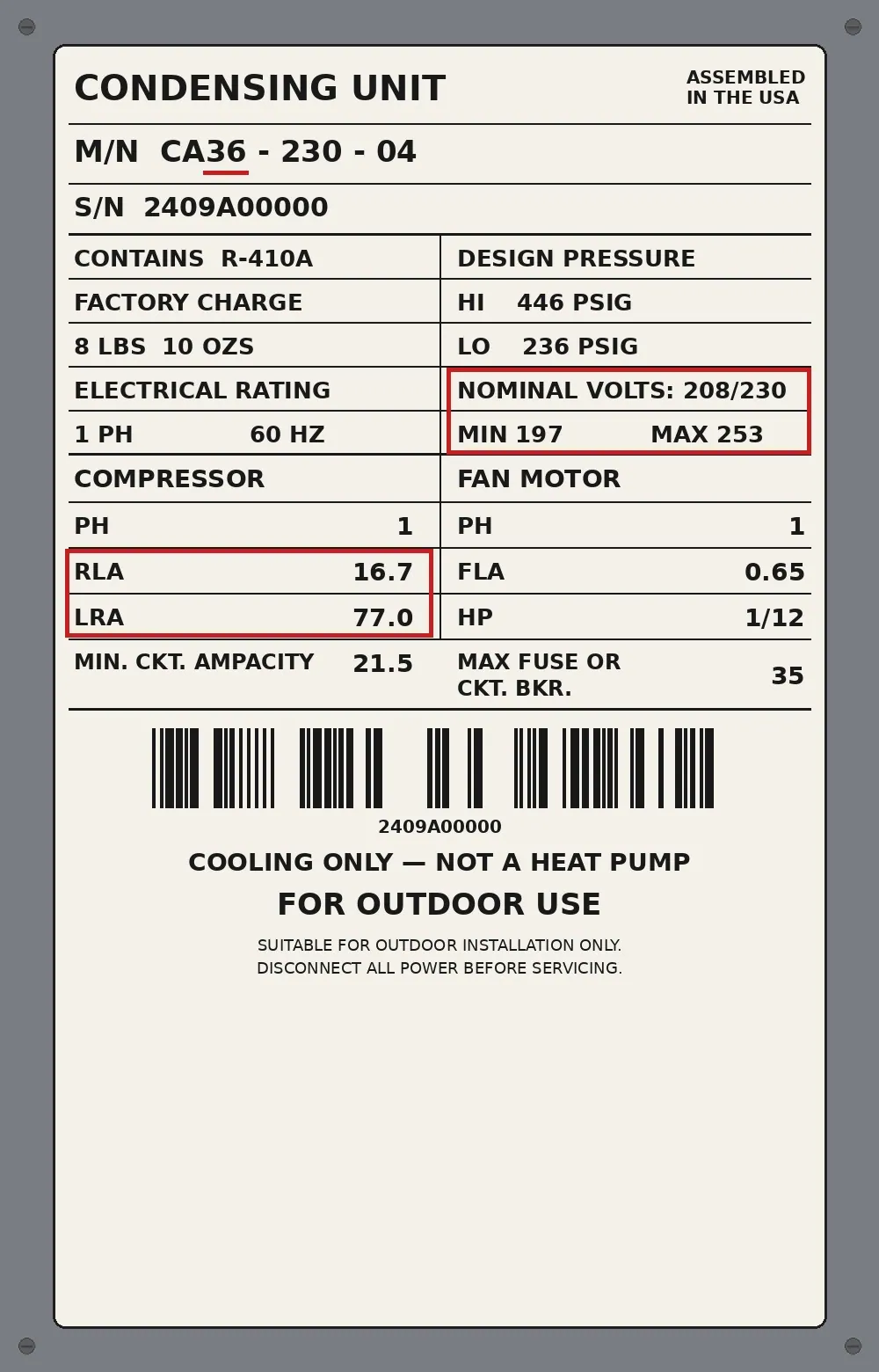
Your tonnage, hiding in the model number. Somewhere in the middle of the model number is a two-digit number you can divide by 6 — it'll be 24, 30, 36, 42, 48, or 60. Divide it by 12 and that's your tonnage: 36 is a 3-ton system, 48 is a 4-ton. (The number is cooling capacity in thousands of BTU, and 12,000 BTU make one ton.) Write down the full model number too — it's how you look up anything else about your unit later.
Heat pump, or air conditioner only. Down near the bottom of the plate, usually in small letters, it says which one you have. A heat pump both cools and heats; a cooling-only condenser is normally paired with a gas furnace. The soft-start people will want to know, and now you do.
A sample plate, drawn to match the way real ones are actually laid out — no brand, and the numbers are examples, not yours. Every manufacturer arranges these lines a little differently, but the labels are the same everywhere: the red boxes mark what the calculator asks for — the compressor's RLA and LRA, and the volts — the red underline in the model number is the tonnage trick (36 ÷ 12 = a 3-ton system), and the line near the bottom answers the heat-pump question. And look at that LRA: 77. That is the very plate the arithmetic below works out, to the watt.
The arithmetic
LRA × Volts = the starting watts your generator must deliver
If the plate says LRA 77 and 240 volts: 77 × 240 = 18,480 watts for about a second and a half.
Now compare that to the number on the front of a generator box. That's the whole lesson. A "9,000 watt" generator is not going to start that compressor, and no amount of wanting it to will change the arithmetic.
What the plate won't tell you, and what to do about it
Two honest caveats, because you deserve them both:
One. Electricians genuinely disagree about whether LRA is the right basis for sizing a generator. The argument against: LRA is measured at full utility voltage. When a generator takes that hit, its voltage sags — and when voltage sags, current falls with it. So the real-world surge is often lower than LRA × volts suggests. The argument for: you don't get to find out you were wrong at 2am in August. We use the plate number here because being over costs you money and being under costs you the appliance you bought the generator for.
Two. If your system is a modern variable-speed or inverter-driven unit, it ramps up gradually and never draws locked-rotor current at all. Those systems don't have this problem. Check before you spend anything.
And heat. A compressor that starts on 10,000 surge watts on a mild day can want 12,000 above 95°F, because heat raises head pressure and makes the start harder. In a hot climate this matters. The worst start of the year happens on the worst day of the year.
And dirt. A condenser coil packed with dust, grass clippings, and cottonwood fuzz does to your compressor what a heat wave does, every day of the year: the trapped heat drives the head pressure up, the amps climb, and every start comes harder and hotter than it needed to. The free fix takes twenty minutes twice a year.
Pull the outdoor disconnect to off, then rinse the coil gently with a garden hose from the outside — no panels opened, no pressure washer, just water through the fins until they look like metal again — and change the indoor filter while you are at it. Clean fins are the cheapest head-pressure medicine there is, and they make the soft starter’s job easier instead of trying to replace it.
The other plates
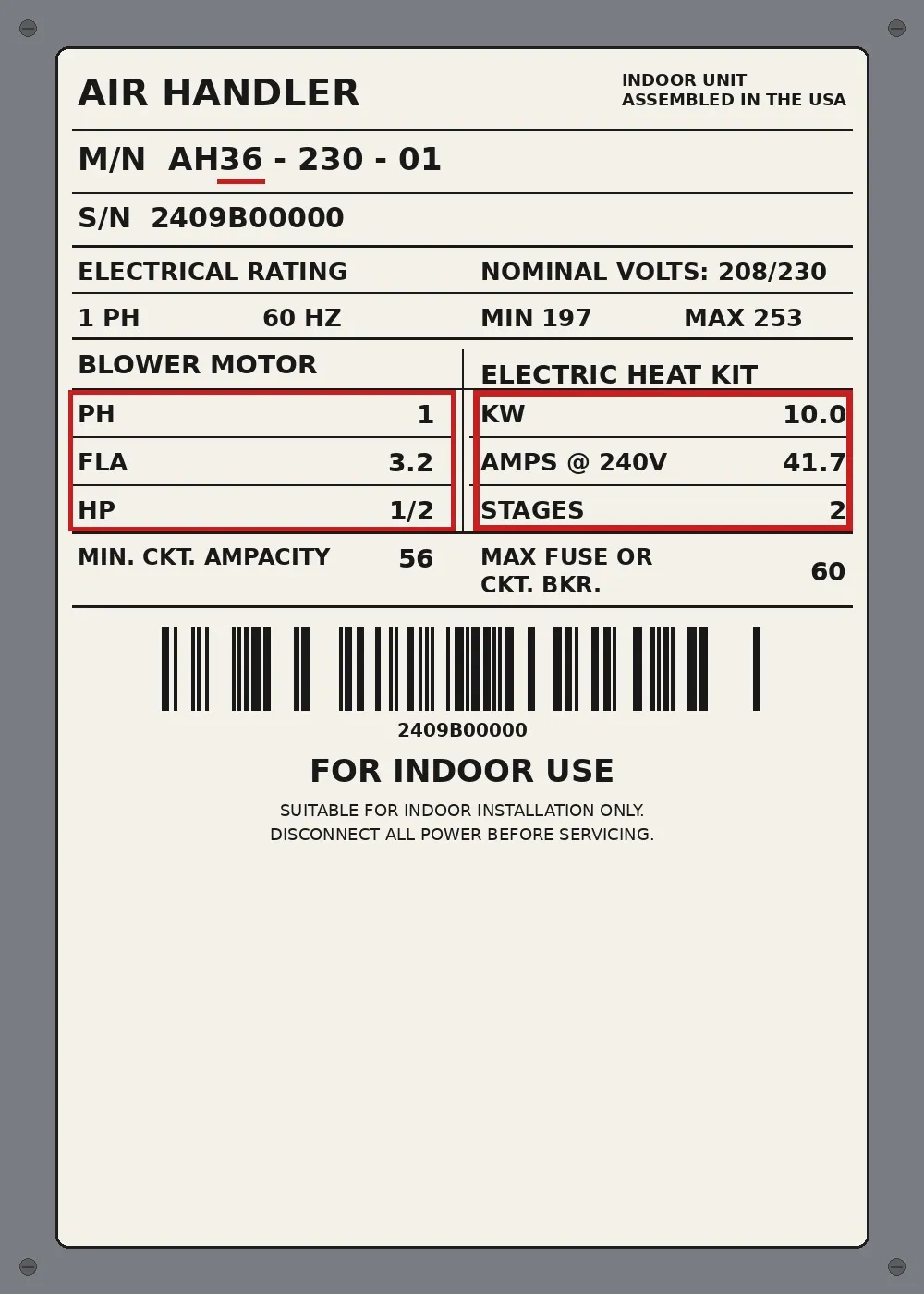
While you're out there: your air handler (the indoor half — closet, attic, or garage) has its own plate, and its blower is a separate load your generator also has to carry. If you have a heat pump, look for a strip-heat or auxiliary-heat rating on that indoor unit. Electric backup heat runs 5,000 to 20,000 watts and it is the single largest thing in most houses. Nobody sizes a generator to run heat strips. You wear a sweater.
The indoor half's plate — same 3-ton system as the sample outside, no brand, numbers are examples. Two red boxes, two very different lessons. The blower motor is the small one: half a horsepower that rides along on your generator every minute the air moves, so it belongs in your count. The heat kit is the big one: 10 KW is ten thousand watts — read that number, respect it, and then refuse to power it. That one line is the sweater lesson, printed on the machine itself.
The $300 Part That Changes the Answer
A man on a generator forum had a 5-ton system that would not start on his 13kW generator. He brought in two air conditioning technicians and an electrician. All three looked at it. Their recommendations were: buy a bigger generator, or fit a hard start kit — and a hard start kit would only shave the starting amps a little.
Three professionals, and not one of them mentioned the thing that actually solves it.
What a soft starter is
It's a small electronic box that wires into the compressor circuit — four wires — and ramps the voltage up gradually instead of slamming the motor with everything at once. The motor comes up smoothly. The surge never happens. Micro-Air, who make the best-known one, state it reduces start current by up to 75%.
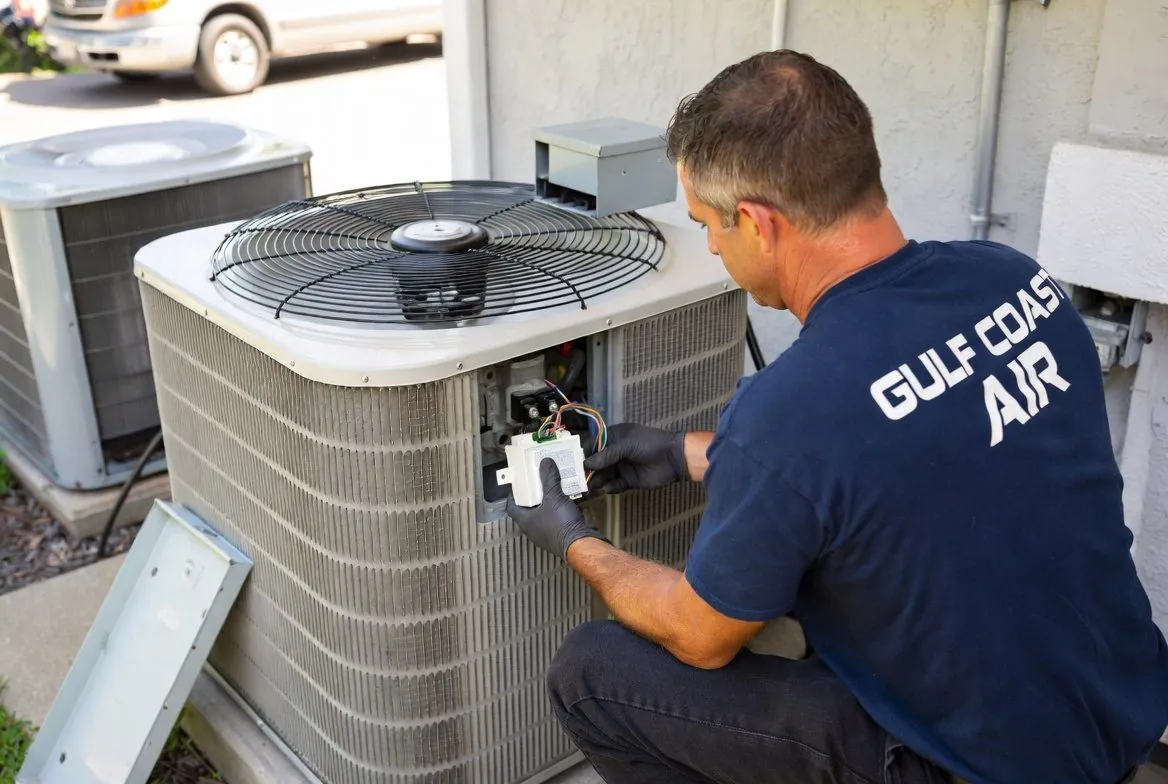
This is the machine and this is the job — an outdoor condenser, the access panel off, a module about the size of a paperback going in on four wires. Note who is doing it: a tech in a company shirt, in gloves, with his van in the driveway. Before any panel comes off, the disconnect on the wall gets pulled and the power gets tested dead. That part is not optional, and it is why this is an hour of somebody's labor rather than a Saturday project.
What that means in practice: a 2,500 square foot house with central air normally calls for a 22–24kW standby generator. With a soft start kit, 10–13kW may do it. That is a roughly $300 part standing between you and an eight-to-fifteen-thousand-dollar decision. Say it plainly, because nobody selling generators will: $300 can save you $8,000. On some houses, more.
And the field results back the arithmetic up. Owners report numbers like a 5-ton unit that needed 135 starting amps coming down to 17 with a soft starter installed, and a twenty-year-old 3-ton dropping from around 70 to around 20 — reductions of 70 percent and better are routine. You will notice it even when the grid is up: the lights stop dimming when the compressor kicks on, the startup bang goes quiet, and the motor gets a gentle ramp instead of a hammer blow every start of its life. The generator is the reason to buy it; the rest is what you get for free, every day, forever.
The bonus nobody advertises: a longer-lived machine
Here is where motors actually die, and it is worth thirty seconds of your time: they die at the start. A motor slammed on at full voltage gulps many times its running current for an instant, and that gulp does two kinds of quiet damage — it heats the copper windings, and it whips magnetic forces through them that beat on the insulation wrapped around the wire. When a compressor finally burns out, the insulation is usually what failed. Every hard start is one more blow to it. The jolt of starting torque does its own share too, on the shaft and the bearings and everything bolted to them.
Factories have known this for generations — which is the part worth hearing. Industry does not buy soft starters for generators. It buys them to make expensive motors that start often live longer, because taking the violence out of the start takes the wear out of the machine. Your compressor is exactly that kind of motor: it starts every single time the thermostat calls, thousands of times through a cooling season, year after year. The box turns every one of those starts into a ramp instead of a punch — on generator power, on grid power, on the mildest day of the year.
The honest limit on the claim: nobody can promise you a number of extra years, because nobody has run that study on home air conditioners, and this site does not sell promises it cannot back. What can be said plainly is the physics: fewer violent starts, cooler windings, less wear on the insulation that decides when the compressor dies. The generator savings buy the part once. The gentler starts keep paying rent every day after, whether the power ever fails or not.
Now the condition on that number
"Up to 75%" is a number with a condition, and here it is: it depends on how your system regulates refrigerant.
Piston / fixed-orifice system — pressure equalizes quickly between cycles, and you'll see close to the full 75%.
TXV system (thermostatic expansion valve) — pressure doesn't equalize the same way, and real-world reports put the reduction closer to half.
Half is still enormous. But if you plan a generator purchase around 75% and you have a TXV, you'll be the man standing in his yard at 2am listening to an engine bog down. This calculator uses 60% — the conservative end — for exactly that reason.
The impostor on the same shelf
One warning before you buy anything, because there is a cheaper device with a confusingly similar name sitting right next to the real thing: the “hard start kit.” It costs $20 to $50, and it is not a smaller version of a soft starter. It is the opposite machine. A hard start kit is a capacitor that gives a tired, worn compressor a harder shove to get it unstuck — and that shove often means more starting current, not less. It has an honest job: keeping an old compressor limping along a while longer. But for running your air conditioner on a generator, it does nothing for you. Nothing. The surge your generator must survive stays the same or gets worse.
Why this matters: the names sound alike, the boxes sit near each other, and more than one homeowner has asked about a soft starter and been offered the cheap kit as “basically the same thing” because it was on the truck. It is not the same thing. It is the same word wearing two different machines — and this site has a rule for exactly this situation: find out whether what you are buying is the name or the function. The function you want is a smaller start, and the spec sheet will say so in numbers. If the paperwork does not show the starting current going down, you are holding the wrong box, no matter what it is called.
What to ask for
Say this, in these words:
"I want a soft starter on my compressor — not a hard start kit. They're different things. I'm sizing a generator and I need to cut the locked-rotor inrush."
Soft starter ≠ hard start kit. A hard start kit is a capacitor that helps a tired compressor get going. It barely touches inrush. If someone offers you one for this purpose, they've misunderstood the question — politely repeat it.
Tell them the tonnage and whether it's a heat pump. The common units cover up to 6 tons and work with heat pumps and two-stage compressors.
Have your RLA ready too, and let it pick the size. Soft starters come in models matched to ranges of RLA, and the right size matters in both directions — a unit too big for your compressor sets its built-in overcurrent protection too high to protect anything. The RLA line you photographed on the plate is how the correct model gets chosen. Bigger is not better; matched is better.
Ask about your warranty in writing. Micro-Air states its kit won't void the compressor warranty and offers its own compressor coverage on top. Get the answer from your manufacturer too, not just from whoever's installing.
Ask them to measure it. An inrush clamp meter is about $60. Have them read the actual inrush before and after. Then you own a real number instead of a brochure number — and you can buy the generator that fits the number.
Where to find one
Direct from the manufacturer. Micro-Air sells EasyStart from their own site; the 3-ton version runs about $299. They publish a dealer map — worth checking, though be warned the nearest listed installer can be a long way off.
Amazon and the usual retailers carry the EasyStart Flex 398 (up to 6 tons) with an install kit. Prices vary a lot between sellers on the same part — and this is where the oldest lesson on this site earns its keep. In 1962, a hardware-store salesman showed my grandfather a pegboard of repair parts in little plastic bags and admitted the same bags fit nearly every brand of water heater he sold (that story is where this whole site comes from). Stand in front of the display on aisle five of any big box store today — air conditioning parts, plumbing parts, just about anything — and the pegboard is still hanging there: same part, same part number, three boxes, three names, three prices. So check the part number, not the storefront — when the identical number wears several prices, the extra money is buying the name.
Who installs it: either an HVAC tech or an electrician can do it. Be ready for blank looks. One homeowner reported his HVAC company had never heard of soft starters at all. That's not a reason to doubt the part. It's the same reason that 1962 salesman one bullet up was worth listening to: most people in a trade sell what they stock.
It is four wires. Some people fit them in an afternoon. I'm not going to tell you to open a 240-volt disconnect — that's your call and your risk, and there's no shame in paying an hour of labor to have someone else do it right.
Teach it before the storm does
Here is something the brochure says quietly and the installer may forget to say at all: the box is not at full strength the day it goes in. It studies. Over its first five starts it watches your compressor — how much push the motor truly needs, how little it can get away with giving — and it keeps the gentlest start that worked. Two rules for those five school days. First, hold class on regular utility power, on an ordinary afternoon with the grid behind it, because the box is taking measurements, and a sagging generator would hand it crooked numbers to memorize. Second, give it about five minutes of rest between starts, so the refrigerant pressure inside the compressor can settle back down and every start it studies is a fair one. When the fifth start is done, school is out for good — the box keeps what it learned and delivers that same small start every time after, whether the power is coming from the street or from the machine in your yard.
Then comes the final exam, and you are the one who gives it: with the learning finished, roll out the generator you actually plan to use, hook up the way you would in an outage, and start the air conditioner on it — deliberately, on a calm day, with the grid one switch away if anything disappoints you. The maker of the best-known box recommends exactly this test, and so does every page on this site in its own words: no piece of storm equipment gets to perform for the first time during the storm. If it is going to surprise you, let it surprise you in the sunshine.
When the next air conditioner comes anyway
One more way to own the gentle start: buy it built in. The modern variable-speed unit — the same inverter-driven kind this page told you to check for — never slams its compressor on at all. It ramps up by design, every start of its life, which is why it draws no locked-rotor current and needs no $300 box. Most of the systems standing in American yards today are still the old one-speed kind, which is why this whole page exists. But among brand-new units, the variable-speed share grows every year.
So the rule splits cleanly by the age of what you own. If your system has years left in it, the soft starter is the answer — $300 against a machine you already paid for. If your system is near the end anyway, do not bolt a new part onto a dying compressor; put the money toward the replacement, and when you shop, ask for a variable-speed unit. You pay more up front and get the gentle start, the smaller generator, and the lower power bill in one purchase — the money spent once, at a moment you were already spending it. Then read the new plate when it lands in the yard: if there is no locked-rotor number left to fear, you bought the right machine.
And this, if you have wondered, is why this site is called what it is called. If you are in your fifties — like most of the people who read here — the air conditioner or heat pump standing in your yard right now is probably not going to see you through to seventy. Somewhere in the years ahead it gives up the ghost, usually in August, and you will be standing across a counter from a salesman, making one of the biggest appliance purchases of your life. Buying it at 50 is a whole lot easier and cheaper than buying it at 70 — easier on the wallet, easier on the body, easier on the nerves — but only if you walk in already knowing what you are looking at. That is what this page is for. The plate, the LRA, the tonnage, the soft start, the variable-speed question: keep them at your fingertips, and when that day comes you will buy exactly the machine you need — not the machine the salesman needs to sell.
Shopping for that next system because somebody said the old refrigerant is now illegal? It is not. Is My Air Conditioner Illegal Now? explains what the R-410A rules do and do not require.
You Are Now a Hard Target
The first rule, performed: the visit you did not ask for, ending politely at a screen door that stays closed. Notice how friendly he looks — that is not a reason to open the door. It is the sales tool that works most often.
The people who run air conditioning scams go looking for two things: somebody home during the day, and somebody who can be hurried. That is why so much of it lands on people over sixty, and it is worth saying plainly on a site built for people over fifty. The good news: you just finished the page that ruins a scammer’s afternoon. First, know who you are dealing with, because the movies get this wrong: the people who run these plays do not look shifty. They arrive warm, friendly, and utterly sincere — being likable is the first tool in the bag, and the good ones are genuinely gifted at it. A friendly face is not a credential. And before any of the plays below, one rule outranks them all: if you did not call them, the visit is already over. Thank them for their time and send them on their way — kindly, firmly, and through the screen door. Nobody you did not call gets near your equipment. Not to “take a quick look,” not to “check something for free,” not for any reason they can offer, because every play that follows requires one thing to work: getting close to your machine. Deny them that, and the rest of this section is reading for entertainment. Now the plays, so you recognize them coming up the driveway.
The knock on the door. A “free inspection” from a company you never called. A licensed outfit in the middle of a heat wave has more work than trucks — it does not need to knock. The first rule above already answered this one for you.
The scare. “Your system is about to fail — approve this today.” Walk through the timeline with your own senses. Before he knocked, the house was cool. While the door is open and he is talking, the house is cool. After you close the door and thank him for his time, the house will still be cool. A machine on the verge of failing does not usually cool a house through all three. So it is probably a scam — and if some part of you wonders whether it is not, remember that you are holding this entire page: ask for the proof. The plate numbers. The meter reading. The failed part, in his hand, where you can see it. He will be charming about all of it — he will tell you he is only trying to spare you from suffering in the August heat, and he can produce more reasons than you can shake a stick at. But reasons are free, and proof is the one thing the play cannot afford. Anyone who shows up unannounced is almost certainly running one. A real problem survives a night of thinking — and if any doubt is left, make the next call yourself: somebody licensed in your area, with plenty of feedback about their company online. Your pick, on your schedule, from your own kitchen table.
The invisible diagnosis. You are told the capacitor is shot, the compressor is dying, or the refrigerant is low — and shown nothing. You met a capacitor earlier on this page, and you know machines carry their numbers in writing. The rule is four words: show me the reading. A meter number, a failed part in hand, a pressure gauge — proof, or no sale.
The standing refrigerant appointment. Your system is sealed. If it truly needs refrigerant, it has a leak, and the honest job is finding the leak — not selling you the same top-off every spring.
And the standing defenses, which cost nothing: a written diagnosis with an itemized price before any work; a second quote — a third for a full replacement — whenever the word “replace” comes out; a license number you can look up — and while you are on the state’s licensing site, look one line further, because in many states, Florida among them, the same free search shows whether complaints or discipline have been filed against that license. Five quiet minutes at the kitchen table tells you who has a history before they ever ring your doorbell again; and never full payment before the work is done. You read your own plate. You know your own numbers. Make anyone who wants your money show you theirs.
Generator Night, With the New Part In the Wall
The soft starter changes which generator you buy. These three habits change how the night itself goes. None of them costs a dime, and each one exists because somebody out there learned it the loud way.
The three-minute silence is the box doing its job
Somewhere in the middle of a long outage, the power feeding your air conditioner is going to stumble — a fuel change, a refill, a tripped breaker, a plain hiccup. When it comes back, the compressor may sit there in silence for about three minutes. This is the moment a person who was never told about it starts working the thermostat up and down, or goes hunting for a repair number by flashlight. Leave it alone. The silence is on purpose. A compressor that quits mid-stride is left holding high pressure inside, and forcing it to start again against that pressure is the meanest start a compressor can be asked to make — so the box holds the door shut until the pressure has drained off, and it keeps that clock running even if its own power was cut. Roughly three minutes, and then it proceeds like nothing happened. While we are naming things that look like trouble but aren't: the outdoor fan waking up several seconds before the compressor is also by design. Two motors taking the stage one at a time is easier on everything than both of them shoulder to shoulder.
The switch on the generator that undoes the part
Many inverter-style generators carry a switch labeled economy, or eco. Its job is thrift: with little being asked of it, the engine loafs along at low speed and sips fuel, then wakes up when a load arrives. Wonderful for lamps and phone chargers. Terrible for the exact instant a compressor calls for its start — the engine gets caught napping, and the voltage dips at the one moment it can least afford to. You spent $300 making the start smaller; that little switch, left on at the wrong time, spends the same moment making the engine slower. The habit is simple: eco off before any big motor starts. Eco on, if you want the quiet and the fuel savings, only after everything is up and humming steadily. And if the engine note stumbles every time the air conditioner kicks in, that switch is the first suspect to question.
The biggest surge goes first — and goes alone
Order matters more with a central air conditioner in the plan than with anything else this series covers. Start the generator with nothing connected and the thermostat off, and let the engine settle into its rhythm. Then the compressor gets the whole machine to itself: every surge watt the generator can muster, with no refrigerator or freezer elbowing in at the same instant. Once the air conditioner is running, its appetite falls to a fraction of its start, and the rest of the house comes back one load at a time behind it. The breaker panel guide lays the whole evening out as a numbered routine; if central air is part of your plan, the compressor takes the front of that line, and everything else files in after it.
Give it four wheels, not two
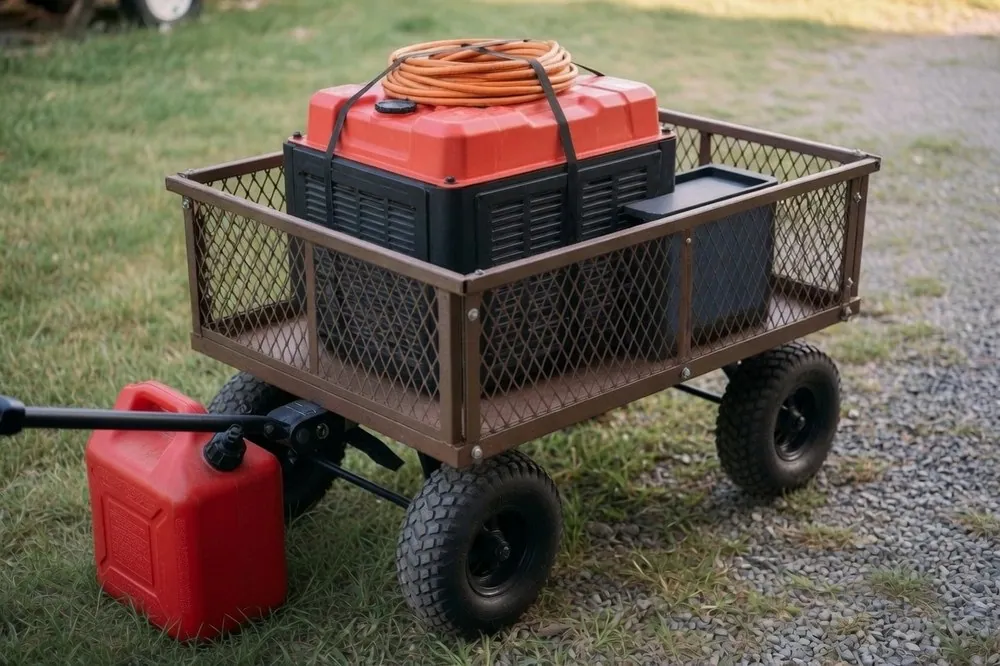
The whole kit on four wheels: generator, cord, and battery box strapped into one garden wagon, fuel can at the ready. Nothing gets tilted, nothing gets carried, nothing gets hunted for in the dark — one handle, and it all arrives together.
First, an honest word about how we got here — why a page about data plates is suddenly showing you a small generator riding in a garden wagon with a gas can and a cord. Because for a lot of readers, this wagon is the plan. Not everyone can afford a whole-house system, or even the mid-size machine the soft starter unlocks — but going without cooling is not something to shrug at past fifty. Heat kills more Americans in an average year than hurricanes and tornadoes combined, most of the people it takes are over fifty, and heat deaths among people sixty-five and up have climbed roughly 85 percent since the start of this century. It reaches soonest for the people whose cooling is not running when the power fails: after one Florida hurricane, a dozen people between fifty-seven and ninety-nine died of the heat in a single building when its air conditioning lost power. So the fallback plan has earned its place on this page, and its job description is short: one cool bedroom — cool through the hottest hours and, above all, cool overnight, the stretch your body uses to recover so it can stand the next day’s heat. With a little planning, the same small machine also runs a little refrigerator beside the bed: the medicines that must stay cold, a few cold drinks, some sandwich meat — enough to keep going without going hungry or thirsty. And thirst deserves its own sentence here, because the sense of thirst itself fades with age — by the time an older body feels thirsty, it is already running behind. Machine, fuel, cord, cold box: that whole plan fits in one garden wagon. Here is how to make it easy to live with.
One more piece of pre-thought, and this one is aimed square at your back. Most portable generators and battery backups come with two small wheels and a stub of a handle — which works fine for a strong person on smooth concrete. But tilting a hundred-plus pounds onto two wheels and holding it there across grass, gravel, and a garage threshold is exactly the kind of lift-and-twist that puts people our readers’ age in a recliner for a week, and the week it happens will be the worst week of the year to be laid up. The fix costs less than a tank of gasoline, and there is a fair chance it is already sitting in your garage: a steel garden wagon. Everything else one of these turns out to carry — and which tires to buy — is its own page. The generator rides flat — nothing tilted, nothing held — and the cord, the battery box, the funnel, and the oil ride beside it, strapped down. Two good things happen at once. Everything lives in one place, so generator night starts by grabbing one handle instead of hunting four corners of the garage by flashlight. And moving the machine becomes a pull instead of a lift, on four fat tires that were built for lawns. Load the wagon on a calm afternoon, park it where it lives, and you have bought yourself the easiest version of the hardest night — a few minutes of thinking ahead, traded for a back that still works when the power comes back on.
And while we are saving your back, save your hands and your shoes too: stop lifting the gas can to pour. A full five-gallon can weighs over thirty pounds, and pouring it means holding all of that tilted, at arm height, over a machine, while aiming at a small hole. That is a young person’s lift, and this site is not written for young people — past fifty, wrists and grip are honest about their age even when we are not, and one slip is all it takes. Gasoline goes down your arm, across your shoes, onto hot equipment — or across the garage floor, where it soaks into the concrete and haunts the room for weeks — or into the lawn, where a real splash poisons the ground and leaves a dead brown patch that can take a year or two to grow back. A hard night turns into a dangerous, expensive mess in about one second. Do not take this page’s word for it — call it a sanity check, and run it the day you bring your gas cans home, with water, while the stakes are zero. Fill one can with water. Set the other in the wagon, or on the floor. Now try to pour the full one into the empty one without losing a drop. Take your time. That is thirty pounds of liquid, a small target, and your own two arms — and every splash on your shoes is the lesson, showing you exactly where the gasoline would have gone. Most people set the can down about halfway through and go looking for a better answer. Here it is: the tool that ends all of it is a squeeze-bulb siphon pump — a plastic bulb with a hose on each end, running eight to fifteen dollars. Set the can on something a step higher than the generator’s tank: a couple of cinder blocks, a sturdy chair, the wagon bed itself. One hose in the can, one in the tank, a few gentle squeezes of the bulb, and it starts flowing on its own while you stand there holding nothing at all. No lifting, no aiming in the dark, no splash — and no starting a siphon with your mouth, ever; the bulb exists so nobody has to. One honest check before you count on it, because those bulbs take a real squeeze and grip strength is one of the things the years quietly collect: work the bulb with your own two hands the day it arrives, not the night you need it. Test day is purchase day — never storm day. And if your hands say no, do not plan on struggling: a battery-powered transfer pump (the TERA PUMP TRHA03) costs a few dollars more, runs on a couple of flashlight batteries, and moves the fuel at the press of one button — it asks nothing of your grip but a fingertip. Whichever one your hands vote for, drop it in the wagon with a set of spare batteries, and it is part of the kit. The standing rule stays standing while it flows: the engine is off and cooled before any fuel moves.
The part nobody wants to say out loud: theft
In a blackout, a running generator is the most wanted machine in the county — and it spends all night outside, in the dark, announcing exactly where it is. People lose them during the exact week they cannot replace them. So the kit gets three layers of protection, and the wagon makes all three easier.
The chain. A heavy-duty chain and a weatherproof padlock, run through the generator’s frame, around the wagon’s axle, through the handle of the gas can, and then around something that does not move — a fence post set in concrete, a patio roof support, a porch column. One chain, and the whole kit is spoken for. Be honest about what a chain does: it does not make theft impossible; it makes your generator the slowest, loudest, most complicated job on the street, and thieves shop for easy. Fit the chain on the same calm afternoon you load the wagon, so on generator night it is one padlock click, not a puzzle in the rain.
The tracker. A coin-sized Bluetooth tracker (a Tile) — an AirTag if your phone is an iPhone, one of its same-sized cousins if you carry Android — tucked out of sight on the generator’s frame. Twenty-five dollars or so, and if the machine ever leaves without you, your phone knows which way it went. That is information for the sheriff, not an invitation to go get it yourself.
The camera thieves never plan for. A solar-powered smart camera with human detection watching the generator’s corner of the yard. The good ones know a person from a raccoon, see in full color at night with their own light, and carry a siren that turns a quiet theft into a neighborhood event — and because they run on the sun and a battery, they are the one witness still on duty when the whole grid is down and every wired camera on the street has gone dark. Say that part again, because it is the entire point in storm country: the power being out changes nothing for this camera. The sun charged its battery all day, the siren still sounds at full voice, and the alerts still reach your cell phone. One footnote makes that last promise true: these cameras talk through your home Wi-Fi, and the router needs power to carry the message — so give the router its own spot on the generator. It sips about as much as a nightlight, and with it running, the watchman in the yard never even learns the grid went down. No electrician, no wiring: mount it, aim it, done. Two details close the last loophole, because the first thing a smart thief thinks about is the camera itself: mount it high — above comfortable reach, where dealing with it takes a ladder and time — and choose a model with tamper protection, so that blocking it, turning it, or knocking it loose is itself what sets off the siren and the phone alert. And here is the part working in your favor the whole time: a camera has to be reached to be silenced, and by the time a hand gets near it, the face attached to that hand is already recorded and already saved. Tampering does not erase the evidence; it becomes the evidence. And the standing rule for whatever the siren catches: let the camera and the recording do the arguing. Nothing parked in the yard is worth walking out into the dark at two in the morning to defend.
And if you would rather start with a name than a search: one camera we can suggest is the eufy SoloCam S340. The brief numbers: a solar panel up top and a battery inside — about two hours of direct sun a day keeps it running indefinitely, and the battery alone holds roughly three months with no sun at all. It connects straight to your home Wi-Fi with no extra boxes to buy, does its people-spotting with its own built-in smarts, and carries the spotlight, the full-color night vision, and a siren with real lungs — plus it stores its recordings itself, no monthly fee for the basics. We know it is a little pricey. It is also built to last you years, and that is not a guess: I have had a eufy watching my own place for years now, and I have replaced its batteries exactly once. The job meant opening the camera’s case, but it was straightforward going, and the replacement batteries were sitting on Amazon waiting. Buy it once, mount it high, and let the sun do the rest.
When the Answer Is One Cool Room
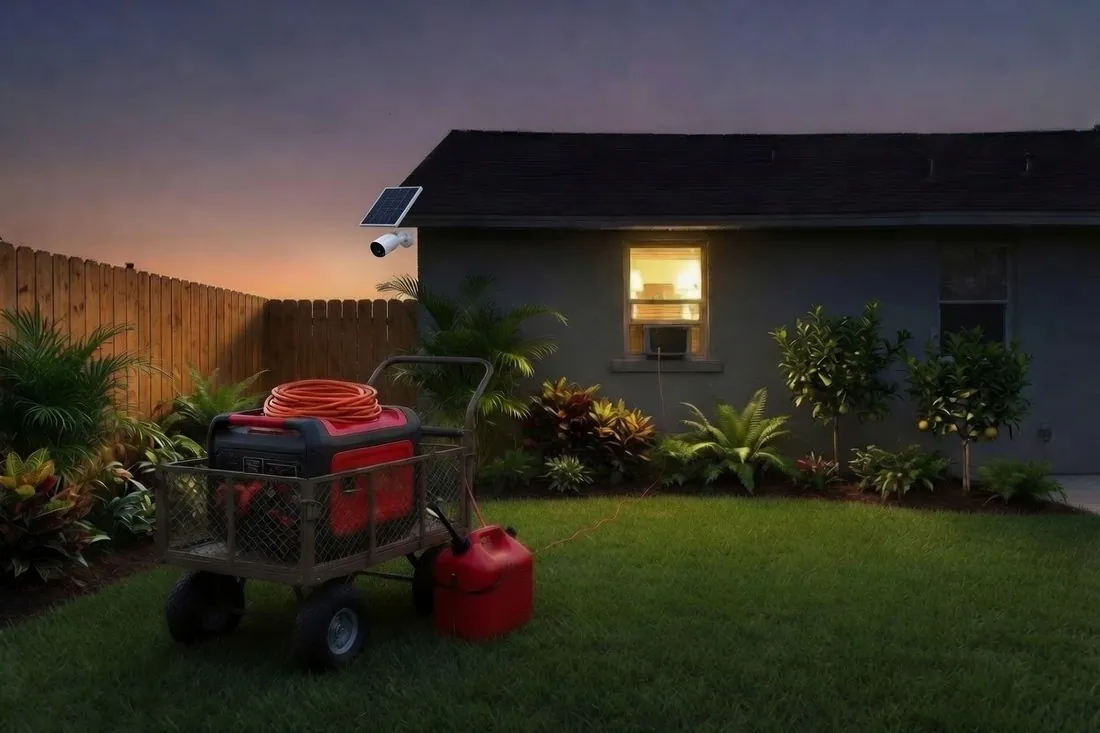
The whole strategy, seen from the yard: the street is dark, the house is dark, and one bedroom glows cool. A suitcase-sized machine in the garden wagon, one good cord, and a plan — with the generator out in the open air, twenty-plus feet from every window and door, exhaust pointed away from the house — and up on the gable end, mounted high where nobody reaches it, the solar camera keeping its watch over the whole arrangement. The only thing that goes inside is the cord.
One more honest path before anything else, because for plenty of readers it beats everything above: skip the big machine entirely and cool a single room. A bedroom-sized window unit runs on a few hundred watts — a quiet, suitcase-sized inverter generator’s worth, fed to the unit’s own wall outlet through an electrician-installed transfer switch or interlock, because window-unit makers forbid extension cords — while central air wants a machine roughly ten times that even after the soft starter has done its best work. This site keeps an entire guide for that play — the sizing, the generator arithmetic, and the overnight temperature drop that makes it all work: the One Cool Room guide. It is the loads-you-skip lesson in summer clothes: buy the outcome — one cool, sleepable room — not the appliance.
Help Paying for the Cool
The whole program, in one picture: a free phone call, made at the kitchen table on an ordinary morning. Dial 2-1-1, ask about cooling assistance for your county — and the notepad is for the case number.
One more thing before the questions, because heat is not the same event at seventy that it was at forty: older bodies sweat less and feel thirst later, and several common prescriptions make heat harder on you still — which is why this site keeps a heat risk calculator, and why in a hot climate a working air conditioner is a health item, not a comfort item.
Now the part almost nobody tells you: there is help paying for it. LIHEAP — the federal home energy program — runs in every state, and in the hot ones it pays toward summer electric bills instead of winter heat. Florida’s, for one, runs its cooling season spring through summer with crisis help year-round and gives priority to households with members sixty and over; what yours covers varies, so ask. The Weatherization Assistance Program can go further — in some cases repairing or replacing cooling equipment outright — and it also puts elderly households at the front of the line. And your local Area Agency on Aging and community organizations quietly hand out fans, portable units, and emergency utility money during heat waves.
The whole thing starts with one free phone call: dial 2-1-1 and ask about cooling assistance for your county. The honest caveats belong in print: income limits apply, program budgets run out, and the details shift year to year — but the call costs nothing, and every year money set aside for exactly this goes unclaimed because people who qualify never ask. You paid into these programs your whole working life. Asking is not charity. It is picking up what already has your name on it.
Questions People Ask About Soft Starters and Generator Sizing
Quick answers for fast reference — every one of these is taught in full somewhere above, so this section repeats on purpose.
What size generator do I need to run central air conditioning?
The honest answer is on the side of your condenser, not in a chart. Multiply the data plate’s LRA by its volts and you have the starting watts your generator must survive — for a typical 3-ton system, well over 15,000 without help. A soft starter can cut that by 60% or more, which is why the answer changes so much. The generator size calculator does the arithmetic with your numbers.
What is LRA on an air conditioner?
Locked Rotor Amps — the current the compressor pulls in the first instant of starting, while the motor is not yet turning. It is the biggest electrical event in the house, and it is the number generator sizing lives or dies on. The plate lesson at the top of this page shows exactly where to find it.
What is the difference between a soft starter and a hard start kit?
A soft starter ramps the voltage up so the surge never happens — starting current drops 60–75%. A hard start kit is a capacitor that shoves a tired compressor harder, which does nothing to shrink the surge and can raise it. If the paperwork does not show starting current going down, it is the wrong device for generator use.
Will a soft starter let a smaller generator run my central AC?
Usually, yes — houses quoted 22–24kW standby generators often run on 10–13kW once a soft starter is installed. The honest caveat: TXV systems see roughly half the advertised reduction, which is why this site’s calculator uses the conservative 60%. In plain dollars, that swing is the whole story: $300 can save you $8,000 on the generator itself.
Why won’t my air conditioner restart right away on generator power?
If the power blipped, the soft starter is deliberately waiting about three minutes so the pressure inside the compressor can bleed down before the next start. The silence is protection, not failure — leave it alone and it will restart on its own.
Do variable-speed or inverter air conditioners need a soft starter?
No. Those systems ramp up gradually by design and never draw locked-rotor current, so there is no surge to cut. Check which kind you own before spending anything.
Does a soft starter make my air conditioner last longer?
The mechanism says yes, even though nobody can honestly promise a number of years. Hard starts heat the motor windings and hammer their insulation — the part that usually fails when a compressor dies — and industry has bought soft starters for decades specifically to extend the life of motors that start often. Fewer violent starts means less of that wear, on every start, outage or not.
Are there programs that help seniors pay for air conditioning?
Yes. Florida’s LIHEAP cooling assistance pays toward summer electric bills with priority for households sixty and over, the Weatherization Assistance Program can repair or replace cooling equipment for qualifying homes, and Area Agencies on Aging distribute fans, portable units, and emergency utility help. Dial 2-1-1 — the call is free — and ask about cooling assistance for your county.
You now know more than most people who will try to sell you a generator.
Take your three numbers — RLA, LRA, volts — and the tonnage out of the model number, and let the calculator turn them into a size and a fuel plan.
A three-hundred-dollar part instead of a fifteen-thousand-dollar install.
A soft start can drop the generator your air conditioner needs from twenty-two kilowatts to twelve — almost nobody selling generators will mention it to you.
General Information Disclaimer: This page is general educational information, and some links are affiliate links (we may earn a commission at no extra cost to you). It is not electrical, engineering, medical or trade advice, and it was not written by a licensed electrician.Generators, camp stoves and any fuel-burning appliance produce carbon monoxide, which is invisible, odourless and kills people every year after storms — never run one indoors, in a garage, or on a covered porch, and keep a working battery carbon-monoxide alarm. Anything behind the cover of an electrical panel, and any permanent connection between a generator and a house, belongs to a licensed electrician and is subject to local codes and permits. If you have a pacemaker or any implanted medical device, ask your cardiologist before using induction cooking equipment. Nothing on this page is legal advice. None of it was written by an attorney, and it is not a substitute for speaking to one about your own situation.Do not undertake any physical effort described or implied here — lifting, pushing, pulling, carrying, climbing, kneeling, or assisting somebody else — without first discussing it with your own doctor, who alone knows your medications, your bone density, your cardiac fitness, the condition of your back and joints, your grip strength and your balance, and whether such activity is appropriate for you. A pushing or pulling task can pull a muscle or injure a joint just as a lifting task can, and nothing on this site should be read as encouragement to attempt physical work you have not cleared with your doctor first. This site does not recommend that any reader attempt to move, tip or shift any tall or top-heavy item, alone or with equipment — those tasks belong to able helpers or to professional movers. Full disclaimer →