The bathroom is where it happens. Wet floors. Hard surfaces. Awkward movements getting in and out of a tub. Rising from a toilet seat. All of it in a room designed in 1960 with no thought for what a body needs at 72. The combination kills people every day who would have been fine for another decade with two $45 bars and four hours on a weekend.
At 50 you can still get on a step stool. You can operate a drill. You can read a level and hit a stud and drive a screw. Your hands work the way you expect them to. Your judgment is intact and entirely yours.
At 65 most of those things are still true. But you might think about whether you should be on a step stool. You might ask someone to help. There is a small hesitation that was not there before.
At 72 the hesitation has a name. The knees have an opinion. The grip is not what it was. You call your son and he says he will come Saturday and then it is three Saturdays and the bars are still not on the wall. Or he comes and does it wrong because he has never done it and does not know what he does not know.
There is a window. It opens somewhere around 50 and it closes somewhere around 65 and most people do not notice it closing until it is gone. The bars get installed after the fall, or they get installed by a family member who is now managing your safety instead of visiting you. Neither of those is the outcome you want.
Do it yourself. Do it now. Two hours, $150 in hardware, and you never have to think about it again.
Fewer than 10% of American homes have grab bars installed before a fall occurs. Most get installed after the emergency room visit. Some get installed at the rehabilitation facility. By then the choice about where and how many and what kind has been made by someone else, in someone else’s bathroom, for someone else’s budget. Do it yourself now and you control all of it.
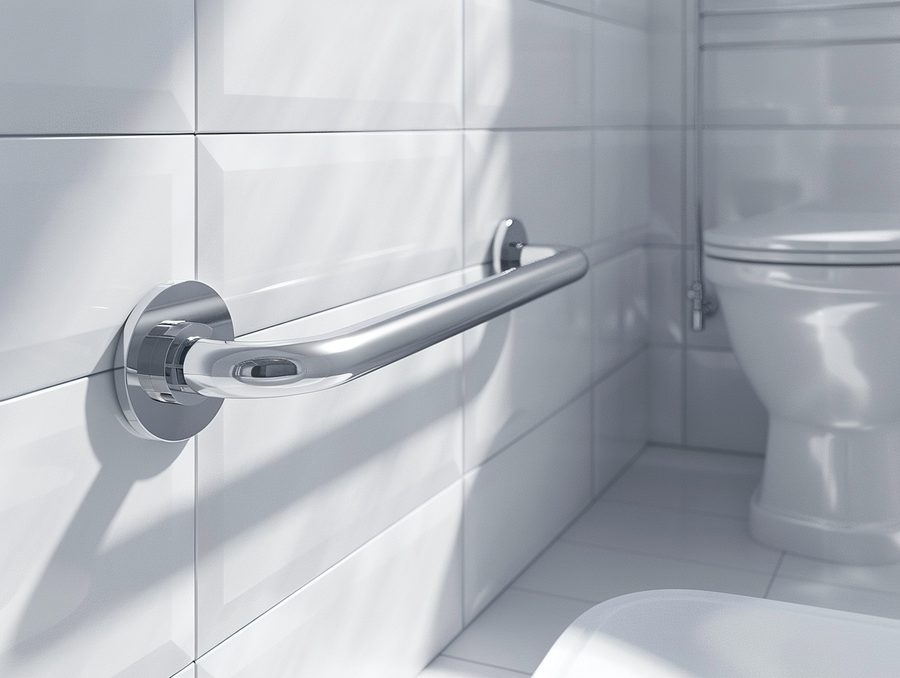
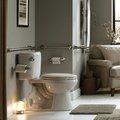
Placement: Side wall, 33–36 inches from the floor. Center the bar 6 inches from the front of the toilet seat, extending toward the back wall. A 42-inch bar is ideal — it gives you something to grab whether you are sitting or mid-stand.
Second bar: A rear wall bar at 33–36 inches gives additional support and is required for ADA compliance in public bathrooms. In a private home it is highly recommended.
The mistake everyone makes: Installing the bar too far back. If you cannot grab it while seated, it will not be used in the moment you need it. Sit on the toilet and reach naturally — that is where the bar goes.
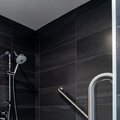
Placement: Vertical bar, on the wall adjacent to the shower opening, 36–48 inches tall, positioned so you can grip it while stepping over the threshold in both directions. Height should allow someone of average height to grip it naturally without reaching or bending.
This is the bar that prevents the most falls. More falls happen during shower entry and exit than anywhere else in the bathroom. If you only install one bar in a shower, this is the one.
Placement: 33–36 inches from the shower floor along the long wall. 36 inches of bar length is better than 24 inches for anyone aging in place — it provides continuous support through a wider range of movement without having to reposition your grip.
Angled bars: A bar angled at 45 degrees serves double duty — useful both as a horizontal grab at standing height and a lower grab when bending. Many aging-in-place specialists prefer angled bars in shower stalls for this reason.
If you have a shower bench: Add a third bar at the front edge of the bench — this is the bar that matters when you stand up from a seated position with wet feet on a wet floor.
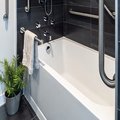
Placement: An angled bar along the long wall of the tub, running from approximately 6 inches above the rim down to the transit height (33–36 inches). This gives you support at the lowest grip point (near the rim when entering) and at the standing grip point (transit height when upright).
Second bar: A vertical bar at the faucet end or entry end gives you an anchor point during the step-over moment — the same logic as the shower entry bar.
Honest note: If getting in and out of a bathtub is already difficult, grab bars help but they do not eliminate the risk. A walk-in shower with a zero-threshold entry eliminates the climb entirely. That is a larger project — but for adults in their 50s, now is the time to consider it.
The most important thing you will read on this page: A grab bar pulls out of the wall during a fall puts you on the floor with the weight of a failed grab bar on top of you. The same towel bar that pulls free and caused the fall in the first place. Install correctly or hire someone who will. There is no middle ground on this.
Use a stud finder to locate studs behind tile or drywall. Mark each one with painter’s tape. In most American homes studs are 16 inches on center — but not always. Older homes, remodeled walls, and non-standard framing mean you cannot assume spacing.
For tiled walls: Use the stud finder on any un-tiled section of the same wall and mark a line across to the tile with an erasable crayon. The stud continues behind the tile at the same location.
The ideal bar position is where the ADA placement guidelines and your stud location overlap. If they do not overlap, the stud wins — adjust bar position slightly rather than mounting without a stud.
Measurement reference:
- Toilet side bar: 33–36 inches from floor
- Shower horizontal bar: 33–36 inches from floor
- Shower entry vertical bar: 36–48 inches tall, positioned at entry
- Tub angled bar: from 6 inches above rim to 33 inches high
For tile into stud: Diamond-tip drill bit only — never a standard masonry bit on tile, it will crack it. Apply masking tape over the drill point to reduce vibration. Drill at low speed with controlled pressure. No hammer drill setting — ever — on tile. Once through the tile, switch to a standard wood bit to finish into the stud.
For fiberglass shower surrounds: Press firmly on the surface before drilling. If it flexes, there is a gap between the surround and the wall behind it. Toggle bolts through fiberglass with a gap behind it are not safe — the fiberglass itself is the only thing holding the bar. Access the wall from behind to add blocking, or hire a CAPS contractor.
Do not use a hammer drill setting on tile or fiberglass. Ever.
WingIts anchors — the professional standard for hollow-wall grab bar installation. Designed specifically for this application, installed through tile or drywall, rated for grab bar loads. Follow manufacturer instructions exactly. Available at plumbing supply and hardware stores.
Heavy-duty toggle bolts — the spring-loaded wings open behind the wall and distribute load across the interior surface. Must be rated 300 lbs minimum. Use only in walls that are 5/8-inch drywall or thicker.
Never use: Standard plastic drywall anchors (not rated for dynamic loads), standard toggle bolts not rated for grab bar use, any anchor in 1/2-inch drywall without a stud, any anchor through fiberglass with a gap behind it.
Apply a continuous bead of mold-resistant silicone caulk around each flange before pressing it to the wall. The silicone creates a waterproof gasket that prevents water from traveling behind the wall surface and rotting your framing over time. Use wet-area or tub-and-tile silicone — not standard latex caulk.
Drive stainless steel screws — at least 1 inch into stud. Using non-stainless screws in a wet environment causes galvanic corrosion between the screw and the bar over time. The screw rusts. The bar loosens. Buy stainless.
Do not overtighten. Snug and firm, not stripped.
Any movement means reinstall. A bar that moves slightly under body weight will move more under the dynamic force of a falling person grabbing it. That is not an acceptable installation.
Check the bar annually. Add the wiggle test to your annual home safety walkthrough. If any movement develops over time, tighten the screws or reinstall before someone relies on it.
The AARP, the CDC, and most occupational therapists have said the same thing: suction cup bars are not safe for fall prevention. They are appropriate for travel or as a temporary aid. They are not appropriate as the safety device you rely on to not land on a tile floor.
If suction bars are what is currently in your bathroom, remove them and install real bars. The false confidence of a suction bar may be more dangerous than nothing at all.
This is not a theoretical risk. The story at the top of this page — the towel bar that pulled out of the wall — is the story that puts people on the bathroom floor. It happens constantly. Every emergency room that treats bathroom falls has seen it.
A towel bar is not a grab bar. Not even close. Do not use one as a substitute and do not allow one to be used as a substitute by anyone in your household.
If someone installed your grab bars with standard plastic anchors, test them now with the load test described above. If there is any movement, reinstall with proper anchors before anyone relies on them.
Before purchasing any bar, verify the weight rating. It must be clearly stated and must be 250 pounds minimum — 500 pounds preferred. If the weight rating is not listed on the product page or the packaging, do not buy that bar for safety use.
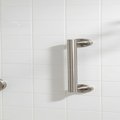
The spec that matters most: ADA-compliant diameter is 1.25 to 1.5 inches. The bar must have at least 1.5 inches of clearance between the bar surface and the wall — this prevents a user’s arm from getting trapped. Weight rating 250 lbs minimum, 500 lbs preferred. Peened or textured finish in wet areas — chrome is slippery when wet. Stainless steel construction for wet environments. All of the brands below meet these standards. The differences are in installation ease, aesthetics, and price.
The peened finish on the Home Care line provides genuine grip when wet — important in shower and tub applications. Weight rating is 500 lbs. Available in 12, 16, 18, 24, 30, 32, and 36-inch lengths. Chrome and brushed nickel finishes.
Best for: Homeowners doing their own installation. The SecureMount system reduces the margin for error more than any other residential bar system.
The engineering behind the aesthetics is solid. Delta’s mounting plate system provides a robust anchor. Weight ratings meet or exceed ADA requirements. Available in brushed nickel, matte black, chrome, and stainless finishes that coordinate with existing Delta plumbing fixtures.
Best for: Homeowners who want a bar that blends with a renovated or designed bathroom. Also the right choice if the bars are going in a guest bathroom that should not look clinical.
The Kohler Memoirs and Purist grab bar series are the most commonly specified in high-end aging-in-place renovations where aesthetics are a primary concern alongside safety.
Best for: High-end bathrooms where fixture coordination matters and price is not the primary decision factor.
WingIts are available at plumbing supply stores and online. Installation requires following the manufacturer instructions precisely — the hole size and installation sequence matter. Done correctly, a WingIts installation is a legitimate, safe anchor point. Done carelessly, it is not.
Use when: No stud is available at the required bar location and you cannot access the wall from behind to add blocking.
Bars outside this range — either thinner decorative towel-bar-style bars or thicker commercial bars — are not appropriate for residential safety use. Check the diameter before you buy.
A 150-pound person falling and grabbing a bar can apply 300–450 pounds of force. A 200-pound person can apply 400–600 pounds. Buy bars rated for 500 lbs whenever possible. The bar, the screws, and the anchors must all be rated appropriately — the weakest element is the one that fails.
- Toilet side bar: 42 inches preferred, 36 inches minimum
- Shower entry vertical: 24–36 inches
- Shower transit horizontal: 36 inches preferred, 24 inches minimum
- Tub angled bar: 24–36 inches depending on tub size
Longer bars are generally better — they provide continuous support through a wider range of movement without requiring the user to reposition their grip. Buy longer rather than shorter whenever the wall allows it.
Peened finish (small dimpled texture) and satin or brushed finishes provide meaningfully better grip when wet. Both Moen Home Care and Delta ADA series are available in peened stainless, which is the optimal choice for shower and tub locations. For toilet bars in a drier location, polished chrome is acceptable.
Do it yourself if: You can locate studs and operate a drill, the bars go into drywall or tile with accessible studs or clear space for proper anchors, and the wall behind your shower surround is solid (not fiberglass with a gap behind it).
Hire a pro if: You have fiberglass surrounds with uncertain backing, you want to add blocking behind an existing wall (requires opening the wall), your tile is old and fragile, you are not confident in your stud location, or you want a CAPS-certified professional to assess the full bathroom and specify the complete installation.
CAPS stands for Certified Aging in Place Specialist — a designation from the National Association of Home Builders. A CAPS contractor has specific training in accessibility modifications and knows what a professional aging-in-place installation requires. Professional installation runs $150–$400 per bar, typically completed in under an hour per location.
Your local Area Agency on Aging coordinates low-cost or free installation programs for qualifying seniors in most counties. If cost is a concern, contact them before hiring a contractor. Many programs cover materials and labor for income-qualified homeowners.
If you are reading this because you are worried about a parent — not yourself — you are doing the right thing. The challenge is that most parents in their 70s will not ask for this and may resist the suggestion. The framing matters more than you think.
Do not frame it as a medical device or a sign of decline. Frame it as a home upgrade. Modern grab bars from Delta or Moen look like intentional design elements, not hospital equipment. Present it as something you are doing for their home, not something you are doing to them.
The most effective approach: Do not ask. Show up on a Saturday with the bars, a drill, and a stud finder. Install them. Say "I wanted to make sure this was done right." Most parents who resist the idea in advance appreciate it after the fact.
If you are not confident in the installation: Hire a CAPS contractor. The cost is $150–$400 per bar. That is the most useful $400 you will spend this year. Call your parent’s local Area Agency on Aging — some provide free or reduced-cost installation for qualifying seniors.
What to buy for a parent’s bathroom: Moen Home Care bars in brushed nickel — they look like they belong in any bathroom, the SecureMount system is forgiving of older walls, and the 500-lb rating gives you confidence the installation will last. Start with the toilet side bar. That is the one that prevents the most falls. Do the shower next.
Screws can loosen over time from vibration, thermal expansion, or minor wall movement. This is normal. Catching it during an annual check means tightening two screws. Missing it means the bar fails during a fall.
If the silicone has cracked or pulled away: remove it completely with a utility knife, clean the surface with rubbing alcohol, let it dry fully, and apply fresh mold-resistant wet-area silicone. Let it cure 24 hours before the shower is used.
Reinstallation is the same two-hour job as the original installation. The cost of getting it wrong is the same as not having installed it at all.
Most renters assume they cannot install grab bars without landlord permission. This is incorrect. Under the Fair Housing Act, landlords are required to allow reasonable modifications for tenants with disabilities or accessibility needs — at the tenant’s expense. Grab bars qualify.
The process: notify your landlord in writing that you intend to install grab bars as a reasonable accommodation. You pay for materials and installation. When you move out, you may be asked to restore the wall — which means patching the screw holes. A tube of joint compound and twenty minutes of work.
The practical reality: Most landlords will not object to properly installed grab bars. Toggle bolt installations can be removed and patched invisibly. A CAPS contractor can install and remove bars with no permanent damage to walls or tile.
If your landlord refuses to allow the modification, contact your local Area Agency on Aging or a housing rights organization. The refusal may violate federal law.
For renters in assisted living or senior housing: Federal regulations require that your facility provide or allow accessibility modifications in your unit. Ask your facility director about their grab bar installation policy. If they do not have one, ask them to create one.
That is the math. Two bars at $45–$75 each, one WingIts anchor kit if needed, two hours on a Saturday morning with a drill and a level. When you are done you never have to think about it again.
The alternative is a $34,000 hip surgery, a rehabilitation facility, and someone else deciding what happens next. The grab bar does not guarantee you will never fall. It changes what happens when you do.
Also on SeniorBlackoutGuide.com
🔨 The Grandfather Toolkit — The tools you need to install grab bars yourself, and every other home repair that matters at 50–70.
🏠 Fall Risk Home Audit — Walk through every room and identify every modification your home needs before a fall happens.
📖 Barbara’s Story — Nine days without power after a hurricane. What she needed and what she did not have.