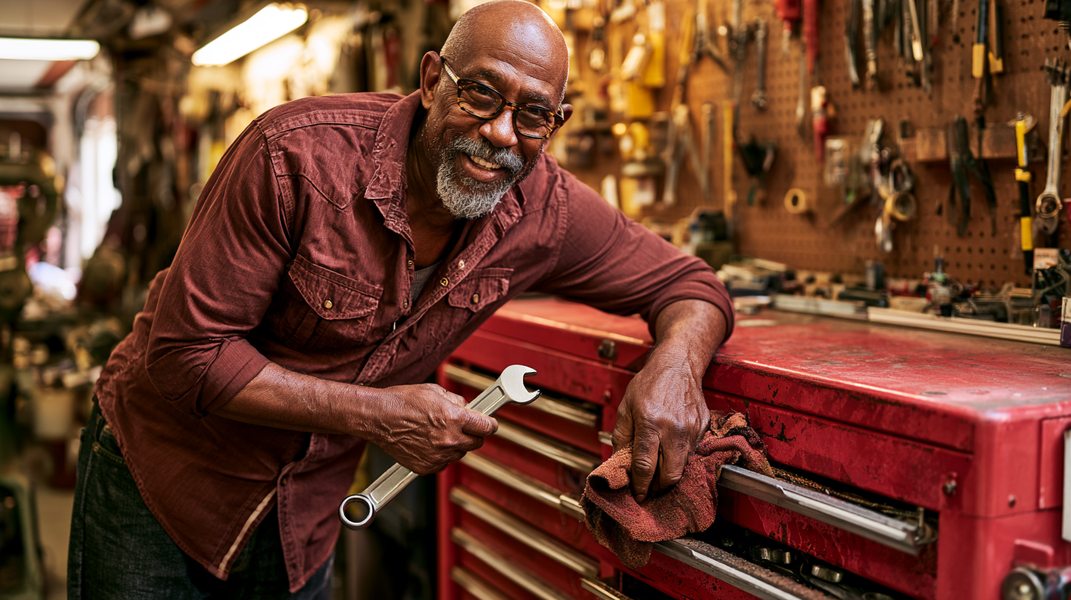
👁️ Eye Protection — Non-Negotiable. Before anything else on this list. Safety goggles or glasses for every power tool, every grinding job, every sawing job. At 70 your eyes do not heal the way they did at 30. A chip of metal or wood at the wrong angle ends your ability to do any of this work permanently. Buy 3 pairs — one for the garage, one for the shop area, one spare. ANSI Z87.1 rated. View on Amazon →
The rule: If it requires a battery, it will eventually fail you when you need it most — and the replacement batteries may not exist in 10 years. A corded drill bought today will still work in 30 years. A DeWalt 20V Max bought today will be a paperweight when that platform gets discontinued.
The exception: Hand tools that amplify your strength rather than replace it. A ratchet screwdriver. A long breaker bar. Vise-Grips. These are force multipliers — they make reduced hand strength at 70 irrelevant.
Buy quality once. Store it dry. It will outlive you.
Do Not Cheap Out On Your Tools

Your grandfather didn't buy his tools at a dollar store. He bought them once, took care of them, and they were still in his garage the day he died. That's the standard.
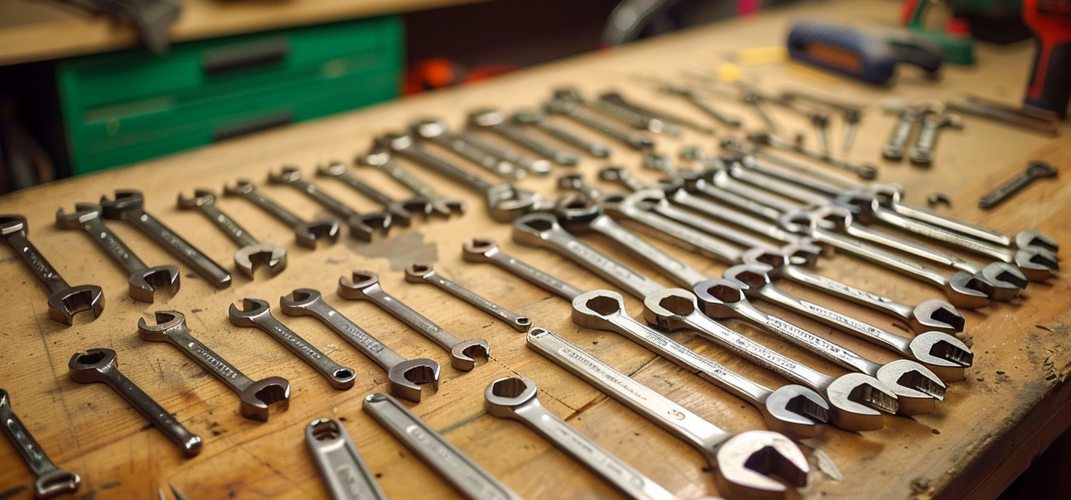
You don't have to buy new. You just have to buy right. Garage sales. Craigslist. Facebook Marketplace. eBay. Estate sales. That's where the real tools are — Craftsman, Snap-on, Proto, Channellock, Irwin, Klein — bought by tradesmen in the 1970s and 1980s, used hard, stored dry, and still better than anything made in the last 20 years at half the price. A $3 Craftsman wrench at a garage sale will outlast a $12 import from a big box store by 30 years.
Go find them. They are out there everywhere.
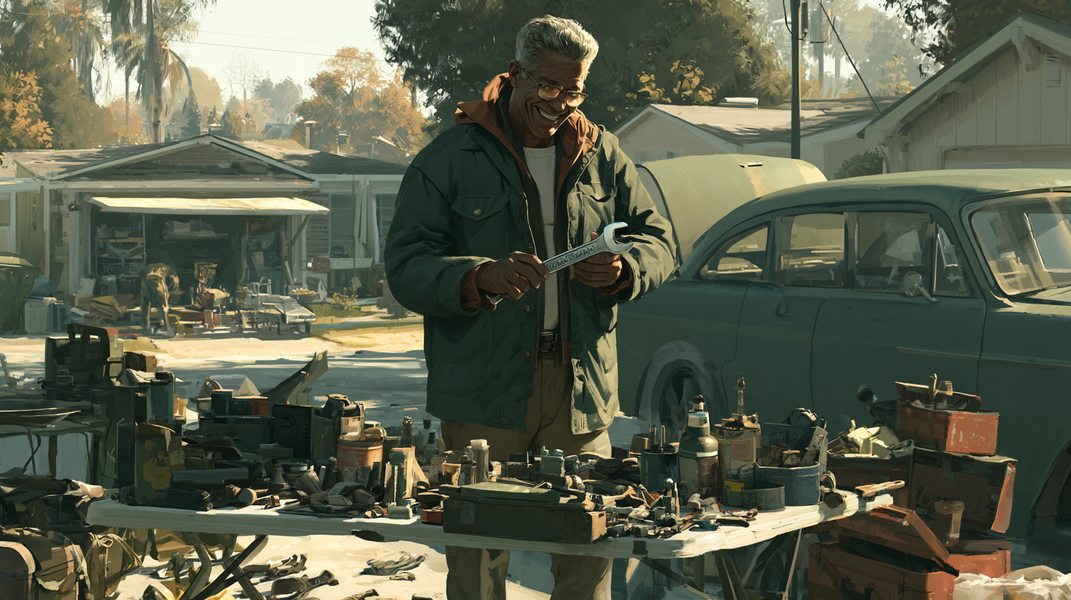
Facebook Marketplace and Craigslist — Search "tool lot," "garage clean out," "estate tools." An entire working man's toolbox for $50 is not unusual. Most people selling don't know what they have.
eBay — For specific tools you're hunting. Search the brand and model. Read the condition notes. Most vintage American hand tools are in fine shape — they were built to last and most of them did.
Estate sales — The best source of all. The tradesman who owned these tools cared about them. They are usually in better shape than new store tools at a fraction of the price.
Pawn shops — Underrated. Tools come in constantly. The staff rarely knows the difference between a Proto wrench and a harbor freight one. You do.
Finish — Chrome vanadium steel has a bright, even finish. Cheap steel looks dull or has a bluish tint.
Markings — Good American tools are stamped with the size and often the steel grade. If it says "Chrome Vanadium" or "CV" it's worth buying.
The fit — Put a wrench on a bolt. A good wrench fits snugly. A cheap wrench has slop — it rocks slightly. That slop is what rounds off bolts and busts knuckles.
The hinge — Open and close a pair of pliers. Good pliers move smoothly with no grinding. Cheap pliers feel rough and can gall over time.
Gripping and Holding Tools
Removing a stripped screw or bolt. When a screwdriver or wrench can't get purchase because the head is damaged, Vise-Grips bite into the metal directly. Lock them on and turn. They grip what nothing else will.
Clamping two pieces together while glue dries. No need to hold it. Lock the Vise-Grip and walk away. Come back in an hour.
Turning a rusted pipe, nut, or fitting. When a wrench slides off because everything is corroded and rounded, Vise-Grips dig in. The locking pressure multiplies your turning force dramatically.
Holding small parts for soldering or grinding. Lock the part in the Vise-Grip, rest the handle on your workbench, and now you have both hands free for the iron or grinder. Keeps your fingers away from heat and sparks.
Emergency hose clamp. Pinch off a leaking hose temporarily — garden hose, fuel line, coolant line — while you get the right repair parts.
Turning a valve that won't budge by hand. Water shutoffs, gas valves, anything that's been sitting unused — lock the Vise-Grip and use the handles as a lever. Dramatically more torque than bare hands.
Grip a broken key or bolt stub. When a key snaps off in a lock or a bolt breaks below the surface and sticks out just a little, Vise-Grips are often the only tool that can get it out.
Makeshift handle on a pan or pot. Handle break off a cast iron pan? Lock a Vise-Grip to the rim. Not pretty, but it works until you get a replacement handle.
Hold a door open or closed. Lock a Vise-Grip to the door edge and it becomes a stop. Useful when you're working alone and need a door to stay put.
Carry heavy wire or cable. Lock onto the end of a spool of wire or heavy cable and use the handles as a carry grip. Much easier than trying to hold the wire itself.
Pinch off a stripped zip tie or wire bundle. Holds things together while you get a replacement zip tie in place.
They are not a substitute for the right wrench. On a bolt or nut you can access with the correct wrench, use the wrench. Vise-Grips are for when the right tool won't work — stripped heads, rounded corners, rusted fittings. Using them on good fasteners will round them off over time.
The adjustment takes practice. You need to set the jaw opening before locking. Too tight and they won't close; too loose and they won't grip. After a few uses it becomes automatic, but the first few times takes a moment.
They are not pliers. Do not use them for jobs requiring finesse — bending fine wire, gripping delicate parts, electrical connections on small terminals. The locking force is too aggressive. Use needle-nose pliers for those jobs.
Tightening or loosening large nuts. The slip-joint adjustment means one tool fits a 1/2" nut and a 2" nut without switching sizes. Faster than hunting through a wrench set for the right size.
Turning stuck jar lids and caps. Lock the jaw around a stuck lid — paint can, jar, bottle cap — and the long handles multiply your grip force several times over. What your hand couldn't budge, these will.
Holding round stock while you cut or drill. Round pipe, rod, or dowel rolls when you try to cut it. Channellocks hold it steady while the saw or drill does the work.
Gripping things that have no flat surfaces. Wrenches need flat surfaces — a hex or square to grab. Channellocks grip anything round, irregular, or oversized. Old corroded fittings that have rounded off are no match for them.
Remove a broken light bulb base. When a bulb breaks off and the base is stuck in the socket — power off first — use a small Channellock to grip the base rim and unscrew it.
Pull cotter pins and roll pins. Grip the pin with the jaws and pull straight out. Works on machine parts, hinges, and linkages where a standard pin punch won't reach.
Straighten bent metal. Small pieces of conduit, bracket, or sheet metal that have bent slightly — grip on both sides of the bend and flex back straight.
Open stuck paint cans without a screwdriver. Grip the lid edge with the jaw and use the handles as a lever to pop it. Doesn't damage the lid the way a screwdriver can.
They require hand pressure to hold. Unlike Vise-Grips, Channellocks don't lock. You have to maintain grip pressure throughout the job. For people with limited hand strength, this is a real consideration. For short jobs it's fine — for sustained gripping, switch to Vise-Grips.
They can slip if not set correctly. If the jaw is set too large for what you're gripping, the pliers will skip to the next groove size under pressure and lose their grip suddenly. Set the jaw snug — you want minimal play before it starts gripping.
Not for precision work. The long handles and wide jaw make them clumsy in tight spaces. For small nuts in confined areas, a box-end wrench or socket is better.
Holding work steady while you drill or cut. One hand operates the drill, the spring clamp holds the piece. Especially useful when working alone — which at 65 is most of the time.
Holding trim, molding, or edging in place. Tack down door trim, chair rail, or cabinet edging while the adhesive or nails set. Far faster than tape and much more reliable.
Securing a tarp or cover. Clip them onto the edge of a tarp to hold it down over a grill, furniture, or a vehicle. During hurricane prep, spring clamps on a tarp are faster than rope and hold in wind better than you'd expect.
Holding a bag, hose, or line closed. Garden hose end, chip bag, dog food bag, paint tray liner. One squeeze and it's closed. Far more useful than a rubber band that breaks.
Hold a flashlight aimed at your work. Clip a small spring clamp to a shelf, pipe, or ladder rung, close it on the flashlight body, angle it at your work. Hands-free lighting with no tripod.
Paper and pattern holder. Clamp a template, pattern, or instruction sheet to the edge of your work surface so it's visible while your hands are busy.
Keep a paint can lid sealed between coats. Standard paint can lids never seal properly once opened. A spring clamp on each side of the lid presses it down tight and keeps the paint from skinning over.
Temporary hinge while you position a door or panel. Clip a spring clamp to the top edge of a cabinet door to hold it in position while you mark and drill the hinge holes.
Plastic ones break. The cheap plastic spring clamps from dollar stores crack and fail, often at the worst moment. Buy steel spring clamps with rubber-tipped jaws — they grip better and last indefinitely.
The rubber tips can leave marks. On very soft wood, freshly painted surfaces, or delicate finishes the rubber jaw pads can leave an impression or mark. Put a small piece of cardboard or scrap wood between the jaw and the work surface if the finish matters.
Squeezing takes hand strength. The larger spring clamps require meaningful grip force to open. For hands with severe arthritis, the smaller sizes are more manageable — or use C-clamps with a T-handle that you can spin with your palm instead of squeezing.
Clamping work to a bench or sawhorse. Lock your workpiece down so it doesn’t move while you saw, drill, sand, or chisel. Working alone without a vise, C-clamps are your bench vise.
Holding metal while welding or grinding. The screw provides enough force to hold steel parts in alignment while you tack weld or grind. Spring clamps can’t handle the heat or vibration — C-clamps can.
Emergency repair hold while adhesive cures. Broken furniture leg, split wood, cracked handle — apply epoxy, clamp, wait. A C-clamp doesn’t care if the repair takes 20 minutes or 24 hours.
Pull dents in thin metal. Drill a small hole in the dent, thread a bolt through, place a wood block on the outside, use a C-clamp to pull the bolt outward. Crude but effective on thin sheet metal.
Compress a spring while you reassemble. Stuck valve spring, screen door closer, any compressed spring you need to hold while you work — a C-clamp compresses it and keeps it there with both hands free.
Hold a door while you work on it. Removed a door for planing or painting? Clamp it to sawhorses. It won’t rock or shift while you work both sides.
They are slow to set and release. You spin a screw handle — sometimes many turns. For jobs needing many clamps set quickly before glue grabs, use spring clamps. Use C-clamps when you need maximum force and time isn’t critical.
They can rack a joint if tightened unevenly. Alternate between clamps, a little at a time, so pressure builds evenly. Never crank one side fully tight before starting the other.
Cheap ones flex under load. A lightweight import C-clamp will spring open under serious pressure. Buy cast iron or drop-forged steel — they cost more, weigh more, and hold without flexing.
Needle-nose pliers have one job better than any other tool: reach into tight spaces and grip things that your fingers can’t reach. The long tapered jaws fit into electrical boxes, behind appliances, under dashboards, inside engine bays, and anywhere else a normal pair of pliers won’t go. The jaws also bend wire cleanly — you close the pliers around wire and push sideways to form a hook, loop, or 90-degree angle. Most also have a small wire cutter built into the base of the jaws, right where the handles join. Klein Tools has been making these in the USA since 1857. The steel is better. The joint is tighter. They last longer. A used pair at a garage sale is almost always better than a new import.
- Reaching into electrical boxes — grabbing wire ends, pulling wire through knockouts, positioning wires you can’t see clearly
- Bending wire ends — making the small hook that goes under a screw terminal on outlets, switches, and light fixtures
- Holding small parts — nuts, bolts, cotter pins, snap rings, anything your fingers can’t grip while the other hand works
- Pulling wire through walls — fishing wire through conduit or wall cavities where your hand won’t fit
- Removing cotter pins — the tiny bent pins that hold trailer hitches, lawn mower blades, and machinery together
- Gripping small bolts — when a wrench is too big and the bolt is in an odd spot
- Unclogging drains — reach past the drain stopper and pull out the hair clump that a drain snake can’t grab
- Removing broken keys — when a key snaps off in a lock, needle-nose pliers can sometimes grab the exposed stub and pull it out
- Pulling heavy staples — better than a staple remover for large staples in wood or drywall
- Crimping small connectors — automotive spade connectors and small ring terminals in a pinch when you don’t have a crimper
- Starting knots in tight spaces — tying fishing line, paracord, or wire where your fingers won’t cooperate
- Extracting broken screws — if a screw head is stripped but the screw sticks up slightly, needle-nose pliers can grip the shank and back it out
- Holding soldering work — gripping a small part while you apply a soldering iron so your fingers stay away from the heat
- Not for big work — the long thin jaws are not strong. Don’t try to tighten a stuck bolt or grip something heavy. The jaws will spring apart or twist.
- The wire cutter is small — it cuts light wire only. Don’t try to cut thick cable, fence wire, or anything heavy. Use dedicated wire cutters for that.
- Not for prying — the jaws are designed to squeeze, not pry. Using them as a pry bar will spring the jaws open permanently and ruin the tool.
- Grip strength is limited — because the jaws are long and thin, they don’t develop the crushing grip of regular pliers. They hold, they don’t crush.
- Spring-loaded versions are nice but not necessary — some open automatically when you release. Fine feature. Not worth paying extra for if you find a solid used pair.
8 inches is the right starting size. Long enough to reach into most electrical boxes and engine compartments. Short enough to control precisely. The 6-inch version is for fine electronics work. The 9-inch is for deep reach inside walls and behind appliances. If you’re buying one pair, 8 inches handles 90% of everything you’ll encounter. The Klein D203-8 is the standard — made in the USA, dip-coated handles, side cutter built in. Find them used at garage sales and estate sales. Any Klein needle-nose in good condition is worth buying at any fair price.
Diagonal wire cutters — also called dikes, diagonals, or side cutters — cut wire, cable, zip ties, small bolts, cotter pins, and anything else that needs to be severed cleanly in a confined space. The cutting edges meet at an angle, which means the jaws can get into corners and along surfaces that straight scissors or bolt cutters can’t reach. Klein Tools makes three useful sizes: small (about 6 inches) for electronics, fine wire, and detail work; medium (7 inches) for general household and garage use; large (8–9 inches) for heavier cable, fence wire, and cutting small bolts flush. Klein has made these in Lincolnshire, Illinois since 1857. The steel holds an edge longer than imports. The pivot joint stays tight. A used Klein wire cutter from a garage sale is worth more than a new Chinese import from a big box store.
- Cutting wire to length — electrical wire, speaker wire, antenna wire, any wire that needs a clean straight cut
- Stripping wire — score around the insulation and pull — not as precise as a wire stripper but works when that’s what you have
- Cutting zip ties flush — the diagonal angle lets you cut right at the locking head so no sharp stub sticks out
- Removing cotter pins — cut one leg, straighten, pull — faster than bending back and forth until it breaks
- Cutting small bolts flush — when a bolt sticks out too far, the large cutter will sever it; not elegant, but it works
- Cutting picture hanging wire — the small size cuts braided picture wire cleanly without fraying
- Cutting fishing line knots — the small version cuts monofilament and fluorocarbon right at the knot without the fraying you get from scissors
- Removing staples from wood — slide the tip under the staple crown and cut it in half, then pull each leg out separately
- Cutting small springs — the diagonal angle lets you cut a coil spring to a shorter length when you need to reduce tension
- Trimming shrub branches up to pencil thickness — the large version will cut small woody stems cleanly in tight spaces where pruning shears won’t fit
- Opening blister packaging — the hardened plastic clamshell that destroys scissors cuts cleanly and safely with wire cutters
- Cutting lock ties on shipping straps — those hard plastic one-way buckles on freight shipments cut in one squeeze
- Clipping ingrown toenails — the small version reaches the corner of a nail better than standard nail clippers — a trick used by nurses and podiatry techs
- Not for hard wire — piano wire, hardened steel cable, and spring steel will chip the cutting edges. Use a bolt cutter or angle grinder for those.
- Not for live electrical wire — unless the handles are rated and labeled for electrical work. Most are not. Turn the power off first, always.
- The cut leaves a diagonal face, not a square end — one side of the cut wire will have a sharp angled point. That’s normal. Account for it when measuring wire length.
- Small versions won’t cut thick cable — forcing them will spring the jaws out of alignment and ruin the tool. Match the size to the job.
- Not for bolt cutting — even the large version is for small bolts only. Anything over 3/16 inch diameter needs a dedicated bolt cutter.
Medium — 7 inch — is the right starting size. Cuts everything a homeowner runs into: household wire, zip ties, small bolts, picture wire, cotter pins. The Klein D228-7 is the standard medium size — made in the USA, induction hardened cutting edges, dip-coated handles. If budget and space allow, add the small 6-inch version for detail and electronics work. The large 9-inch is a specialty tool — buy it when you have a specific need. Find used Kleins at garage sales, estate sales, and pawn shops. The pivot joint should move smoothly and the cutting edges should meet cleanly with no gap when closed. If both of those are true, buy it.