🔇 A Clog at Least Has the Decency to Tell You
There is a page on this site about stopped drains and stopped toilets, and those are the loud failures. Water stands where it ought to be leaving. You cannot miss it and you cannot live with it, so it gets dealt with that afternoon.
This page is about the other half of the plumbing bill.
These do not stand in the sink. They do not smell. Nothing overflows and nothing stops working. A toilet runs on quietly in a back bathroom. A kitchen tap gets a little weaker every year, so slowly that you adjust to it without ever once deciding to. A rubber hose behind the washing machine spends eleven years getting older.
Every one of them is cheap to put right.
And every one of them costs more the longer it is left, which is the difference between this list and the other one.
A clog costs you an afternoon and then it is over. These charge you rent.
Why the steps are here. This is not a repair manual, and we are not trying to make a tradesman out of anybody.
The steps are on the page so you can weigh the job. “Replace a flapper” tells you nothing at all. Shut a valve, unhook two ears, hook the new one on — six dollars, no tools, ten minutes tells you everything, because now you can set it beside a two-hundred-dollar minimum call-out and decide for yourself. That decision is the whole point of the page. The instructions are only how we show our working.
Some of these you will read and think: not for me. That is a real answer and it cost you four minutes. Take it and hire the job out with your eyes open, which is a better position than most people are in when they make that call.
But take your time with one. Look it up twice. Watch somebody do it before you touch anything. A fair number of people who do that find the job was a good deal smaller than the fear of it — and then find out the same is true of the next one. That is what we are actually after. Not the repair. The surprise.
✋ Before You Start: Is This One Yours?

There is a running toilet somewhere costing somebody two hundred gallons a day, and the person who owns it has already decided the job is beyond them. Most of the time that decision is made before anybody has looked at what the job actually involves.
So this section does two things, in order: it sends you to somebody who can show you the job, and then it helps you work out honestly whether it is yours to do.
First, go and watch two plumbers do it
Before anything else on this page. Nothing written down beats watching somebody do the job. Not this page, not the instructions in the box, not the best-written manual you ever struggled through at the kitchen table. A good video shows you the motion, the angle of the wrist, how hard he actually pulls — and you know you have got it right because what is in your hands matches what is on the screen.
Watch two. Watch a dozen if that is what it takes. Any single video makes any job look easy, because the man doing it has done it four hundred times and edited out the part where it stuck.
Keep going until you can see what every one of them does the same way. That is the whole method, and it is worth more than any set of written instructions including these. The steps they all share are the job. Everything else — the order he does two things in, the brand in his hand, the way he holds his wrist — is that particular man's habit, and none of it is binding on you. Once you can pick the common thread out of five different bathrooms, you know the repair. And wherever all of them slow down and start explaining, that is the hard part. Watch that minute twice.
How to pick a decent one. A working plumber beats a channel that covers everything under the sun. A real cramped bathroom beats a bench mock-up with the parts laid out in the open, because your toilet is jammed against a wall and his should be too. And a video that shows the whole job — including him wrestling the shutoff valve — beats one that cuts from "first, turn off the water" straight to a tank already empty. That cut is exactly where the difficulty lives.
Watch it once through with your hands in your lap, and once more with the parts in front of you. Fifteen minutes of somebody else's time, and it saves you standing in a bathroom wondering if what you are looking at is normal.
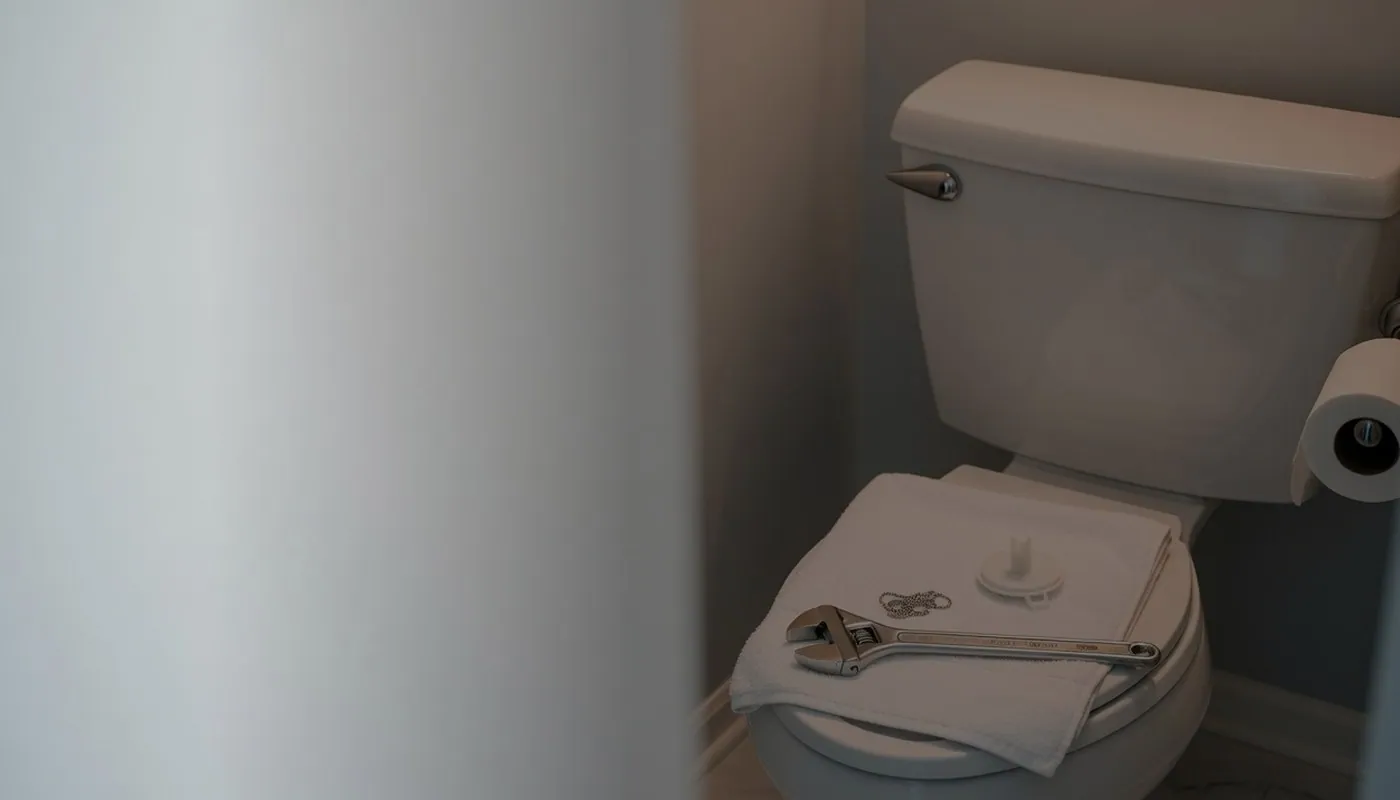
Have the tools in the house before you start, not halfway through. And be clear about what we are talking about, because it is not much: a pair of pliers, an adjustable wrench, a screwdriver, an old towel. Nothing fancy, nothing specialist, and not one thing on that list needs electricity or a battery. They are the same tools your grandfather kept in a drawer and used to fix his own running toilet, and they will still be working long after everything with a charger in it has died.
That is the honest bar for this job. Not strength, not a trade, not a van full of equipment. The right few tools in your hand, and having watched somebody do it — which is most of why that generation could fix things and we assume we cannot.
And it is worth being accurate about who they watched, because it was often not their fathers. Fathers were at work, and then working more, trying to earn enough to keep a family in the house. The man who had the time, and more to the point the patience, was usually the grandfather. He would let a boy stand at his elbow and get in the way and ask the same question three times, which is exactly what learning a thing looks like and exactly what a tired man home from a long day cannot manage.
That has not changed, it has only moved along a generation. If something is running in your house tonight, your grandfather is more likely to know how to stop it than your father is. The knowledge skipped a stop. Which is the reason a screen full of plumbers is worth what it is worth — it is the patient old man at the elbow, available at eleven at night, willing to be asked the same question three times.
And plenty of the people who do this best are women. Hands, patience, and the willingness to watch it done twice are what the job asks for, and not one of the three cares who is holding the wrench.
Watch until you have got it. You are far less likely to make a mistake, and far more likely to avoid doing it the hard way — which on this job is most of what separates a quiet twenty minutes from a bad afternoon.
Here is a search for this particular job. We are not sending you to any one video — they come and go, and the good ones change. Pick two that look like the description above.
And here is what none of them will tell you, which is why this page exists. Every one of those videos is made by somebody whose body does what he asks of it. He drops to his knees at the side of the bowl, reaches in behind, cranks a stiff valve a quarter turn with two fingers and bounces back up without a thought. He never says what that costs at sixty-eight, and he never says which jobs are genuinely off the table.
So watch the videos for how. Use the rest of this page for whether — two lists, measured in the same units, so you can hold one against the other. What the job asks of you, and what you have got. Do it before the water is off and the lid is on the floor, not after.
What this job asks of you
- Grip
- The shutoff valve is the hardest part of this whole job and it is not close. About what opening a new jar of pickles takes, except at arm’s length and usually with the wrong hand. Everything after the valve is finger work.
- Position
- You kneel twice and you can sit down for everything in between. Once at the start and once at the end, you kneel to work the valve. The shutoff valve sits seven to ten inches off the floor, low on the wall behind the bowl — too low to reach standing and too high to lie under. And a toilet is nearly always jammed up against something: a wall, a tub, the side of a shower. That is what makes it awkward, not the valve itself. You go down on your knees at the side of the toilet, put your right hand flat on the lid to steady yourself, reach in behind with your left and turn. Then you get back up.
- Reach
- Your forearm into the tank, about elbow deep. Nothing overhead. The water in there is clean and nothing in it is sharp.
- Weight
- Nothing over five pounds. The tank lid is the heaviest thing you will pick up, and it goes straight onto a folded towel on the floor.
- Time, and how long the water is off
- Forty minutes the first time, fifteen the second. Most of that can be spent sitting down. The water is off for about thirty of those minutes, and only to that one toilet — the rest of the house keeps running.
Almost everybody is right-handed, and almost every valve is on the left. That is the whole difficulty in one sentence. You are either doing the hardest part of the job with your weaker hand, or you are twisting yourself into a bad position to get the strong one in there. Neither is comfortable and neither means you cannot do it.
Try it bare-handed first. Kneel, brace, and just see whether it moves. Look at what it is made of before you do anything else. If the valve body is brass or chrome-plated brass, and it will not go, do not haul on it — rock it back and forth a little, a few degrees each way. A valve that has been sitting still for years will often break loose that way and then turn the rest of the way with no trouble. If it is cream, tan or white plastic, stop reading here and go to the next block.
Then close it all the way. It has to come up fairly tight. Left half-shut, water keeps trickling into the tank while you are working — not the end of the world, the job still gets done, but you are fighting a filling tank the whole time and it makes an easy job feel like a struggle.
Fair warning on an older house: a valve that has not been touched in ten years does not want to move at all. That is the one where the rag and the pliers earn their keep, or where you ask somebody.
And there is a second way an old stop punishes you for touching it, which almost nobody warns about. Inside the valve, up where the stem comes through to meet the handle, is a rubber seal. Sat still for twenty years it has gone hard. Turn that valve off and back on and the seal no longer does its job — and now you have a slow weep coming out around the stem where the handle attaches. Not a burst, just a bead that keeps coming back, and a repair you did not want on a day you were fixing something else.
That is the whole case for going out to the main instead. Turn the meter valve off and on as often as you like; it is a different animal and it does not start weeping at you afterwards. Forty years of doing this, and it is not the one that gives trouble.
Read this before the rest of it, because for a lot of people it is the end of the matter.
If your house has some years on it, or if the shutoff behind that toilet is wedged in somewhere awkward, do not fight it. Take the easy way out and shut the water off to the whole house at the main. Then everything below about stiff valves, rags and pliers and which way they turn stops applying to you.
The reason is worth saying plainly. Somebody is going to put both hands on a shutoff valve without ever registering that the thing they are torquing on is a piece of plastic pipe glued into the wall. Pop goes the weasel, and now they are flooding their own house — over a six-dollar flapper. If they had walked outside first and turned it off at the main, they would never have laid a finger on that valve. The whole of how to do that is a little further down this page.
Which of the two valves have you got?
Before you kneel down, know which one you are reaching for. There are two in common use and they behave completely differently — and if you expect the wrong one you will think the valve is broken when it is working perfectly.
The quarter-turn ball valve. A straight lever handle rather than a knob. It moves ninety degrees and stops, and that is the whole travel — one short sweep and the water is off. Lever lined up with the pipe means open; lever sitting across the pipe means closed. You can read it from across the room without touching it. These are what goes in new work and they are far and away the easier of the two.
The multi-turn stop. A small ridged knob — oval and football-shaped on some, a round ribbed wheel on others — and it does not stop after a quarter turn — you keep winding, several full turns, before the water is actually off. Clockwise to close, counterclockwise to open — righty-tighty, the same as a jar lid or a garden tap. Nothing about the handle tells you whether it is open or shut, so you have to turn it and watch.
The multi-turn is the one in most older houses and it is the one that seizes. If you are winding away and the water is still running, keep going — people give up on these half a turn short and decide the valve has failed.
The easiest way of all: never touch that valve
Newer houses are plumbed in plastic, and a good many of them have a plastic shutoff valve behind the toilet — cream, tan or white, glued onto a stub of pipe coming out of the wall. Plastic pipe gets brittle with age; plumbers put the turn at around ten years.
A plastic valve almost never breaks on its own. It breaks when somebody forces a stiff one. Every bit of effort you put into a seized handle — gripping it, rocking it, putting pliers on it — twists that glued joint inside the wall. Brass takes it. Brittle plastic snaps, and then you have an open half-inch line under pressure inside the wall and nothing left to shut it off with. That is a flood and a ceiling, not a repair.
So: if a plastic valve does not turn easily by hand, leave it completely alone. You do not need it.
Here is the part worth reading twice, because for a lot of people over sixty it is not the fallback — it is the better way to do the whole job.
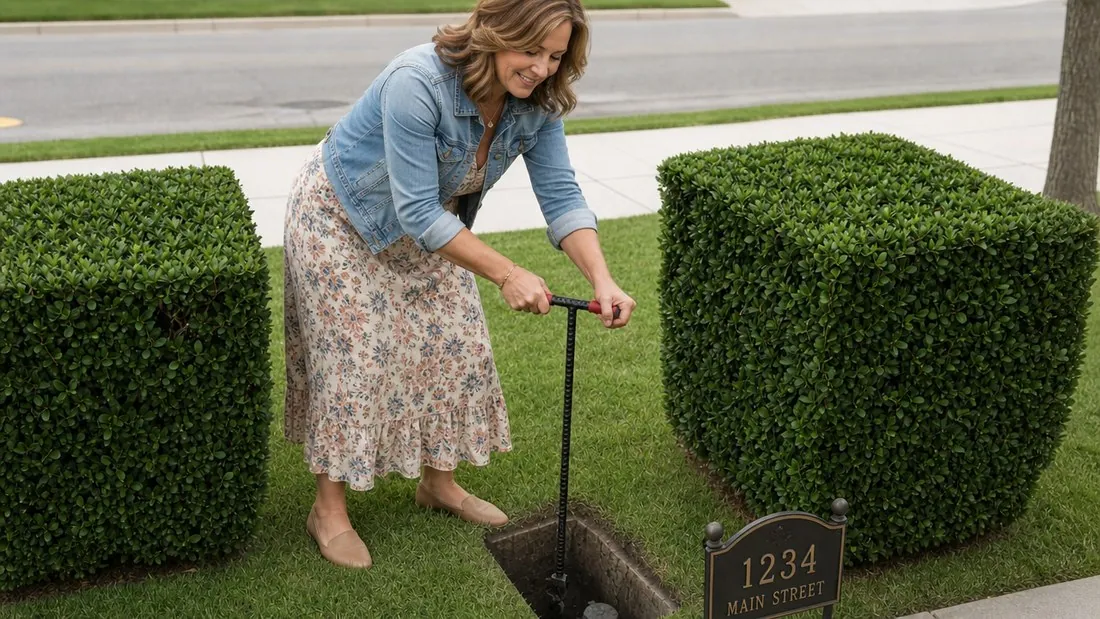
Go outside and shut the water off at the meter instead. A meter key is a long steel bar with a forked end, about twenty-eight inches, made for exactly this. You are on your feet in the yard with both hands on it, and it turns. Nothing is cramped, nothing is at arm's length behind a toilet, and there is no small stiff handle to fight.
And it is a quarter turn. That is all it is. The valve down in that box has a flat tang across the top rather than a handle, and the forked end of the key drops over it. One ninety-degree sweep and the water is off — you are not winding anything, you are not counting turns, and you cannot overdo it, because it stops itself. Tang lying in line with the pipe means the water is on; tang sitting crosswise means it is off, so you can look down into the box and read it without touching a thing.
The whole operation, honestly described: lift the lid, drop the key on, quarter turn, glance down to see the tang is crosswise, walk back inside. Under a minute. The same in reverse when you are done.
Compare the two honestly. Behind the toilet you are on your knees in a gap the width of your shoulders, working one-handed with your weaker hand on a valve that has not moved in a decade, with a hard porcelain edge against your ribs. At the meter you are standing on the grass with a long lever and both hands on it. For a lot of readers that is not a compromise. It is simply the easier job.
And the cost is nothing. The house is without water for the fifteen or twenty minutes it takes to change a flapper. Nobody in the house will notice, and you will not have gambled a plastic valve on it.
This is not only for toilets. The same is true of the little stop valves under a kitchen or bathroom sink — the ones you would be lying on your back in a cupboard to reach, which are just as likely to be plastic. Changing a faucet cartridge or a set of washers, you have the same choice. Twenty minutes without water in the whole house beats folding yourself into a sink cabinet to fight a valve you cannot see.
While you are still outside: let the pressure off
Shutting the valve stops any more water arriving. It does not empty what is already sitting in the pipes, and that water is still under pressure. One more step while you are out there and the whole job gets tidier.
Open the lowest faucet in the house and leave it open. The lowest one is what matters, because gravity does the work — everything standing above it comes down and out.
The best one to use is usually the outside spigot, the hose bib you water the grass with. Two reasons, and both are worth having. It sits lower than any sink in the house, so it drains more of the line than a bathroom tap will. And it empties onto the ground, not into a basin you are standing over with your sleeves rolled up. You are already outside at the meter; the spigot is a few steps away.
Let it run until it stops on its own. That is the pressure gone. Now you can walk back in, flush the toilet to empty the tank, and start work knowing that nothing in that line is waiting to spit at you when you loosen a nut.
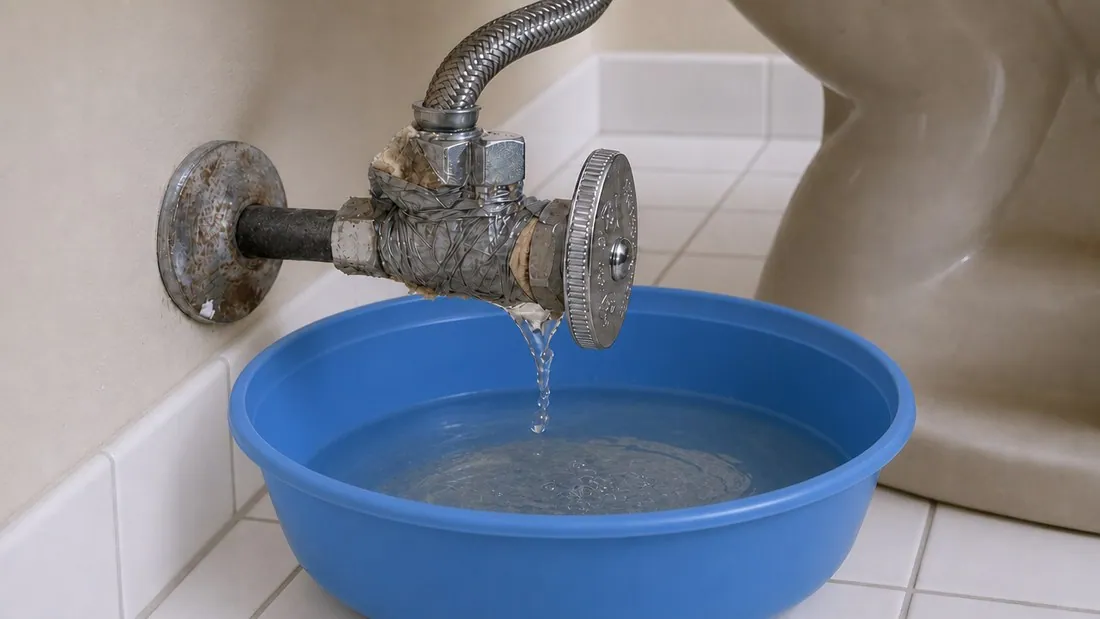
One small thing that will still be wet, so have something ready for it. The flexible hose running from the wall up to the bottom of the tank holds a little water of its own, and that comes out when you disconnect it. Not much — a few tablespoons.
Deal with it before it happens rather than after. Fold an old towel and set the end of the hose on it, and it soaks straight in. Or hold a small plastic container underneath — a margarine tub, a yoghurt pot, anything you were going to throw out. Either works. The point is having it to hand before the nut comes loose, not going to look for it while water is running down the wall.
One tool, and it does more than the one job
Twenty-odd dollars of solid steel with nothing on it to break — no motor, no battery, no seal, nothing that goes stale in a drawer. It will still work in forty years and it works when the power is out. But the reason to own one is that it is not really a single-purpose tool at all.
What it opens and turns
- The valve at your meter
- The job we have been describing. Quarter turn, water off, whole house.
- The meter box lid itself
- Most lids are held by a five-sided bolt no ordinary spanner fits, which is the point — the utility does not want it opened casually. The key drops on, turns, locks and lifts the lid, all in one motion. Standing up. That alone is worth the price to anybody who does not want to be crouched over a heavy iron lid trying to hook a fingernail under it.
- The curb box out by the street
- The narrow lid over the utility's own valve. Same five-sided bolt, same key. Whether you may operate that valve is a separate question — see below.
- Sprinkler and irrigation valve boxes
- The green lids scattered round a yard with a system. Same fittings, and the same buried valves underneath that a key reaches without kneeling in wet grass.
- Buried gate valves generally
- Anything down a pipe sleeve in the ground on a well, a barn line, a pasture tap or an outbuilding. The reason the tool is long is that everything it touches is two feet down.
The one thing to check before you buy, because half of them only do half the job. Some keys are lid keys — a pentagon socket and nothing else. Some are valve keys — a slot or fork and nothing else. The one worth owning has both: a five-sided socket for the lid, with the slot for the valve tang machined down inside that same socket. One tool, both halves of the trip.
And a size note nobody tells you. Those lid bolts come standard and large, and the makers do not agree on how to measure them — you will see a standard called both 27/32 of an inch and 5/8, and a large called 1-1/16, 1-1/32 or 3/4 depending whose catalogue you are reading. Buy one that says it fits both sizes and stop worrying about it. The good ones say so on the packet.
Two things to settle before the day you need it, and both are free.
There are two valves in that meter box and only one of them is yours. The one on the street side belongs to the water utility; the one on the house side is the customer's. Which one you are allowed to operate genuinely varies from one utility to the next — some forbid anybody but their own crews from even lifting the lid. Ring your water company once, on a dry afternoon, and ask which valve is yours to use. Five minutes on the phone, and you never have to wonder about it again.
Do not go hunting for extra leverage. Two hands on the key is fine and always has been — you are not going to hurt anything that way, whatever your age or your grip. What does damage these is somebody slipping a length of pipe over the handle to make a cheater bar out of it, and then leaning on it with everything they have. That is what shears an operating nut, and it is a job for the utility afterwards. If the valve will not go under steady two-handed pressure, it is telling you something. Stop and ring them.
Best of all, go and try it on a Saturday when nothing is wrong. Get the lid up, find the valve, turn it and turn it back. Then you know. The full guide to your three shutoffs — water, gas and electric — is here.
You do not have to stand over it
Do the middle of this job on your feet and you will be bent over that tank the whole time. There is no way round that standing up — the tank is below your waist and the work is inside it. But you do not have to stand up.
Put the lid down and sit on it, facing the wall, with the tank in front of you and the toilet between your knees. That is it. The open tank is now at a comfortable height and you are looking straight down into it instead of over the front edge of it.
The difference is bigger than it sounds. Bent over from standing you are looking across the water at an angle, in your own shadow. Sitting down you are directly above it and everything is in plain view — most people find they do not even need their reading glasses on, which they certainly do leaning over the front.
And replacing a flapper is only three movements, all of them done sitting: unhook the flapper ears from the two little pegs, unclip the chain from the lift arm, then do the same three in reverse with the new one. That is the entire repair.
When it is back together, stand up, lean over, kneel back down to the valve and turn the water on. Watch it fill, and watch the bowl for a minute to see that it stops. This is only how one person does it — it is not the only way. But if bending is what has been stopping you, it is worth knowing the bending is optional.
What you have — go and check, it takes two minutes
Not a quiz about how you feel. Five things to go and do right now, before you buy a part or turn anything off.
Where that leaves you
All five checked — ask yourself first. This one is yours. A flapper is six dollars and the whole job is described further down this page. Go and do it, and notice afterwards how much smaller it was than it looked.
The valve will not turn, everything else checked — ask somebody to help you. Old shutoff valves seize; it happens to everybody and it says nothing about your hands. But it is the one spot where a second person settles it in ten seconds and then goes home. A son, a neighbour, whoever cuts your grass.
Three other ways past it if nobody is handy. Wrap a rag around the handle and take a pair of pliers to it — the cloth saves the chrome and the pliers turn a finger pinch into a wrist turn. Squeeze hard, turn slowly. A basin wrench does the same for about twelve dollars. Or skip the valve altogether — shut the water off at the main, flush the tank empty, and do the job with the valve untouched.
Two or more unchecked, or the water is coming from around the base of the bowl — call a professional. Water at the base is the wax ring, not the flapper, and that means lifting sixty to a hundred pounds of porcelain and setting it back down square over two bolts you cannot see. Set down crooked and you get sewer gas in the house.
Making that call is not a failure. Knowing which of the three you are looking at, before the water is off, is the skill this page is actually teaching.
And if you start and want to stop
This is the part nobody prints, and it is why people do not start. You can back out of this job at any point and still have a working bathroom tonight.
Open the valve again, set the lid back on, and you are exactly where you were this morning — a toilet that runs. Annoying, wasteful, not an emergency. Nothing you have touched up to that point cannot be untouched. Even with the old flapper already off, a six-dollar replacement puts you back to normal, and the store is open until nine.
Somebody who knows he can stop is far more likely to start.
The same five questions, every job on this page
Grip, position, reach, weight, time. Every repair below is measured the same way, and each one tells you plainly where its own hard moment is — the seized valve, the bolt you cannot see, the sixty pounds of porcelain. Nowhere on this page will you find the words "moderate difficulty." That phrase tells nobody anything, and you are the only one who knows what your hands did this morning.
🚾 The Running Toilet Is the Expensive One

Watch it done before you do it
Do not start this repair from reading alone. Go and watch two or three people do this exact job all the way through, and keep watching until you can see what every one of them does the same way. Fifteen minutes, and it is the difference between following along and guessing.
Parts
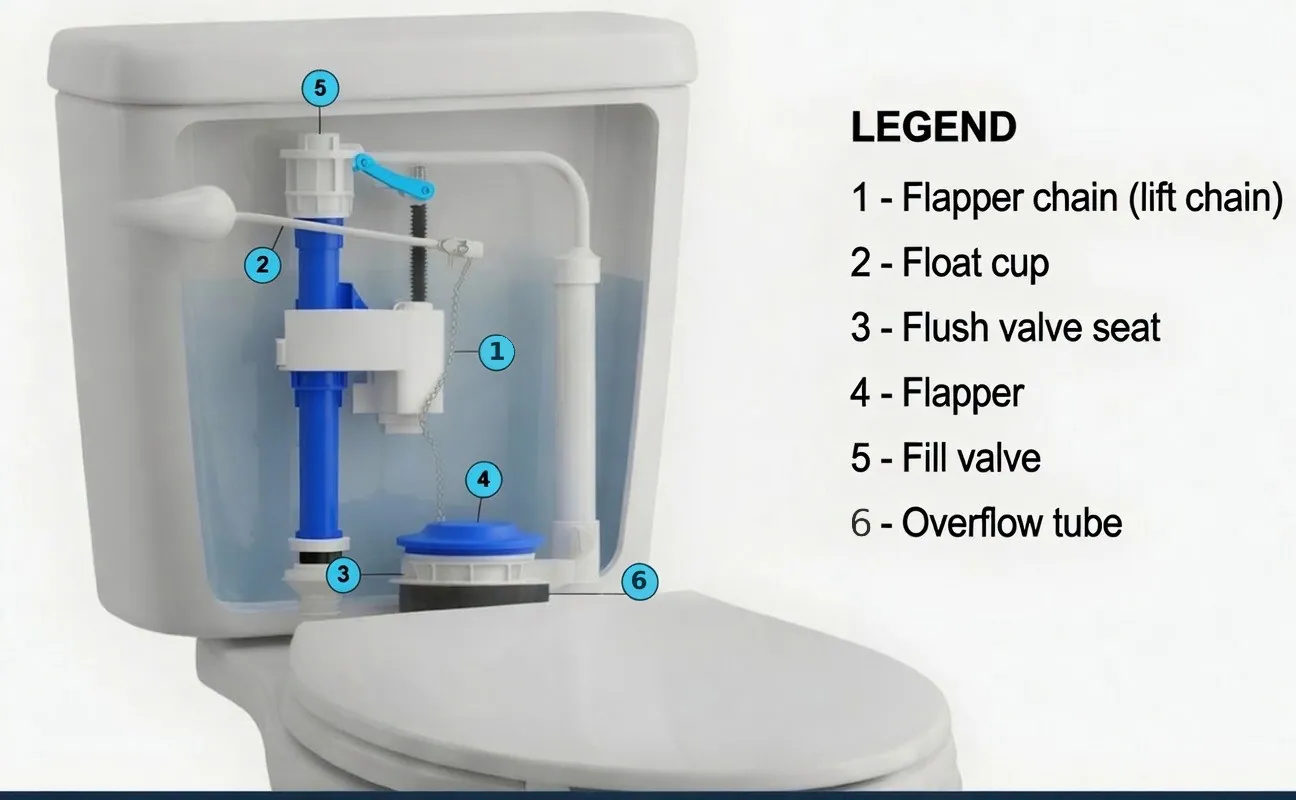
Six words worth knowing before you stand over the tank. The two in amber are the two that fail.
- Fill valve
- The tower on the left. Lets water back in after a flush and shuts it off again when the float tells it to. The fifteen-dollar part.
- Float cup
- Rides up and down the fill valve as the tank fills. Where it stops is how high the water goes, and it adjusts.
- Flapper
- The rubber lid over the hole in the floor of the tank. Lifts to flush, drops to seal. The six-dollar part.
- Flush valve seat
- The rim the flapper closes against. Pitted or crusted with lime, a brand-new flapper still will not hold, which is why the second flapper sometimes does not fix it either.
- Flapper chain
- Also called the lift chain. Runs from the handle arm down to the flapper. Too slack and it will not lift; too tight and it will not sit back down.
- Overflow tube
- The open pipe standing beside the flapper. It is what you set the water an inch below, and if the fill valve ever runs on, it sends the water into the bowl instead of onto the floor.
A toilet that will not stop running is not a plumbing emergency. That is precisely why it goes on running, sometimes for years, in a bathroom nobody much uses.
Here is what it is costing.
The Environmental Protection Agency puts the average household’s leaks at more than 9,300 gallons a year, and says nine per cent of homes are leaking fifty gallons a day or more — with a worn toilet flapper at the head of the list of causes. Their own advice is that a flapper ought to be replaced every five years whether it is misbehaving or not, because when the rubber goes the toilet will either flush by itself or leak silently.
Nine thousand gallons is not a number anybody can picture, so here is another way to hold it. It is a bathtub filling itself and emptying itself, over and over, every day, all year, in a room you walk past.
🧪 The Free Test, and It Takes Ten Minutes
Food coloring in the tank
Take the lid off the tank, put a few drops of food coloring in the water, and leave it ten minutes without flushing. If color turns up in the bowl, the flapper is leaking. Do it in every bathroom in the house. It costs nothing, it needs no tools, and it finds the leak that never made a sound.
The flapper — about six dollars, ten minutes, no tools
The flapper is the rubber disc at the bottom of the tank that lifts when you press the handle and drops back to seal. Rubber perishes. That is the whole story.
Shut the water off at the little valve behind the toilet, flush to empty the tank, unhook the old flapper from its two ears and the chain from the handle arm, hook the new one on. Turn the water back on. That is it. There is no tool in the job at all.
Take the old one to the store with you. They are not all the same and the picture on the packet will not tell you.
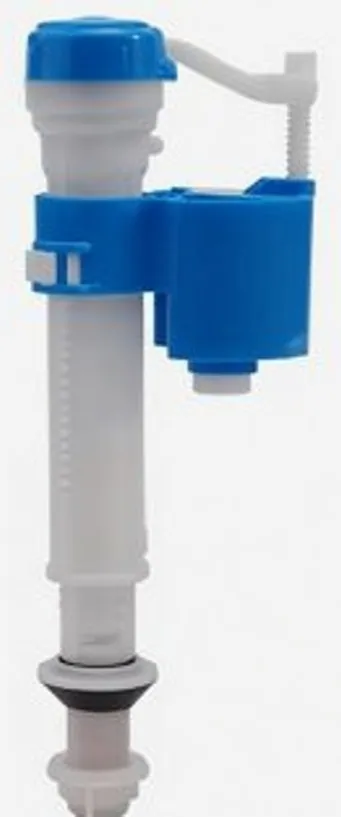
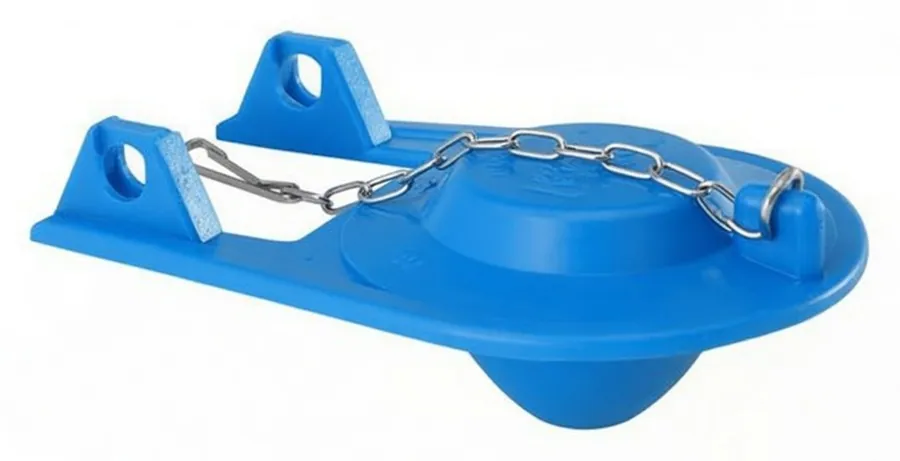
The fill valve — about fifteen dollars, twenty-five minutes, one wrench
If the dye test is clean and the thing still runs, the trouble is the fill valve — the tall column on the left that lets water back in and is supposed to know when to stop.
Shut off, flush, sponge the last inch out of the tank, put a towel under it. There is one plastic nut underneath the tank holding the valve in and one holding the supply line on. Both come off by hand more often than not, and with a wrench when they do not. New valve in, nut up hand tight and then a gentle nudge, supply line back on, water on, set the float so the water stops about an inch below the overflow tube.
A plumber charges a call-out minimum for this. It is fifteen dollars and one nut.
🚰 The Tap That Went Weak
Watch it done before you do it
Do not start this repair from reading alone. Go and watch two or three people do this exact job all the way through, and keep watching until you can see what every one of them does the same way. Fifteen minutes, and it is the difference between following along and guessing.
Somebody says the water pressure in their kitchen has gone bad. Nine times in ten the pressure is perfectly fine and the little screen in the end of the spout is full of grit and lime.
It unscrews. That is the entire repair.
Turn it anticlockwise as you look up at it — by hand usually, and with pliers and a rag round the chrome if it is stuck. Inside there is a screen and a plastic insert. Soak the lot in white vinegar for an hour, brush it with an old toothbrush, put it back the same way round it came out.
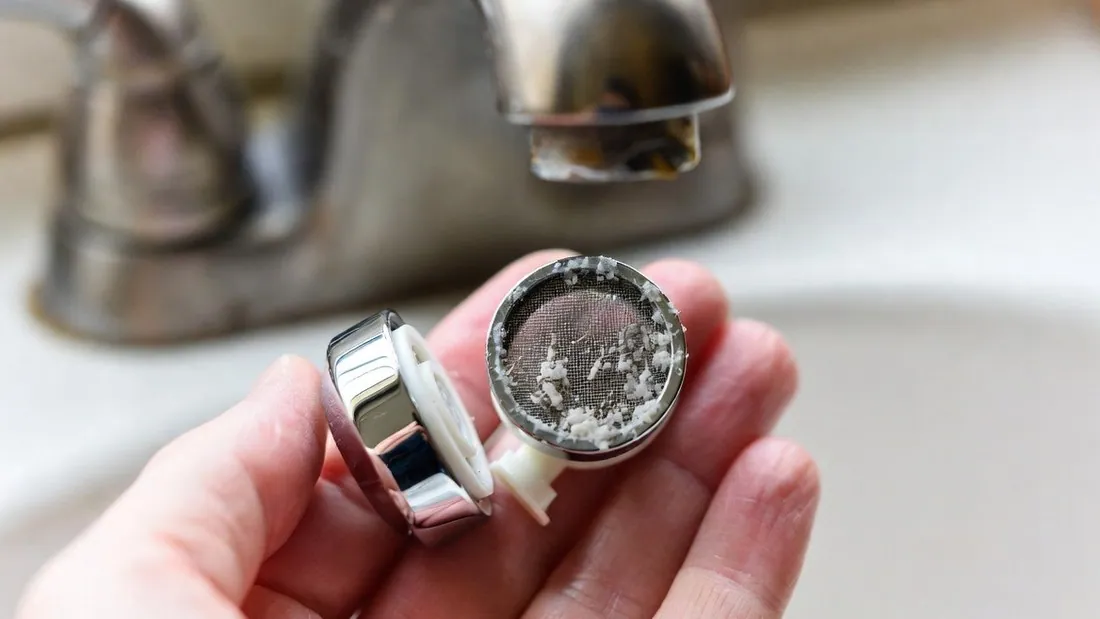
Five minutes. No money at all, unless the screen is torn and wants replacing, which is about three dollars.
If every tap in the house is weak at once, this is not your problem — that is a pressure question for the whole house and a different conversation. One weak tap is an aerator. Nearly always.
🧵 The Twenty Dollars That Prevents the Flood
Watch it done before you do it
Do not start this repair from reading alone. Go and watch two or three people do this exact job all the way through, and keep watching until you can see what every one of them does the same way. Fifteen minutes, and it is the difference between following along and guessing.
This one is not a repair. Nothing is wrong yet. That is the point of it.
Behind every toilet and under every sink there is a short flexible line carrying water to the fixture. On older work those are rubber with a woven jacket, and rubber has a life. When one lets go it does not drip. It opens, and it goes on delivering house pressure into the room until somebody turns it off.
If that happens while you are at the shops, you come home to a wet floor. If it happens while you are at your daughter’s for a fortnight, you come home to a different house.
Braided stainless lines cost about ten to fifteen dollars and take twenty minutes. Shut off the little valve, unscrew the old line at both ends with an adjustable wrench, screw the new one on hand tight and then a quarter turn. No thread tape — these seal with a rubber washer and tape only makes a mess of it.
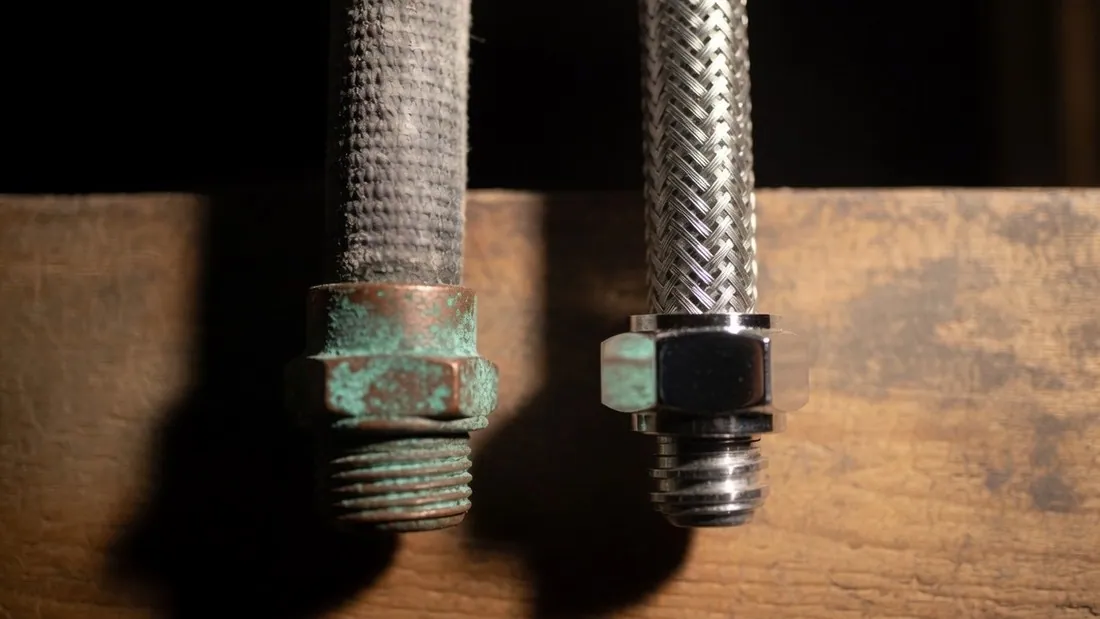
Do the washing machine hoses at the same time. Those are the biggest ones in the house and they carry pressure every hour of every day, and they are behind a heavy appliance where nobody has looked since it was delivered.
🗓️ What to Write on the Tag
Put the date on it
A strip of masking tape on the new line with the year written on it in marker settles the question forever. Otherwise, ten years from now, somebody is standing there wondering whether these are the old ones, and wondering is how they end up staying in another ten years.
🛠️ The Wax Ring, and Who Helps You Lift It
Watch it done before you do it
Do not start this repair from reading alone. Go and watch two or three people do this exact job all the way through, and keep watching until you can see what every one of them does the same way. Fifteen minutes, and it is the difference between following along and guessing.
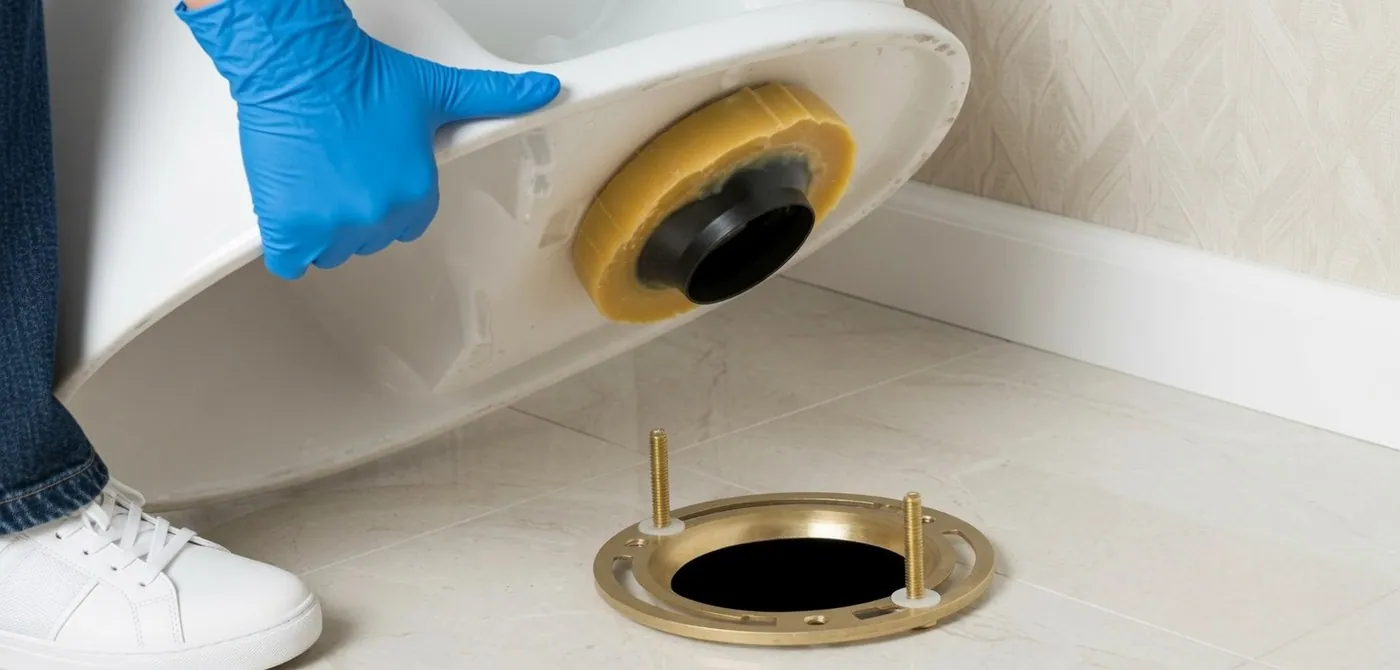
A toilet that seeps at the floor, or rocks slightly, or has left a stain on the ceiling below it, usually wants a new wax ring. The ring is the seal between the bottom of the toilet and the pipe in the floor, and it is made of wax because wax does not perish. It just gets squashed flat over thirty years, or the toilet gets rocked loose and breaks the seal.
The part costs about eight dollars.
Now, the honest difficulty here is not the plumbing. Every step of it is simple. The difficulty is that a toilet weighs somewhere between sixty and a hundred pounds and has to come straight up and be set down again without being dropped.
Which is a job for a homeowner, or for a homeowner and a couple of friends, and that is a perfectly respectable way to own a house.
It is also the argument of this entire site standing in a bathroom. The tools do not care whose hands are on them. You are not hiring strength — you are hiring somebody to know what to do, and the knowing is on this page for nothing.
💡 The Trick That Halves the Weight
Take the tank off first
On a two-piece toilet the tank comes off the bowl on its own with two or three bolts inside it. That is thirty-five pounds set aside before anybody lifts anything. What is left is awkward rather than heavy, and two people manage it easily. On a one-piece it all comes together and that is a three-person job — know which you have before you start.
The order of it: shut the water off and flush, sponge the tank and the bowl dry, take the supply line off, take the tank off, prise the caps off the two bolts at the floor and undo the nuts, rock the bowl side to side until the old wax lets go, lift it away and lay it on an old towel.
Scrape the old wax off the flange and off the bottom of the toilet. It is unpleasant and it takes ten minutes. New ring on, toilet back down square over the bolts, press it down with your weight and do not rock it back and forth once it is seated.
⚠️ Two Things That Stay Flat
Read these before you start
Do not overtighten the floor bolts. Snug, alternating side to side, and then stop.
Porcelain does not bend, it cracks, and it cracks at the last quarter turn.
If the floor around the toilet is soft or spongy underfoot, stop. A soft floor means
water has been getting into the subfloor for a long time, and that is a structural repair and not a
wax ring. Putting a new seal on a rotten floor hides the problem and does not fix it.
Never reuse a wax ring. They seal once.
One more thing worth knowing before you buy the part. There are waxless seals now — rubber or foam instead of wax — and they cost a few dollars more. The reason to consider one has nothing to do with how well it seals.
Wax seals once. Set the bowl down crooked and you take it back up and start again with a new ring. A waxless seal can be lifted and set down a second time without being spoiled, which is worth the extra few dollars on the day three people who have never done this before are trying to land a heavy thing squarely over two bolts none of them can see.
🪑 The Ten-Minute One That Changes the Most
Watch it done before you do it
Do not start this repair from reading alone. Go and watch two or three people do this exact job all the way through, and keep watching until you can see what every one of them does the same way. Fifteen minutes, and it is the difference between following along and guessing.
Two bolts, usually plastic, usually reachable from underneath the back of the bowl. Ten minutes and about twenty-five dollars.
It is on this page because of what else it can do while it is off.
Standard toilets sit around fifteen inches to the rim. A comfort-height or right-height toilet sits about seventeen to nineteen, which is chair height, and the difference between those two numbers is the difference between standing up out of a chair and standing up out of a hole.
You cannot change the bowl in ten minutes. But a thicker seat, or a raised seat, buys you a good part of it for the price of a seat, and it comes off again when the person who needed it does not any more.
There is a calculator on this site that works out the right height for a particular person rather than a general one. It is worth two minutes before you buy a seat.
🔑 Find the Main Shutoff Before You Need It
Watch it done before you do it
Do not start this repair from reading alone. Go and watch two or three people do this exact job all the way through, and keep watching until you can see what every one of them does the same way. Fifteen minutes, and it is the difference between following along and guessing.
This is not a repair either, and it may be the most valuable quarter of an hour on this whole site.
Somewhere there is one valve that stops all the water coming into your house. Most people have never touched theirs. Some could not tell you within thirty feet where it is.
Go and find it. Then turn it off, and turn it back on.
That second part is the part people skip, and it is the part that matters. A valve that has not moved in twenty years is very often a valve that will not move at all, and the night a line lets go at eleven o’clock is a poor time to find that out with water coming through a ceiling.
If it will not turn by hand, that is a real finding and worth a plumber’s visit on a calm Tuesday rather than an emergency call-out on a wet Saturday. Ball valves — the sort with a straight lever — are far better than the old round wheel sort, and swapping one is an hour of somebody’s time.
While you are down there, find the little valves behind each toilet and under each sink and work those too. Those are the ones you will actually reach for, and they seize just as readily.
Then tell somebody else in the house where it is. A shutoff only one person can find is half a shutoff.
The whole of this, for all three utilities, is on its own page. Where the water shuts off and whether your utility will let you use it, the quarter turn that stops the gas, the panel and the main breaker, and what to do walking back into a house that has flooded — water, gas and electric shutoffs, and where yours are.
📡 Catching It While It Is Still Cheap
Everything above assumes somebody is there to notice. The reason water does real damage to a house is almost never the size of the leak. It is the number of days.
There are three ways to shorten that, and they cost three different amounts.
The free one — read your own meter
Turn off every tap and appliance in the house, go out and read the water meter, then leave it two hours without a drop being used and read it again. If the numbers moved, water is going somewhere it should not.
That test finds the running toilet, the dripping tap and the line weeping under the house, and it costs nothing but the walk out to the meter.
The cheap one — a puck on the floor
Most alarm and home security systems now sell a small flood sensor that sits on the floor and hollers when it gets wet. They are cheap, they run for a year or two on a battery, and they will call your telephone from two states away.
But be clear about what they catch, because it is easy to put one in the wrong place. A puck beside a toilet will never once notice a running toilet — that water goes into the bowl and down the drain and never touches the floor. What the puck catches is the sudden failure: a supply line letting go, a cracked tank, an overflow, a wax ring beginning to seep.
So the dye test and the meter catch the quiet leak. The sensor catches the fast one. They are two different jobs and you want both.
Where to put them, in the order that matters:
- The water heater, and it is not close. They fail from the bottom, they fail without warning, and they hold forty or fifty gallons ready to go.
- Behind the washing machine. Biggest hoses in the house, and nobody has looked back there since delivery day.
- Under the kitchen sink — a cabinet floor with a leak in it can stay wet for months before it shows anywhere you can see.
- Under bathroom vanities, then the dishwasher, then the base of each toilet.
The one that catches everything — and you have it fitted
A flow monitor sits on the main line and watches for water moving when nothing in the house should be running. That is the signature of every leak on this page at once, including the silent ones the puck cannot see, and the better ones will shut a valve on their own when the pattern looks wrong.
That one goes on the main, which puts it on the far side of the line this site draws. You choose it and you have somebody fit it.
Why the slow ones cost more than the loud ones, and why insurance usually will not pay for them, is on the page about the bills that come after the mortgage. Every yearly check, the toilet test included, is on the once-a-year house checklist.
💵 Twenty Years of This, Added Up
Nothing on this page happens once. That is the part people miss when they work out whether a job is worth learning.
A flapper is not a thing you replace. It is a thing you replace every four or five years, in every toilet you own, for as long as you own the house. The same goes for most of this list. So the honest question is not what one repair costs. It is what the whole habit costs across the twenty years between signing the papers and handing them on.
| The job | How often | Part | In 20 years | If you call somebody |
|---|---|---|---|---|
| The flapper | every 4–5 years, per toilet | about $6 | 4–5 times | ~$130 a visit |
| The fill valve | every 4–5 years, per toilet | about $15 | 3–4 times | $100–200 a visit |
| Toilet supply lines | every 5–7 years | $10–15 | 3 times | folded into a call-out |
| Washing machine hoses | every 3–5 years | $20–25 a pair | 4–6 times | folded into a call-out |
| The aerator | whenever the tap goes weak | nothing but vinegar | many times | you are paying the minimum |
| The toilet seat | every 5–10 years | about $25 | 2–3 times | $60–190 a visit |
| The wax ring | when the toilet comes up | about $8 | once or twice | $150–300 a visit |
Run an ordinary house through that — two toilets, a washing machine, the taps — and the parts bill for two decades lands somewhere around three to four hundred dollars. Spread over twenty years that is about the price of a takeaway a year.
Hired out, the same two decades runs to several thousand.
Why the gap is that wide, and it is not the labor
A plumber replacing a six-dollar flapper is not charging you for twenty minutes of skill. He is charging you for the truck, the fuel, the hour he could have spent elsewhere and the hour he will spend getting to the next house. That is a one- to two-hour minimum on a twenty-minute job, plus a trip charge, plus a markup on the part.
Which means the arithmetic is lumpy rather than proportional. One flapper on its own is most of two hundred dollars. Six jobs done on the same visit are barely more than one. And over twenty years these do not arrive together — they arrive one at a time, years apart, each one its own separate minimum. That is the whole of the difference.
So if you are going to hire it out, hire it all out at once. Walk the house first, write the list, and have somebody do the lot in one visit. Nothing on this page is urgent except a wax ring already seeping, so there is no reason to buy the same call-out six separate times. That one decision saves more than any single repair on the list.
Two honest warnings about these numbers. The professional figures are national averages off the big estimating sites, and those skew high — a small independent plumber in a country town will often quote well under them. And the sources disagree with each other by a lot; a wax ring alone came back anywhere from fifty dollars to three hundred depending on who was asked.
So take the shape of this rather than the digits. Ring two plumbers in your own town and ask what their minimum call-out is. That single number tells you more about what these jobs are worth learning than any table on the internet, this one included.
And there is one line on that list where hiring it out is still the right answer. The main shutoff, if it will not turn, is a job that takes the water off the whole house and sometimes a permit with it. That one belongs to somebody else, and it is on the leave-it list further down for exactly that reason.
And plumbing is only one corner of the house. The same arithmetic runs through the water heater, the dryer vent, the caulk and the gutters — we have added it all up in twenty years of small jobs, added up, including the one row on that table where the honest answer is to pay somebody.
🛑 The Short List of Things to Leave Alone
Everything above is a nut, a washer or a rubber part. These are not, and the difference is worth being plain about.
Gas water heaters. The tank, the burner, the flue and the gas line all stay somebody else’s work.
Anything soldered, and anything behind a wall or a ceiling. If the repair starts with opening the house up, it is not on this list.
The main shutoff itself, if it will not turn. Finding out is your job. Replacing it is not.
A soft or spongy floor. Around a toilet, under a sink cabinet, anywhere. That is rot in the structure and a new seal on top of it only hides how long it has been going on.
Sewer smell that will not go away, or more than one fixture backing up at once. That is the main line and it wants a camera, not a hand tool.
Water that has been standing in a house for days. Once carpet, plasterboard and cabinet bases have been wet a while, drying it out properly is its own trade and getting it wrong grows things you cannot see.
⚖️ Why These Belong on the List
Look back at what is actually on this page.
A six-dollar rubber flapper. A screen soaked in vinegar. Two braided hoses. A valve turned off and on again. A packet of wax. Not one of them is difficult and not one of them is expensive.
What every one of them has in common is that nothing goes wrong today.
That is what makes them easy to leave, and it is exactly what makes them worth doing at fifty rather than at seventy-five. At fifty you get under the sink because you happened to think of it. At seventy-five you get under the sink because water is coming through the kitchen ceiling, and getting under a sink is a different proposition by then, and so is finding somebody who can come out today.
The flapper costs the same six dollars either way.
What changes is whether you were on your knees on a Saturday afternoon with a cup of coffee going cold on the counter, or on the telephone at eleven at night trying to explain to a stranger where your water shutoff is.
Winter has its own version of that same afternoon: taking the garden hose off and sleeving the cold runs, months before anything is wrong.
And you cannot answer that second question unless you went and found it on some ordinary afternoon, years earlier, when nothing whatever was wrong.
Before You Close This Page
Put a few drops of food coloring in every toilet tank in the house.
Then leave them ten minutes without flushing and look in the bowls. It costs nothing, it needs no tools, and it is the only way to find the leak that has never once made a sound. You will know before supper whether you have one.
If color turns up in a bowl, that toilet has been running money down the drain for somewhere between a month and a decade. The part that fixes it is six dollars.
And that is the whole argument on this page in one evening. Ten minutes and no money tells you whether the next twenty years cost you about three hundred and fifty dollars in parts or several thousand in call-outs. Nobody has to decide anything tonight. Go and look.
Elsewhere on this site, if it is useful:
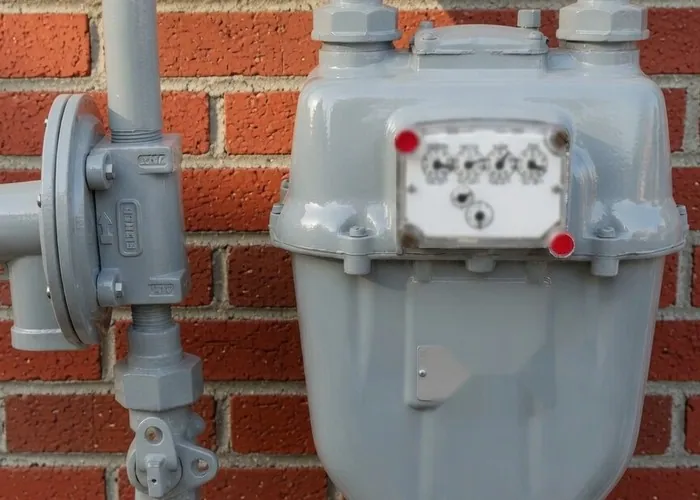
where the water, gas and electric shut off
Three valves, one afternoon, and the order of operations for going back into a flooded house.
Read the guide →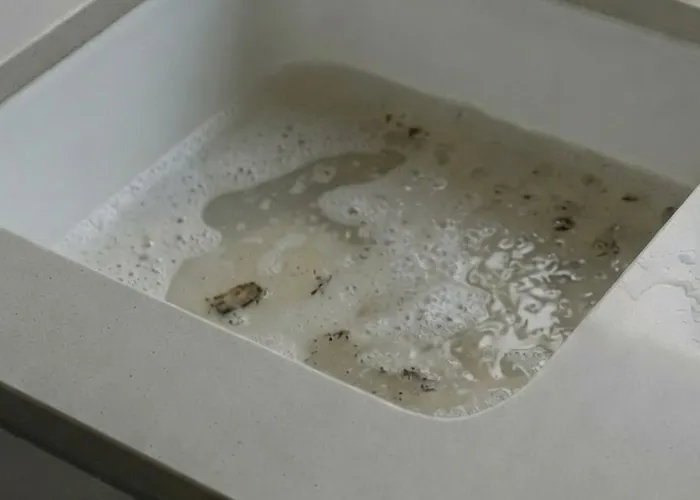
the loud half — stopped toilets and stopped drains
The other two calls, the three cheap tools that settle them, and why the same auger costs twice as much at one store as at another.
Read the guide →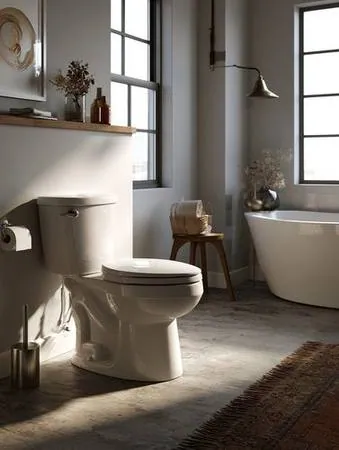
what height that toilet ought to be
Worked out for a particular person rather than a general one. Two minutes, and worth it before you buy a seat.
Open the calculator →
the forty small things that cost people their houses
Not the roof. Forty little jobs across eight years, every one reasonable to have put off.
Read the guide →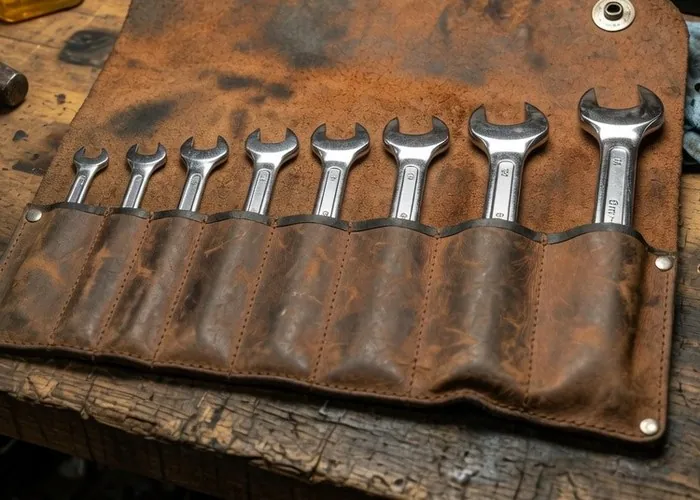
never mind the brand, these are the sizes
Which wrenches, which sockets, which pliers. Including the one wrench nothing else on this page can replace.
Read the guide →What This One Buys You
The leak you found instead of the one that found you.
Every job on this page is small, cheap and entirely optional today. That is the whole trap. Done on an ordinary afternoon they cost an hour and forty dollars; left alone they choose their own moment, and it is never a convenient one, and by then the price is not forty dollars any more.
❓ Plain Answers
The short version of this page, one question at a time — the answer is always the first line.
How do I tell if my toilet flapper is leaking?
Put a few drops of food coloring in the toilet tank and wait ten minutes without flushing; if color turns up in the bowl, the flapper is leaking. The test costs nothing and needs no tools.
How much does it cost to fix a running toilet?
A running toilet usually needs a new flapper, which costs about six dollars and takes about ten minutes with no tools. If the dye test is clean and it still runs, the fill valve is the likely culprit, at about fifteen dollars.
How often should a toilet flapper be replaced?
The Environmental Protection Agency advises replacing a toilet flapper every five years whether it is misbehaving or not. When the rubber goes, the toilet will either flush by itself or leak silently.
Why is the water pressure weak at just one faucet?
Weak pressure at one faucet is nearly always a clogged aerator, the little screen in the end of the spout, full of grit and lime. Unscrew it, soak it in white vinegar for an hour, brush it and put it back. If every tap is weak at once, that is a whole-house pressure question.
Should I replace the rubber water supply lines under my sink and toilet?
Old rubber supply lines are worth replacing with braided stainless lines before they fail, because a rubber line that lets go keeps pouring water until somebody shuts it off. Braided lines cost about ten to fifteen dollars and take twenty minutes.
What should I do if my toilet shutoff valve is plastic and will not turn?
If a plastic shutoff valve behind the toilet does not turn easily by hand, leave it completely alone and shut the water off at the main instead. Forcing brittle plastic can snap the glued joint inside the wall and cause a flood.