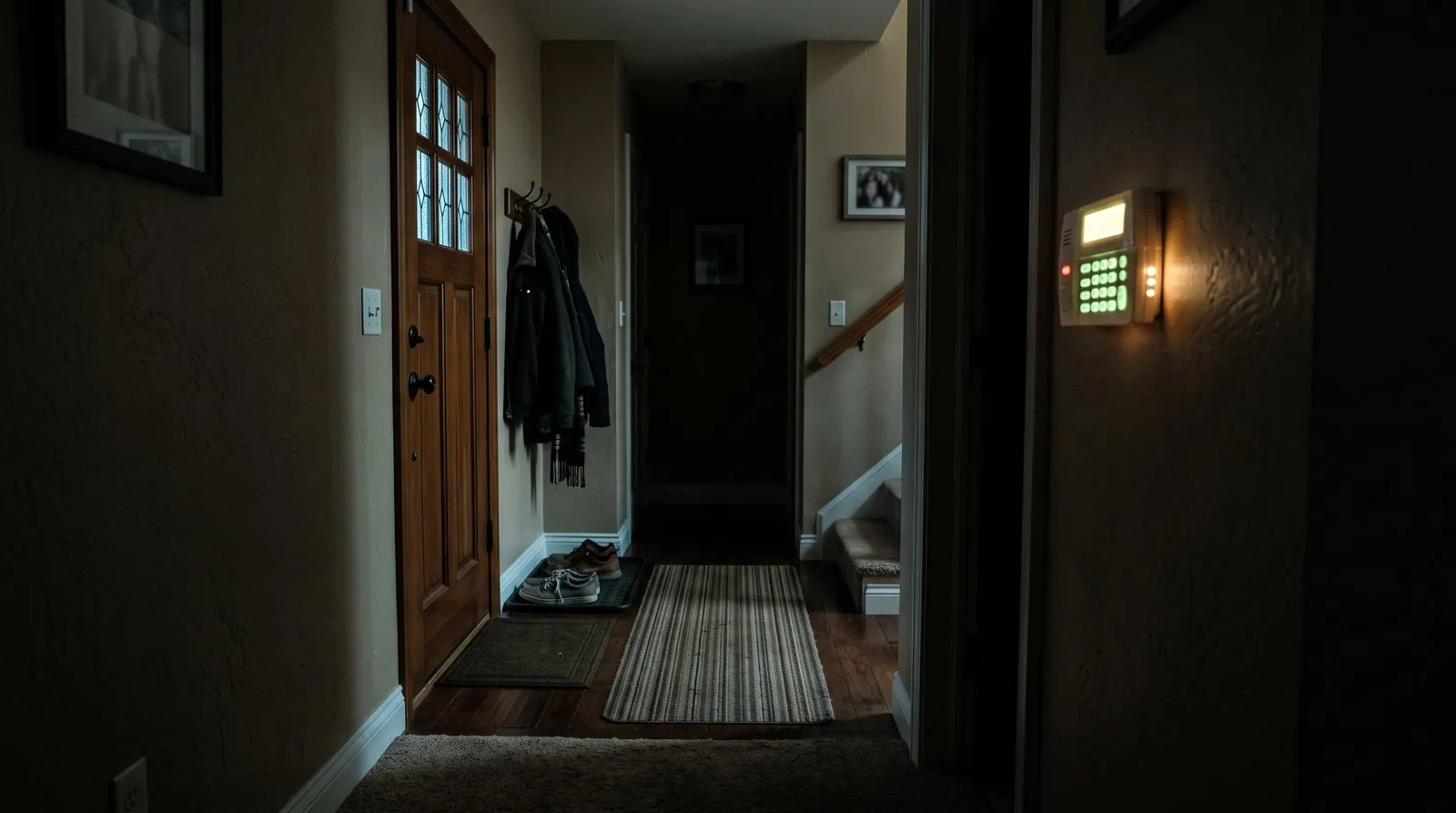
🔔 Start by Being Honest About What a Siren Is
A siren going off at three in the morning is not security. It is an intrusion.
Think about what has to have already happened before you hear it. Somebody is through the window, or across the threshold, or standing in your kitchen. Every part of the arrangement that was meant to keep him outside has finished its work and lost. What the siren does is inform you of the result.
That is not nothing, and this page is not an argument against alarms. Noise genuinely does send people out of houses. A man who has been quiet for two minutes and is suddenly the loudest thing on the street has lost the only advantage he came with. But the ordering matters, because ordering is how you decide where the money goes.
So if you are buying a siren at all, buy a loud one — loud enough that the neighbors hear it with their windows shut. That is where most of the value of the noise actually goes. People go to the window. Their porch cameras and their doorbells catch whoever is leaving and which way he went. Some of them come over. And if for any reason you were not able to get to the telephone yourself, they are the ones dialing 911. A siren that can only be heard inside your own house is talking to the one person who already knows.
Check it from next door. Set the alarm off on purpose once, in daylight, with a neighbor warned, and have somebody stand on their porch with the doors closed. If they can barely hear it, add an outdoor siren — most systems sell one that pairs with the base station without any wiring.
The hardware is what stops it happening. The electronics tell you that it is happening. You sleep on the first kind. You get woken up by the second. Both are worth owning, and almost everybody buys them in the wrong order — because four dollars of long screws has nobody advertising it, and the alarm comes with a website, a van and a man on the telephone.
So the rule this page runs on: fit the hardware first, and then decide what you want the electronics for. The deadbolt with four-inch screws behind it, the bar on the basement door, the lit driveway, the thorny planting under the windows — all of that is on the security page and none of it costs a monthly bill. Get that done and the alarm becomes a considered purchase rather than the whole plan.
🎛️ Two Roads, and Neither One Is Wrong
There is really only one decision here, and every other question is downstream of it. When a sensor trips, who does something about it?
From that point the road forks, and this is not a case where one branch is the sensible answer and the other is for people who did not read carefully. They are two genuinely different purchases for two genuinely different situations, and the thing that decides between them is usually not the burglary at all. Here is each one with its case made honestly and its costs printed rather than buried.
Self-Monitored — You Are the Monitoring Station
The sensor trips, your telephone buzzes, and the decision is yours. You look at it, you work out whether it is the cat or the back door, and if it needs calling in you call it in yourself. Either no monthly bill at all, or a small one for camera recording.
What is genuinely good about it:
- No bill, or nearly none. Over ten years that is thousands of dollars that stayed in your account, and it is the single largest number in this whole category.
- Nobody can put the price up. Equipment you own outright cannot be repriced, rebranded into a higher tier, or discontinued underneath you.
- No permit trouble in most towns, because nothing is being dispatched on your behalf. You call the police yourself, as a person who has seen something — which is a different kind of call altogether from an automated one.
- You are faster than a monitoring center when you are home. You are in the building. Nobody has to ring you first to check. A monitoring center rings you before it rings the police, and in a growing number of towns and states it is required to try a second number as well before it may ask for a car. When you dial 911 yourself, all of that is skipped — there is no telephone call in between, and seconds count.
- It suits somebody who is home most of the time, which describes a great many retired people and is not a small category.
What it honestly costs you:
- It does nothing at all when you cannot pick the telephone up. Asleep, in the shower, on the floor, in hospital, or the phone is charging in the other room on silent. That is the whole of the gap, and everything else on this list is a detail beside it.
- Nobody calls the fire service for you. If the alarm going off is a smoke detector and you are inside the house, there is no second person in this arrangement.
- Cellular backup usually sits on a paid tier. So on many systems, self-monitoring and "still works when the power is out" are the same decision pointing in opposite directions — see the outage section below before you assume you have both.
- It depends on you responding every time. After the fourth false alert from a sunbeam, most people start swiping the notification away without reading it, and that is a real failure mode rather than a hypothetical one.
- There is nobody to call your family. A monitoring center works down a contact list. Self-monitoring has a list of one.
Professionally Monitored — Somebody Else Is Awake
The sensor trips and a person at a desk in another state sees it first. They ring you. If you do not answer, or if you answer and say the word, they call your police or fire department, and then they start working down the list of people you gave them.
What you are actually buying, and it is not what the advertising says:
- Somebody who acts when you cannot. That is the entire product. Every other benefit on this list is a version of it.
- Fire and carbon monoxide get called in whether or not you are conscious, and whether or not anybody is home. This is the part the burglar-heavy advertising undersells badly, and for most households it is the strongest single argument on the page.
- A contact list that gets worked. Your daughter in another state gets a phone call from a human being rather than finding out on Tuesday.
- Cellular backup is normally included, so the system keeps talking to the outside world when the power and the internet are both down — which is exactly the week houses stand empty and streets stand dark.
- Video verification, where it is offered, is worth real money in a town with false-alarm penalties, because an operator who has looked at a camera can tell dispatch that somebody is actually there.
- The medical side, which is a large enough argument that it has its own section directly below this one.
What it honestly costs you:
- Roughly four thousand dollars over ten years at current average pricing, on top of the equipment. Not a reason against it — a number to decide with.
- The price moves and you do not control it. No contract means you may leave; it also means they may reprice.
- Permits, fines, and the possibility of non-response. Dispatch is what you are paying for, and dispatch is the thing your town can take away after enough false alarms.
- A delay by design. They ring you first. That is correct behavior and it is the whole reason false-alarm rates are survivable — but it is not instant.
- It can be cancelled by somebody else's decision. Companies get sold, plans get renamed, features migrate up a tier. Ask any long-standing customer of any of them.
Whichever road you take, put a card in the nightstand drawer with your full name, address, phone number and who else is in the house, and read it to the 911 operator. Under stress a great many people cannot say their own address correctly. What goes on the card, and the rest of the bedside plan →
And the road nobody sells you, because there is no money in it
Give a key and your mobile number to two neighbors, and take theirs. That is a response time of about ninety seconds and a cost of nothing. It will not ring the fire service at four in the morning and it is not a substitute for either road above. It handles the other three hundred and sixty things, and it is the most underrated line on this page.
The short version, if you want one. If you are home most of the time, in decent health, and the thing you are worried about is somebody trying your back door — Road One, and put the saved money into hardware. If you live alone, or you are out of the house for long stretches, or there is any chance of you being on the floor and unable to reach a telephone — Road Two, and read the next section before you choose the plan.
👑 The Button on the Chain — Where This Stops Being About Burglars
Here is the thing that decides this for more households than any burglar ever will, and it is barely mentioned in the alarm advertising because it does not photograph well.
You fall, and you cannot get up, and there is nobody in the house.
Most people picture that as a broken hip and an ambulance. The research says something less dramatic and more useful. Cambridge researchers followed a group of people over ninety for a year and found that eighty-two per cent of falls happened when the person was alone, that eighty per cent were unable to get up again after at least one fall, and that thirty per cent had lain on the floor for an hour or more. An earlier study found that forty-seven per cent of people who were not injured at all still could not get themselves up.
Read that last one twice, because it is the one that changes the argument. Getting up off a floor and being hurt are two separate questions. Plenty of people who fall are perfectly fine and simply cannot get from lying down to standing without something to pull on. If somebody is in the house, that is a ten-second problem and a slightly embarrassing story. If nobody is, it is however long it takes for somebody to notice.
Why the time itself is the injury
Clinicians call more than an hour on the floor a long lie, and they treat it as its own event rather than as a consequence of the fall. The damage it does — dehydration, pressure injuries, muscle breakdown that goes on to hurt the kidneys, low body temperature, pneumonia from lying still — accrues to people whose fall did no harm whatsoever.
The clearest figure on this comes from a study of people found helpless at home. Where help arrived within the hour, mortality was around twelve per cent. Where it took more than three days, it was around sixty-seven per cent. The long lie is also strongly associated with hospital admission and with going on to move into long-term care.
So the honest framing is not "you are frail and need a button." It is arithmetic about living alone. The thing that decides how a fall ends is not how hard you hit the floor. It is how long you are on it — and the only variable you can buy is who finds out, and how soon.

What the pendant does that the wall keypad cannot
This is worth being precise about, because the two get muddled constantly.
A panic button on the alarm panel, or a key fob in a drawer, is in a fixed place. The bathroom is where a great many falls happen, and the keypad is in the hall. A button around your neck is the only version of this that is where you are. That is the entire difference and it is not a small one.
Two ways to buy it, and they are not the same product:
- Bundled with the alarm monitoring. Several of the big security companies sell a medical pendant on the same contract. Convenient, one bill, one app — but check the range, because a home unit typically only reaches a few hundred to a thousand feet from its base, which may not include the far end of the garden.
- A standalone medical alert service. A separate company, a separate monthly fee, and generally a wider choice of pendant, watch and mobile options with their own cellular connection. Often the better device, at the cost of a second subscription.
Automatic fall detection — what it is and what it is not
Most of these now offer a version that calls for help by itself if it senses a fall, usually five or ten dollars a month on top. It is genuinely valuable if there is any prospect of fainting or of being knocked unconscious, because it covers the case where nobody presses anything.
But it should be bought with the limits understood rather than assumed away:
- None of them work every time, and every one of them says so in the paperwork. Slow, sliding falls — the sort where somebody goes down the wall of a hallway — are the ones most likely to be missed.
- Where it is worn changes how well it works. These are calibrated for a device sitting on the chest, near the center of the body, where the motion of a fall is clearest. Worn on the wrist, ordinary arm movement looks a great deal more like a fall than it should.
- False alarms are normal. Dropping the pendant on a tile floor will do it. Every decent system gives you a window of twenty or thirty seconds to cancel before anybody is called, and you should expect to use it occasionally.
- It is a supplement to the button, not a replacement for it. Press it yourself whenever you can.
And now the finding that matters more than all of the above, because it is the same failure as the alarm nobody arms. That Cambridge study looked at whether people used the call alarms they already owned. The alarms were widely available in those households and were not used in most of the falls. Not broken. Not out of range. On the nightstand, or in a drawer, or being worn and not pressed — because the person did not want to make a fuss, or thought they would manage in a minute, or did not want to be the one who called somebody out at three in the morning.
So if you buy one, buy the one that gets worn. Waterproof, so it does not come off for the shower — which is precisely where and when it is most needed. Light enough and plain enough that it is not a thing to be embarrassed about. And have the conversation once, out loud, with whoever is on the contact list, so that pressing it is understood in advance to be the correct thing to do rather than a fuss. A pendant on the nightstand is a monthly bill for nothing.
What to ask before you sign anything
- Is this bundled with the alarm, or a separate service and a second bill?
- What is the range from the base unit — and does that cover the garden, the garage and the end of the drive?
- Is it waterproof, or only splash-resistant? Can it be worn in the shower?
- What does fall detection cost on top, and what happens in the seconds before anybody is called?
- Who do you ring, in what order, and does anybody hold a key?
- If it is a mobile unit, what is the battery life and who is responsible for charging it?
💵 Price It Over Ten Years, Not Per Month
Everything sold by subscription is quoted by the month, and it is quoted by the month for a reason. Thirty-odd dollars is a nothing number. It is a takeaway. It does not feel like a decision.
So do what you would do with any other purchase this size and put a real number on it. As of the spring of 2026, one industry tracker put the average professional monitoring plan at a little over thirty-two dollars a month and the average equipment package at about three hundred and thirty. Thirty-two dollars a month is roughly three thousand nine hundred dollars over ten years, on top of the box.
That is the number to hold in your head. Not because it is too much — it may very well be worth it to you — but because four thousand dollars is a decision and thirty-two dollars is not, and it is the same money.
And the price is not fixed, even where the contract is. One of the best-known DIY brands has moved its basic plan from about fifteen dollars to about twenty-three, and its middle plan from about twenty-five to about thirty-three, with existing customers told by email before the change landed. "No contract" cuts both ways: you are free to walk out, and they are free to reprice you. Whatever the ten-year figure is when you sign, assume it is the floor.
Do not take a monitoring price off this page, or off any review site, including the ones that look official. We went looking while writing this and found five different current prices for the same plan from five different sites, none of them the company's. Get the number from the company's own website in the week you are actually buying, and then multiply it by a hundred and twenty.
It is worth knowing what the other four thousand dollars buys, if only so the comparison is in front of you. Long screws and reinforced strike plates on every exterior door. A bar for the basement door. Security film on the ground-floor windows. Two motion floodlights. A camera that records to a card with no subscription at all. Wedge alarms for every door and contact chimes for every window. All of it, everywhere in the house, once — and you would still have most of the money left.
That is not an argument against paying for monitoring. It is the argument for knowing which of the two you are choosing, instead of drifting into the one with the direct debit attached.
📋 The Permit, the Fines, and the Words "No Police Response"
Here is the part nobody mentions at the till, and it is the part that decides whether the money you just spent does what you think it does.
Most towns require you to register an alarm system, and most of them fine you for false ones. Not the company — you.
The reason is a number that will surprise you. Fairfax County, Virginia puts the share of alarm calls that turn out to be false at between ninety-five and ninety-eight per cent. Seattle has put it above ninety-eight per cent, and reports that of roughly thirteen thousand burglary alarm calls in a recent year, fewer than four in a hundred were confirmed to involve a crime that produced an arrest or a written report. Los Angeles police handle six or seven thousand alarm calls a month and put the false share above ninety per cent.
Why your town started charging for this
Read that again from the point of view of the officer being dispatched. Ninety-odd times out of a hundred, it is a cat, a balloon, a door left ajar, a flat sensor battery, or somebody's grandchildren. So towns did the obvious thing and started charging.
- Escalating fines. Houston gives a permit holder three free false burglar alarms in a rolling twelve months, then charges fifty dollars for the fourth and fifth, seventy-five for the sixth and seventh, and a hundred each after that. Winston-Salem, North Carolina, allows three, and charges five hundred dollars each once you pass ten.
- Penalties for having no permit at all. Houston assesses a non-permitted residential alarm around a hundred and seventeen dollars per incident, before any false-alarm fine on top.
- Limits on how long the siren may sound. Winston-Salem forbids an audible alarm running more than twenty minutes. Beaverton, Oregon, gives itself the power to disable a system sounding more than fifteen minutes with nobody available to shut it off.
And then there is the one that actually matters, and it is the reason this section exists. They can stop coming. Houston revokes the permit and provides no police response after the seventh false burglar alarm. Winston-Salem places an address on "No Police Response to Burglar Alarms" after nine. Your alarm can be, quite legally and quite formally, a noise that the police department has already decided to ignore. Hold-up, panic and duress alarms are still answered — but the burglar alarm you are paying for every month is not.
None of that is an argument against having one. It is an argument for finding out what your own town does before you buy, and for treating a false alarm as a fault to be fixed rather than an annoyance to be lived with.
One phone call, three questions
Ring your police department's non-emergency number and ask: Do I need a permit for a burglar alarm? What does a false alarm cost me? And after how many do you stop coming? Five minutes, and it will tell you more about what an alarm is worth at your address than any review site will.
While you have them, ask one more, because it is worth real money to this audience and hardly anybody knows it exists. Some towns waive the permit fee for older residents. Beaverton exempts residential users aged sixty-five and over from the annual fee entirely — they still file the application, they simply do not pay for it. That will not be true everywhere. It costs one sentence to find out whether it is true where you live.
🔌 What It Does When the Power Goes Out
This site spends a great deal of its time on what happens when the electricity stops, so it would be strange to skip it here — particularly since the days after a storm are exactly when empty houses, dark streets and distracted police departments all arrive at once.
There are two separate questions and people run them together. Does the box still have power, and can the box still talk to anybody?
Power is the easy half. Almost every modern panel has a battery in it, and the usual figure is somewhere between four and twenty-four hours depending on the model and on how old the battery is. Call it a night. It is not a hurricane, and it is certainly not the four days after one.
But do not underrate that one night. When the power goes out and the whole street goes dark, a burglar assumes your alarm went with the lights. If the panel is on its battery and you are in night mode, the front door opens and the thing starts screaming anyway. The last thing he expected in a blacked-out neighborhood was an alarm that worked — and that is a hell of an advantage to have bought for the price of a battery. So when you shop, ask how long the panel runs after the power is cut; the answer runs from a couple of hours to a couple of days depending on the make and model. And replace the batteries in the sensors once a year, so they are fresh the night it matters.
Talking to the outside world is the half that catches people
Talking is where the real differences are, and it is worth knowing which of these you have bought:
- Cellular. The panel has its own SIM card and reaches a mast the way your telephone does. A local power cut does not touch it as long as the panel battery holds. This is the one that works, and on most systems it lives on a paid tier — which is worth knowing, because it means "I self-monitor to avoid the fee" and "my alarm still works in an outage" are often the same decision pointing in opposite directions.
- Wi-Fi or internet only. Your router goes down with the power, and everything outside the house goes quiet with it. The siren still sounds in the room. Nobody's telephone buzzes, and no monitoring station hears a thing.
- A "landline" that runs through the internet box. Millions of houses now have one of these and think of it as a phone line. It is not. It dies with the power exactly like the router does, because it is the router.
- An actual copper telephone line carries its own low voltage from the exchange and will generally keep working when your house is dark. Which was a fine arrangement, and is why alarms were built this way for forty years. Most people no longer have one. The disappearance of the copper line is the single reason cellular backup went from a luxury to the thing that makes the system function at all.
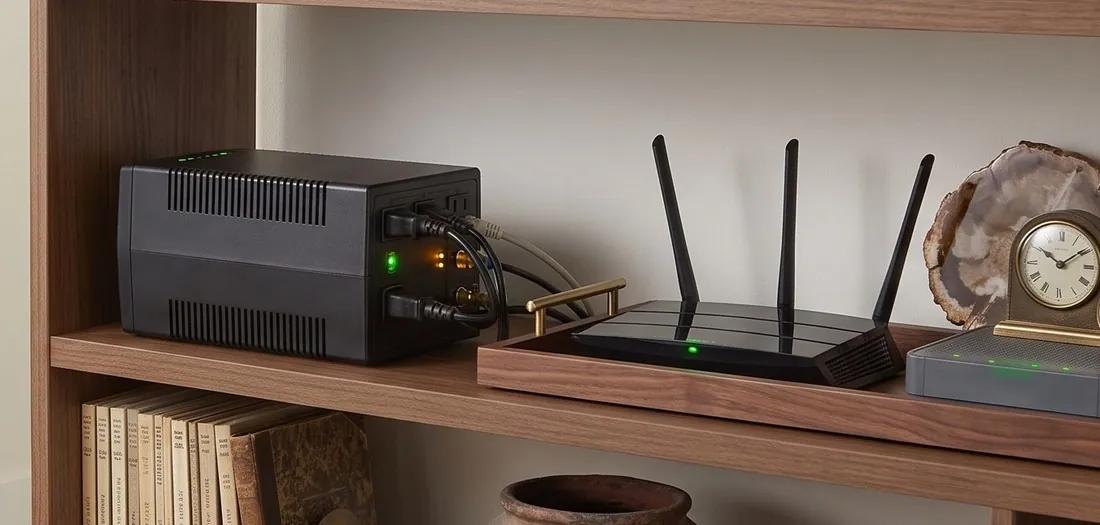
The cheap repair, if you are self-monitoring over Wi-Fi and do not want a monthly bill: put a small uninterruptible power supply under the router. Thirty minutes of desk-size battery keeps the router, the panel and the cameras talking for a few hours instead of zero, and it costs less than three months of monitoring.
🔑 A System You Do Not Arm Is Worth Nothing
This is the same rule as the bar you never drop and the deadbolt you never turn, and it is the one that quietly wastes more money than any other mistake on this page. The most common failure of a home alarm system is not that it was defeated. It is that it was switched off.
People stop arming them for entirely reasonable reasons. The dog sets it off. You got fined twice. The grandchildren came for the weekend and nobody could remember the code. Or the plain one: you cannot reliably get from the door to the keypad and enter four digits in thirty seconds with shopping in both hands, so the third time it shrieks at you, you stop turning it on.
Design against that on the day it goes in, not in five years:
- Put the keypad by the door you actually use. Almost everybody has the keypad at the front door and comes in through the kitchen or the garage, every day, for years.
- Set up a one-button night mode — doors and windows watched, motion sensors off. This is the mode that matters most in this house, because you are home and asleep, and it is the mode that lets you get to the bathroom at two in the morning without waking the street. And use it every night, when you go to bed. Most people with an alarm arm it when they leave the house and never when they are asleep in it, which is exactly backwards — an empty house loses a television, but you are the thing in it worth protecting.
- Zone the dog out. If the dog sleeps in the back room, that room's motion sensor comes off the night circuit. A system that shouts at the dog will be off within a fortnight.
- Practice the disarm with the lights off, the way you would practice anything else you might have to do half asleep and frightened. Everybody in the house, once.
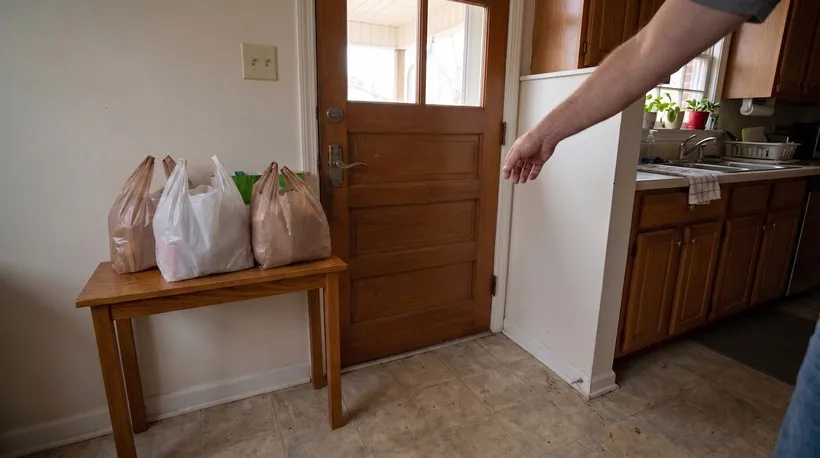
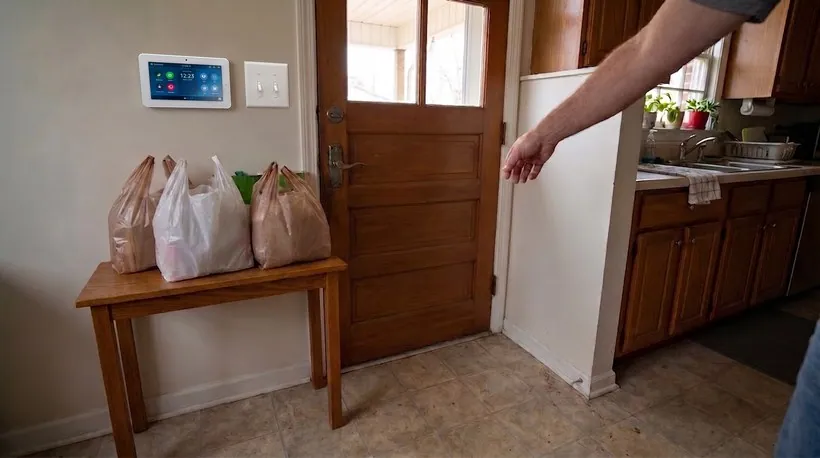
The same door, twice. On the left, the panel is around the corner by the front door — the door nobody in this house has used in a year. On the right it is where the hands and the shopping actually arrive, four times a day. That is the whole difference between a system that is still armed in five years and one that got switched off in the first fortnight, and it is decided on the morning the installer asks where you would like it.
The sign does a job the siren does not
Worth saying plainly, because it cuts both ways. In the Charlotte study of over four hundred convicted burglars — funded, and we say so every time we cite it, by the alarm industry's own research foundation — about eighty-three per cent said they tried to work out whether there was an alarm before going in, and around sixty per cent said they would go and find a different house if they found one.
Notice what that means. Nearly all of that deterrent value is delivered by the evidence of a system, standing in the flowerbed, in daylight, before anything happens. It is delivered by the sign and the sticker and the little box on the wall. It is not delivered by the siren, which only ever speaks after the decision has already been taken.
Which leads to the question people ask quietly and are usually given a dishonest answer to: can you just buy the sign? Yes. It is a few dollars, and on the evidence above it does most of the deterrent work. And it does nothing else whatsoever. It does not wake you, it does not call anybody, it does not know your smoke detector went off, and it is not there at all on the night somebody comes anyway. Buy it if you understand you are buying a bluff. Buy it as well as, and it is the cheapest thing you will ever add to a real system.
And check your own local code before any of it goes in. Alarm permits are only the start of it. Hard-wiring a panel or a siren, running low-voltage cable through walls, fitting a smoke or carbon monoxide detector to a monitored system, and recording audio are all governed somewhere, and the rules differ by state, county and town. Renters, condominium owners and anybody in an HOA have a second set on top. Ask the building department and read the lease before you buy, not after.
🚪 What the Parts Actually Do
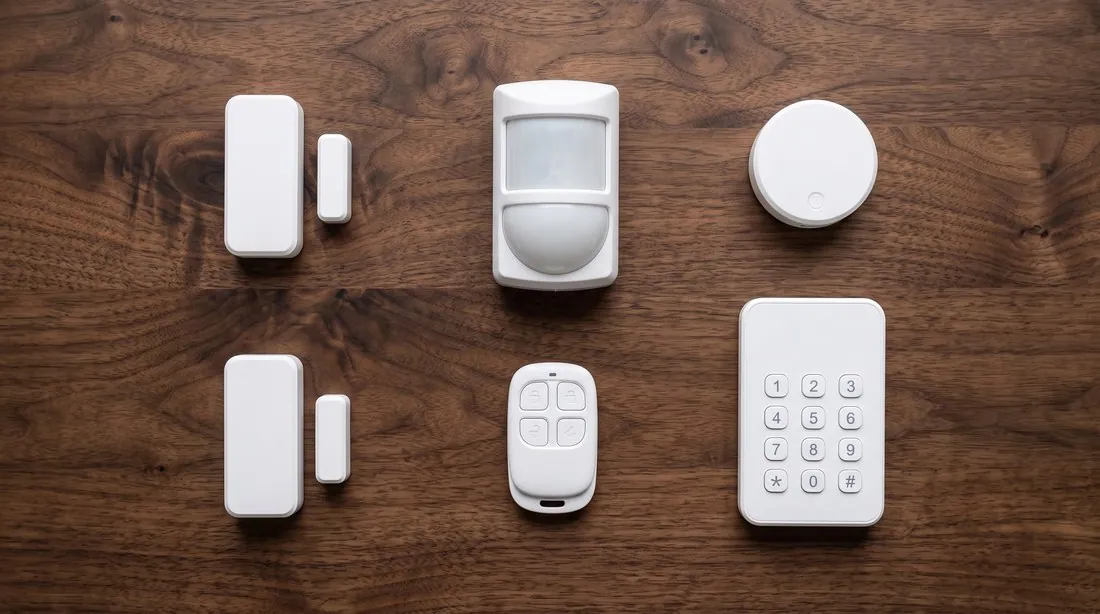
The catalogues make this sound complicated and it is not. There are five or six things and each one does one job.
- Door and window contacts. Two pieces of plastic that know when they are no longer touching. Cheap, tiny batteries, and the workhorse of the whole system. Every exterior door gets one. And the walkout basement door and the basement windows get one each, because that is the part of the house nobody upstairs will ever hear.
- Motion sensors. One well-placed sensor in the hallway that everything has to pass through is worth six scattered around rooms. Ceiling corners, pointed across the route rather than at a window — sunlight moving on a floor sets off more of these than burglars do.
- Glass-break sensors. They listen for the frequency of breaking glass rather than for the window opening, which matters for the big fixed panes that no contact can protect. One covers a room.
- Smoke and carbon monoxide on the same system. This is where monitoring earns its keep more clearly than anywhere in the burglar half of the page, and it is the part the advertising undersells. A monitored smoke detector calls the fire service whether or not you are conscious, and whether or not you are at home — which also covers the house with nobody in it and a fridge on a bad circuit.
- The panic button. A key fob or a bedside button. Worth two things: it works without you finding a telephone, and in towns that suspend police response to false-plagued burglar alarms, hold-up and panic alarms are still answered. It also does the medical job that a separate pendant does, if the plan includes it — ask, because plans differ.
- Water and freeze sensors. Ten or fifteen dollars each under the water heater, behind the washing machine and under the kitchen sink. Statistically these are the ones most likely to save you actual money, and no burglar is involved. When I did handyman work, plenty of people with alarms had thought to add smoke detectors. Hardly anybody had thought of these. Put one behind each toilet as well, and choose the kind that alerts your phone, so a leak is caught in the first hour and not after a working day. Where else to put them is on the house checklist, and why the slow leaks matter is on the hidden bills page.
If you have cameras already, they are a separate question from the alarm and should stay one. A camera tells you what is happening. An alarm makes something happen. Buying one under the impression that you have bought the other is the most common muddle in this whole category.
🔕 The Version With No Bill At All
Plenty of people read all of the above and land on "no subscription", and that is a legitimate answer rather than a cheapskate one. Here is what that looks like assembled properly, for well under a single year of monitoring.
- A wedge alarm under each exterior door. Twenty dollars, a nine-volt battery, and genuinely painful to stand next to. It braces the door and screams at the same time.
- Contact chimes on ground-floor and basement windows. A few dollars each, no wiring, no hub.
- A camera that records to a card, so you can look, review and download without paying anybody monthly.
- A driveway alarm if you are set back from the road — a chime indoors when something comes up the drive, which is the earliest warning available to anybody at any price.
- The yard sign and the window stickers. See above. It is a bluff and it works on the people who were choosing between your house and another one.
- A charged telephone on the bedside table, which is the part of every plan on this page that actually summons help.
Be clear about the gap you are accepting. That collection covers the burglar tolerably well. It does not cover the fire when you are asleep in it, and it does not cover the night you are not in a position to pick the telephone up. Those two are what the monthly bill is really for. If you decide they are worth thirty-odd dollars a month, that is a sound decision. If you decide they are not, that is also a sound decision — but make it on purpose, knowing which two things you have set aside.
📋 Why This Belongs on the Fifty List
Because this is the category where the money most easily goes to the wrong half of the problem, and it goes there quietly, thirty dollars at a time, for twenty years.
The things that decide whether somebody gets into your house are physical and they are cheap and they are one-time. Screws long enough to reach the framing. A bar on the door that nobody upstairs can hear. A light that comes on when something moves. Something thorny under the window that is going to be there whether or not anybody remembered to set anything.
The electronics do a different job, and it is a real job: they tell you, and they tell somebody else, and on the one night it counts that head start is the whole difference. Buy them for that. Buy them knowing what your town will and will not do about them, what they cost over a decade, and what happens to them when the power goes.
And buy them at fifty or sixty rather than at eighty, for the same reason as everything else on this site — because installing sensors, learning a keypad and choosing where the panel goes is a pleasant Saturday now, and it is somebody else's decision made on your behalf later.
A siren at three in the morning is not security. The security was fitted months earlier, in daylight, with a screwdriver. The siren is only how you find out it was needed.
Related: fall detection without a camera or anything to wear →
❓ Plain Answers
The short version of this page, one question at a time — the answer is always the first line.
Is a self-monitored alarm as fast as a monitoring company?
When you are home and awake, it is faster. A monitoring center calls you first, and many towns require it to try a second number before asking for police. If you hear your own alarm and dial 911 yourself, there is no call in between. The gap is when you cannot reach the phone — asleep through it, in the shower, or away.
Should I arm my alarm at night?
Yes — every night, in night mode. Night mode watches the doors and windows with the motion sensors off, so you can walk to the bathroom without setting it off. Most people only arm the alarm when they leave, which protects the house when it is empty and leaves it unarmed when they are asleep inside it.
Should I get a monitored or a self-monitored alarm system?
Self-monitoring suits someone home most of the time and in decent health, while professional monitoring suits someone who lives alone or could be unable to reach a phone. Self-monitoring does nothing when you cannot pick up the telephone.
How much does alarm monitoring cost over ten years?
At about thirty-two dollars a month, professional alarm monitoring comes to roughly three thousand nine hundred dollars over ten years, on top of the equipment. Get the current price from the company's own website, and expect it can go up.
Can I be fined for a false burglar alarm?
Yes, most towns require you to register an alarm system, and most fine you, not the company, for false alarms. Some towns stop police response to burglar alarms after too many false ones, so ask your police department's non-emergency number what your town does.
Does a home alarm work when the power goes out?
Almost every modern alarm panel has a battery, usually lasting four to twenty-four hours, but a Wi-Fi-only system goes silent to the outside world when the router loses power. Cellular backup keeps it talking, and on most systems that is a paid tier.
Is a medical alert pendant worth it if I live alone?
A medical alert pendant matters most for someone who lives alone, because how a fall ends depends on how long you are on the floor. Buy a waterproof one so it is worn in the shower, and agree ahead of time that pressing it is the right thing to do.
Does an alarm sign keep burglars away?
In one survey of over four hundred convicted burglars, around sixty per cent said they would go and find a different house if they found an alarm. That study was funded by the alarm industry's own research foundation, and a sign alone does nothing else.