💧 Eight Years On My Counter
Most of what is on this site is researched. This part is not — it is just what happened in my own kitchen, and you should weigh it accordingly.
🏡 From the owner of this site
I have had a gravity filter sitting on my counter here in Crystal River for close to eight years. The water in this part of Florida is honestly pretty good — nobody is going to write a newspaper story about it. But good is not the same as nothing, and there are chemicals in it that I would rather not spend the next thirty years drinking. That was the whole reason I bought it.
What I did not expect was the taste. Filtered tap water out of that spigot beats the bottled water I used to carry in from the store, and it is not close. Once every year or two I change the elements and that is the entire maintenance program. Eight years, and it has never needed a repair, a filter subscription, a plumber, or an outlet.
The part worth telling you about is what goes inside it. I do not run the housing manufacturer’s own elements. I run washable ceramic elements made by somebody else entirely — the kind sold as a cross-fit for several different gravity systems — and they drop straight into the chambers I already owned. I did not do that to be clever. I did it because they were available and they work. It turned out to be the smartest accidental decision in this whole setup, for reasons the next section explains.
— Franklyn Galusha, Crystal River, Florida
That is one person’s counter, and it is not evidence about your water. What follows is the part that is checkable: how these things work, what the certifications actually promise, where the category genuinely falls short, and what the arithmetic looks like when you stop buying water at the supermarket.
🪣 How It Works — and Why It Is Not a Pitcher

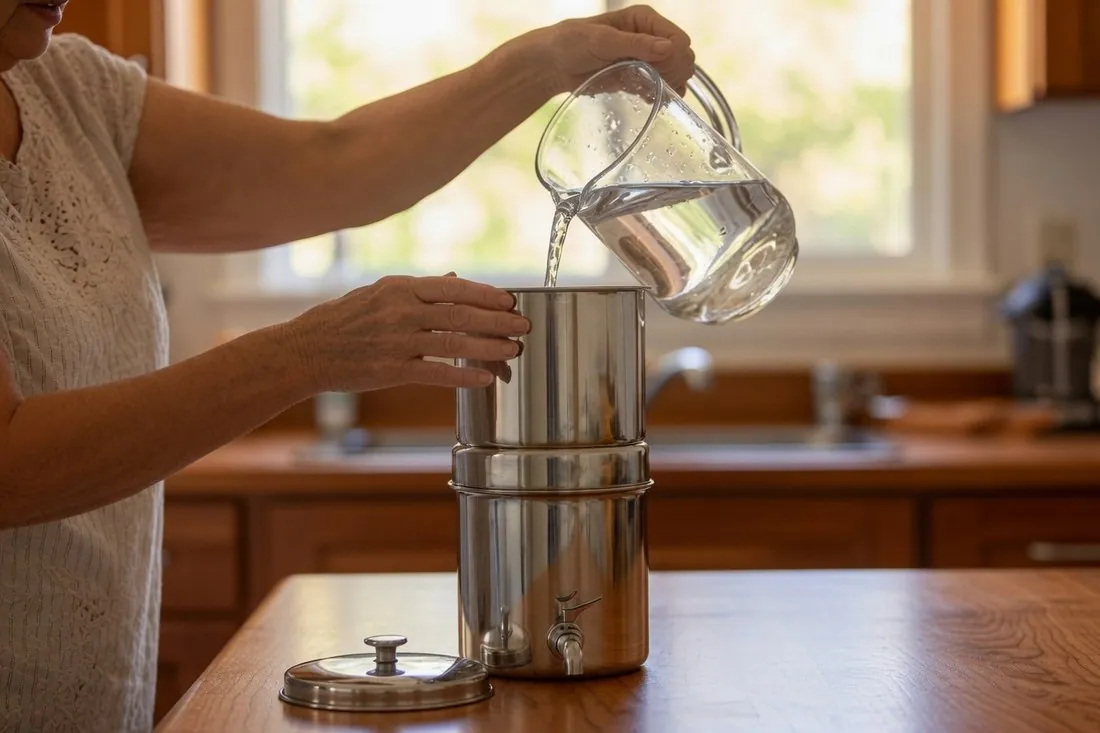
The mechanism is almost stupidly simple, which is the point. An upper chamber holds untreated water. Filter elements — usually two, sometimes four or six on the bigger units — screw through the floor of that chamber and hang down into the lower one. Water can only get from the top to the bottom by going through the element, and the only thing pushing it is its own weight. No pump, no pressure line, no power cord. You fill the top in the morning and there are gallons of finished water waiting in the bottom by afternoon.
That slowness is a feature, not a defect. A faucet filter has a fraction of a second to do its job as water rushes past under mains pressure. A gravity element has minutes. Longer contact with the carbon is exactly what carbon adsorption wants, which is why gravity units can use dense, slow media that would choke a faucet mount.
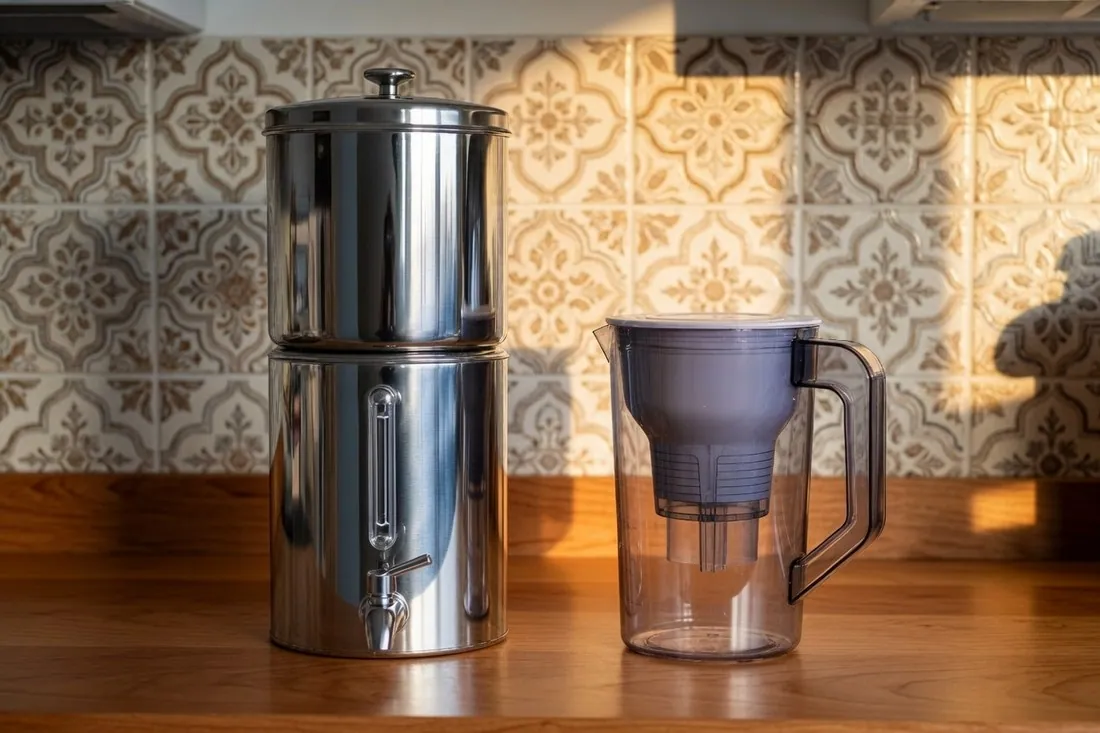
Here is how the three common approaches actually differ, and it is worth being clear-eyed about it because the cheapest one to buy is the most expensive one to own:
Cheapest to buy, most expensive to run
Twenty or thirty dollars on the shelf, holds half a gallon, and lives in the refrigerator door. The catch is the cartridge: a common standard cartridge is rated somewhere around forty gallons, which at a gallon a day is about six weeks. You are back at the store roughly nine times a year. It needs the refrigerator, it needs refilling constantly, and lifting a full pitcher is its own small problem for hands that have earned their mileage.
Convenient, but it lives on the plumbing
Screws onto the tap, switches in and out of line, and gives you filtered water on demand — genuinely useful. But it needs mains pressure to work, which means it does exactly nothing on the day the water is off or the pressure is gone. It also does not fit every faucet, and the fitting is one more small thing to unscrew and re-seat with stiff fingers.
Cheaper to buy than it used to be, cheapest to run, works with the power off
This page used to tell you the entry price was two hundred and fifty dollars and up. That is no longer true, and it is the single biggest change in this category in years. A two-and-a-quarter-gallon system in 304 stainless steel, with two carbon elements, a spigot and a stand, can now be had for well under a hundred dollars. The old price was the barrier that kept this off most kitchen counters. It is gone.
What you get for it: elements measured in thousands of gallons instead of dozens, a stainless housing with nothing in it to break, several gallons of finished water standing ready at all times, and total independence from both the outlet and the water main. Pour anything drinkable into the top — tap, stored water out of your containers, water hauled from somewhere else — and it treats it the same way.
The catch is not the steel. It is what the elements are certified to do, and that is the next section.
That is also why this is a buy-it-once object rather than a gadget. Every other filter in the house is attached to something — the plumbing, the refrigerator, the tap — and is therefore only as long-lived as the thing it is attached to. This one is attached to nothing.
🔍 The Number That Tells You What It Really Does

This is the most useful thing on the page, and almost nobody selling water filters wants to explain it plainly.
Filter boxes are covered in impressive-sounding numbers. The one that actually means something is the NSF/ANSI standard the product is certified to — and the standards are not a ladder from good to better. They cover completely different things, and the cheapest one to earn is the one that sounds the most reassuring.
| Standard | What it actually covers |
|---|---|
| NSF/ANSI 42 | Aesthetic effects only. Chlorine taste and odor, and particulates. How the water looks, smells, and tastes. This is not a health claim and it says nothing about lead, chemicals, or anything that could make you ill. |
| NSF/ANSI 53 | Health effects. Contaminants with a known or suspected health effect — lead, cysts such as Giardia and Cryptosporidium, volatile organic compounds, asbestos, mercury, and in some listings chromium-6 or arsenic. Crucially, it only covers the specific contaminants named in that product’s claim. Certified to 53 does not automatically mean certified for lead. |
| NSF/ANSI 401 | Emerging contaminants. Trace pharmaceuticals and pesticides. An add-on standard covering a defined list of incidental compounds turning up in drinking water. |
| NSF/ANSI 372 | A materials standard, not a performance one. It certifies the filter housing is lead-free in its construction. It tells you nothing whatsoever about what the filter removes — and it is frequently listed alongside 42 in a way that makes a taste-only product look thoroughly certified. |
| NSF/ANSI 58 | Reverse osmosis systems. A different category of product entirely — plumbed in, powered by mains pressure, and the usual answer when dissolved contaminants such as nitrates or fluoride are the concern. |
The trap, in one sentence: a gravity filter certified only to NSF/ANSI 42 and 372 is certified to improve the taste and to be built out of lead-free parts. That is the entire promise. It is a genuinely useful promise — it is most of why my water tastes better than the bottled stuff — but it is not a certified health claim, and marketing copy routinely blurs the two.
What this looks like on a real listing. Go and read the budget gravity systems for yourself and you will see the same shape over and over. The product title says NSF/ANSI 42 Certification — taste and odor. Then the bullet points underneath promise the filter handles PFAS, fluoride, heavy metals, microplastics and bacteria. Those two things are not the same claim, and only the first one has been independently verified. Some listings even spell the pathogen words with odd accented characters so the automated moderation does not catch them, which tells you the seller knows the claim is doing work it should not be doing.
This is not a reason to avoid the cheap systems. It is a reason to buy them for what they are certified to do — make chlorinated municipal water taste and smell better, out of a lead-free stainless housing, with no power — and to stop reading at the certification line.
“Tested to” is not “certified to.” A manufacturer can commission its own lab work and truthfully print “tested to NSF standards” on the box. Certification means an independent body verified the claim and lists the product. If the words on the box are tested, meets, or designed to meet rather than certified or listed, you are reading the manufacturer’s own homework.
Do the free thing first. Every community water system in the United States has to publish a Consumer Confidence Report once a year, and it is free. It tells you what disinfectant your utility uses and what was actually detected in your water. Read yours before you spend a dollar, then buy the filter certified for what the report shows — not the one with the longest list of claims on the carton. On a private well, no report exists and the equivalent step is a certified laboratory test, which your county health department can point you to.
🗜️ The Elements — The Part That Actually Does the Work
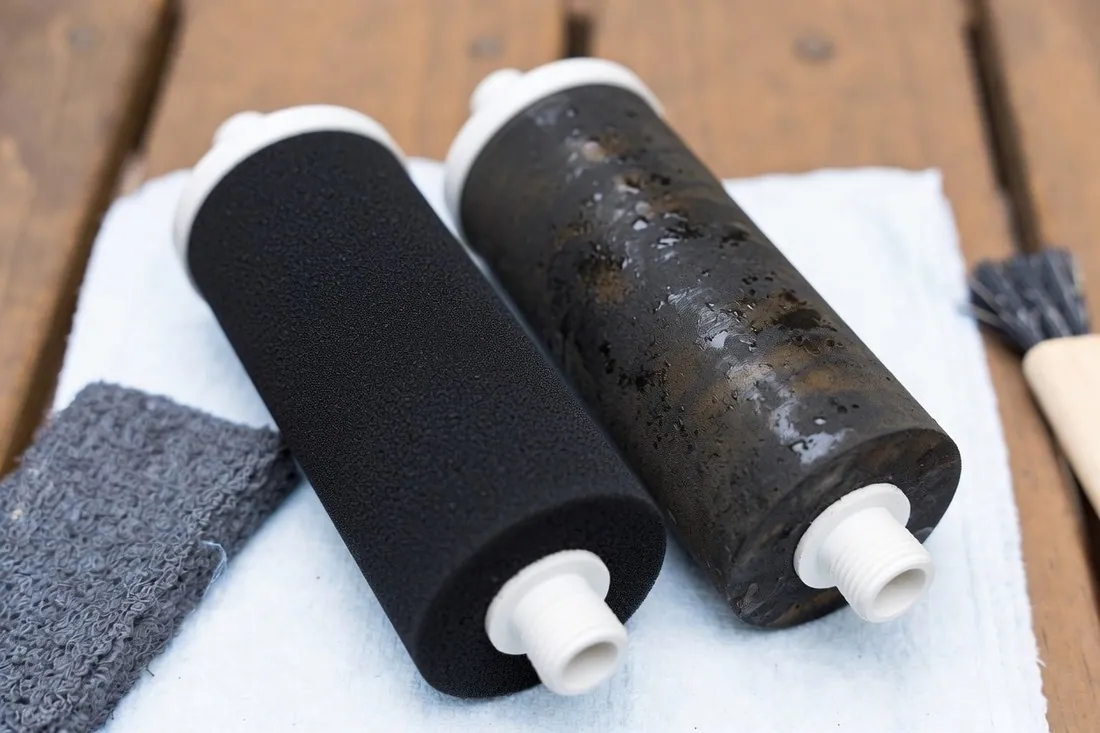
Here is the thing almost every article on this subject gets backwards. The steel is a bucket. A well-made bucket, one that will outlive you, but a bucket. Every single thing your filter actually does happens inside two replaceable cylinders that cost a fraction of the housing. Which means the element is the product, and the housing is just what you hang it in.
Once you see it that way, two useful consequences follow.
The elements are cross-compatible — and that is your insurance policy
The common gravity chambers take standard-threaded elements, and several manufacturers make them. A single set of elements will commonly list fitment across three or four different brands of housing at once. This is the quiet reason the whole category survives its own manufacturers: your housing is not orphaned when a brand stops making parts. It is a bucket with a standard hole in it, and somebody is always making something that fits the hole.
That is not a hypothetical. It is exactly what happened when the best-known name in this category stopped producing its own replacement elements — the housings on all those counters kept working, because other people’s elements fit. The people who were stuck were the ones who believed the brand and the filter were the same thing.
Ceramic can be washed. Carbon cannot.

This is the difference that decides how long an element lasts, and it is barely advertised. A carbon block works by adsorption — contaminants stick to the surfaces inside the media until those surfaces are full, and when they are full the block is spent. Nothing you can do at the sink will bring it back.
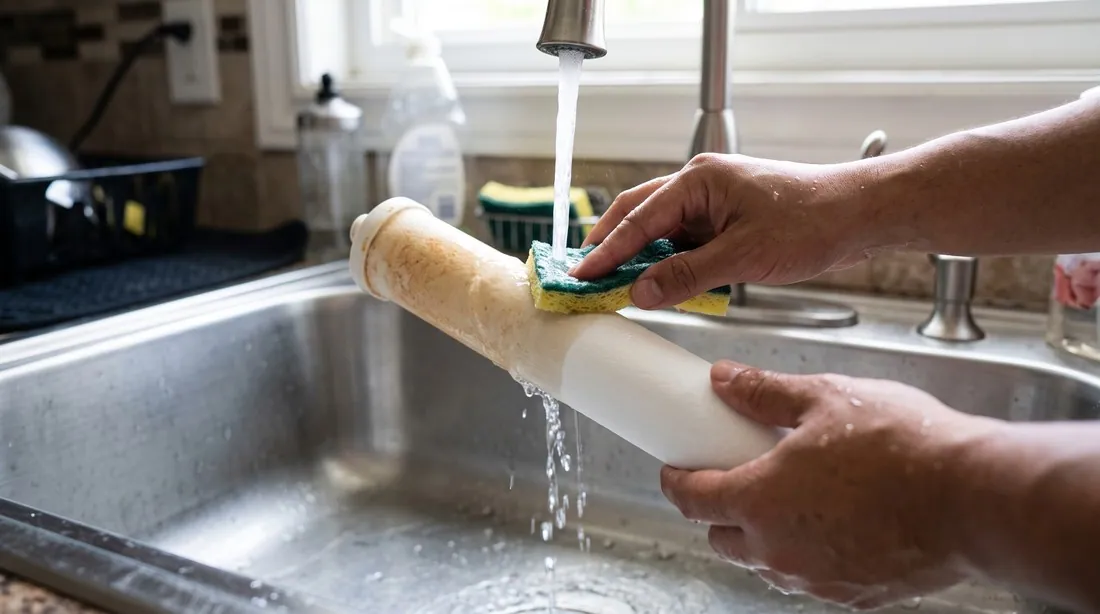
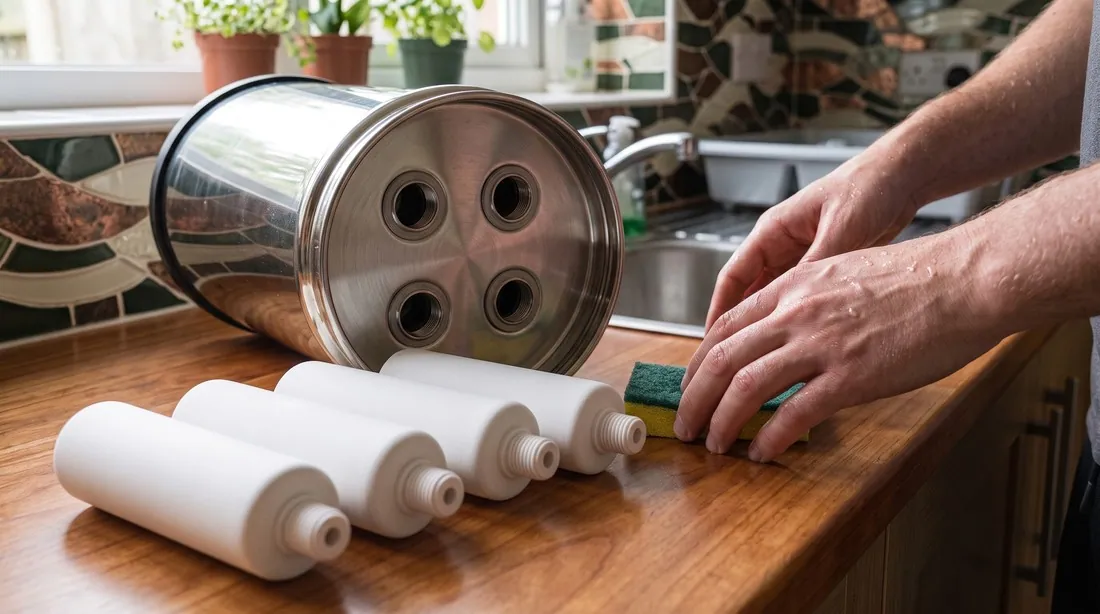
A ceramic element works as a physical barrier. The pores are on the outside, so what slows it down is a skin of fine sediment sitting on the surface. When the flow drops, you take the element out and scrub the outside with a sponge or a clean abrasive pad under running water — no soap, ever, because soap clogs the pores — and the flow comes back. You are not restoring a chemical; you are sweeping a doorway. A ceramic element can go through that cycle many times before it is genuinely finished.
The capacity numbers follow from that. Budget carbon elements are commonly rated around three thousand gallons a pair. Ceramic pairs are frequently rated to ten thousand. At a gallon a day, ten thousand gallons is longer than most people will own the house — which means in practice you replace ceramic when it stops cleaning up rather than when you hit a number, and the running cost per gallon drops to something close to negligible.
What is on my own counter, since people ask. The elements I run are a washable three-stage ceramic set sold as a cross-fit for several gravity systems, rated up to ten thousand gallons a pair, with a sponge in the box for exactly the scrubbing described above. They are certified to NSF/ANSI 42 and 372. This is the set I buy →
And now read that certification line the way this page taught you to. Forty-two and 372 means taste and odor, out of lead-free parts. It is an independently verified claim and it is the honest reason my water tastes better than the bottled water it replaced. It is not a health-effects certification. If your water report shows lead, cysts, or VOCs, this is not the element that answers it — you want one listed to NSF/ANSI 53 naming that contaminant, and those exist in the same cross-compatible ceramic format and drop into the same housing.
I am telling you what I use, not telling you it is what you need. Those are different sentences, and most of the internet runs them together.
What this means when you buy
Judge the element, not the box it came in. Before you buy any gravity system, look up what its elements cost, how many gallons they are rated for, whether they can be cleaned, what standard they are certified to, and — the one nobody checks — how many different companies make something that fits. A housing with one supplier is a subscription with a stainless shell. A housing that takes a common element is a thirty-year appliance.
✅ What They Can Do — and What They Cannot
The category is oversold in both directions. Enthusiasts talk about it as though it makes any water safe; skeptics call it an expensive novelty. Neither is right. Here is the honest split.

What a good carbon gravity filter genuinely does
- Removes chlorine taste and smell. This is the most reliable thing carbon does and it is the whole reason filtered tap water tastes better than it did out of the tap. It is also why it can beat bottled — a great deal of bottled water is municipal water that has been through a filter and then sat in plastic for months.
- Reduces disinfection byproducts. When chlorine meets natural organic matter in the supply, it forms trihalomethanes and haloacetic acids. The EPA caps total trihalomethanes at 80 parts per billion as a running annual average, which means legal water still contains some. Activated carbon is an effective treatment for them, and countertop carbon filtration is specifically among the methods recommended for reducing them at home. For most people on chlorinated municipal water, this is the real answer to “chemicals I would rather not be drinking.”
- Removes what it is certified to remove. If the product carries an NSF/ANSI 53 listing naming lead, cysts, or VOCs, that claim has been independently verified. Read the listing, not the carton.
- Works without being plumbed in or plugged into anything. No installation, no electrician, no landlord conversation, and nothing to disconnect if you move house. It goes on the counter and it is yours.
- Handles volume without your hands. Several gallons at a time, poured once, with no lifting a heavy pitcher in and out of a refrigerator.
What it does not do — and this is the part that gets left out

It is not a boil-water notice remedy. If your utility issues a boil-water notice, follow the notice. Filters certified for microbiological purification are a separate and much narrower category, and even those do not override a public health advisory. Boil the water.
- It does not make unsafe water safe. A filter is chosen against a known problem. Pouring water of unknown quality through it and assuming the machine handled it is exactly the wrong instinct.
- Carbon does not remove dissolved salts, nitrates, or hardness. Nitrate is a serious concern on wells near agriculture and carbon does essentially nothing to it — that is a reverse osmosis or ion exchange problem. The water will also be exactly as hard coming out as it was going in.
- Fluoride and arsenic need separate add-on elements on the systems that offer them — and those add-ons have far shorter lives, commonly around a thousand gallons against several thousand for the main element. If you buy for that reason, budget for it.
- Filtered water has no chlorine left in it. This is worth sitting with, because it is the one people never hear. The chlorine you just removed was doing a job: keeping the water from growing anything on the way to your glass. Finished water in the bottom chamber has no such protection. Use it within a couple of days, empty and wash the lower chamber regularly, and do not treat it as long-term stored water. Long-term storage is a different job with different rules — ours are on the water storage calculator.
- It is slow. Gravity is gravity. You fill it and walk away; you do not stand there holding a glass.
💵 The Money — What You Stop Handing the Supermarket
Assume a two-person household going through one gallon a day of drinking and coffee water — 365 gallons a year. Everything below is approximate and prices move constantly; the shape of the answer is what matters, not the decimals.
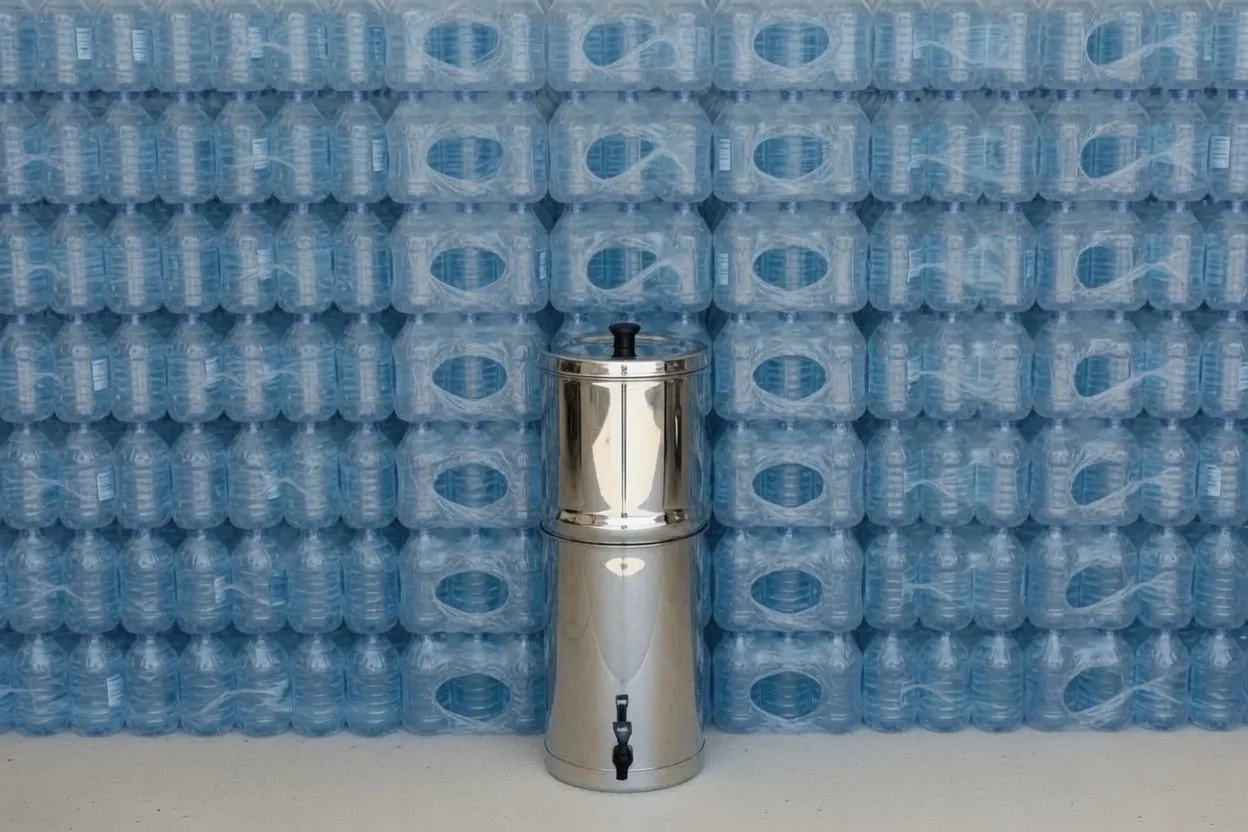
Run those over a year at a gallon a day and the picture stops being subtle. Bottled water in jugs comes to roughly $440 a year. The same water bought in cases of small bottles is closer to $690. Pitcher cartridges cost about $65 a year and put you at the store nine times to buy them. Gravity elements run about $40 a year.
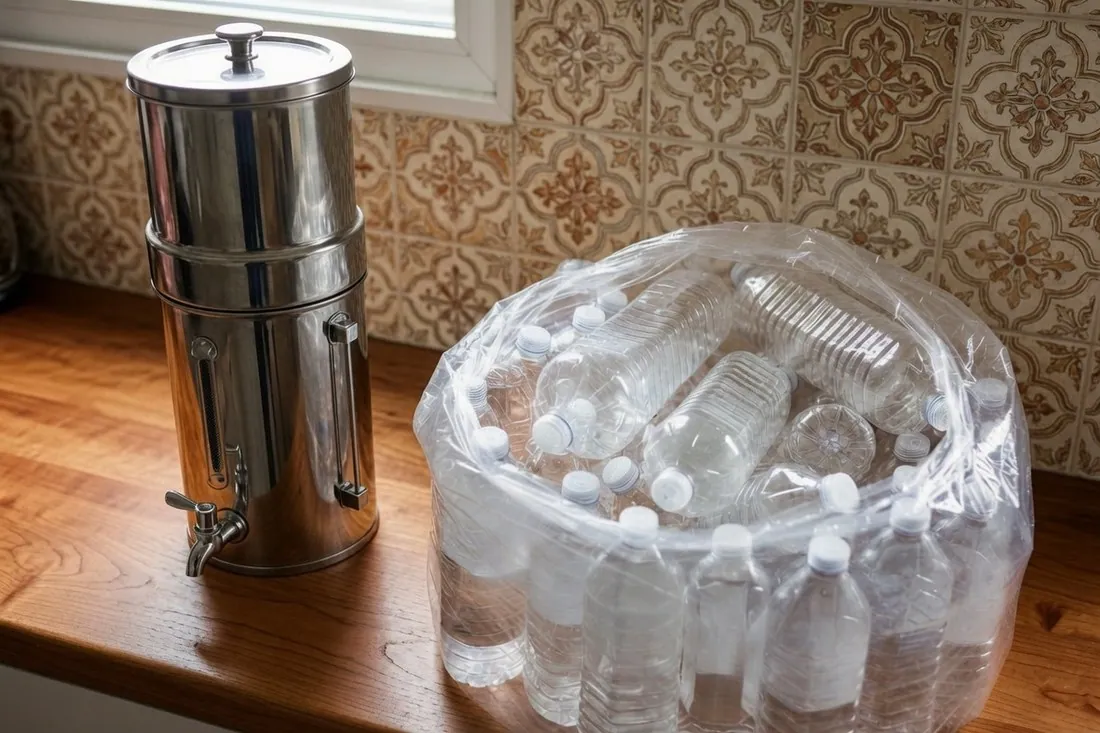
Then add the equipment, and this is where the arithmetic has genuinely changed. An entry-level stainless gravity system is now under a hundred dollars rather than the two-fifty to four hundred it was. There is nothing in it to wear out — no motor, no pump, no electronics, no seals under pressure. So:
What each route actually costs
- Bottled water in cases: around $6,900 — plus hauling every drop of it in from the car.
- Bottled water in jugs: around $4,400.
- Pitcher filter: around $670, and about ninety cartridge purchases.
- Entry-level gravity countertop: around $450 — roughly $80 of equipment and the rest elements.
- Health-certified gravity countertop: around $640 — a $350 system with elements certified for contaminants that carry a health effect, not just taste.
Against bottled water in jugs, the entry-level system pays for itself in about ten weeks and saves roughly $4,000 over ten years. Against cases of small bottles it is well over six thousand dollars, and that is before you count the plastic and the lifting.
The result that surprises people is the last one: the gravity filter is also cheaper to run than the cheap pitcher. The pitcher wins on the day you buy it and loses every year after, because forty gallons a cartridge against three thousand gallons an element is not a close race. The pitcher is the expensive option wearing a low price tag — which is more or less the founding argument of this entire website.
One honest adjustment. If you are on good municipal water and buying bottled purely out of habit, the fairest comparison is not filter-versus-bottled — it is filter-versus-tap, and tap is free. The filter still earns its place on taste and on disinfection byproducts. But if someone tells you it pays for itself against water you were already getting for nothing, that is a sales pitch, not arithmetic.
And one caution about the cheap end. The gap between the eighty-dollar system and the three-hundred-and-fifty-dollar one is not the steel — both are 304 stainless and both will outlive you. The gap is the certification on the elements. If your water report says taste is your only issue, the cheap one is the correct purchase and the expensive one is money wasted. If your report shows something with a health effect, the cheap one does not address it no matter what the bullet points say.
⚠️ The Berkey Question
You cannot write this page honestly without addressing the brand, because for twenty years Berkey was this category in most people’s minds. If you are reading this, it is probably the name that brought you here. Here is the situation as plainly as we can put it.
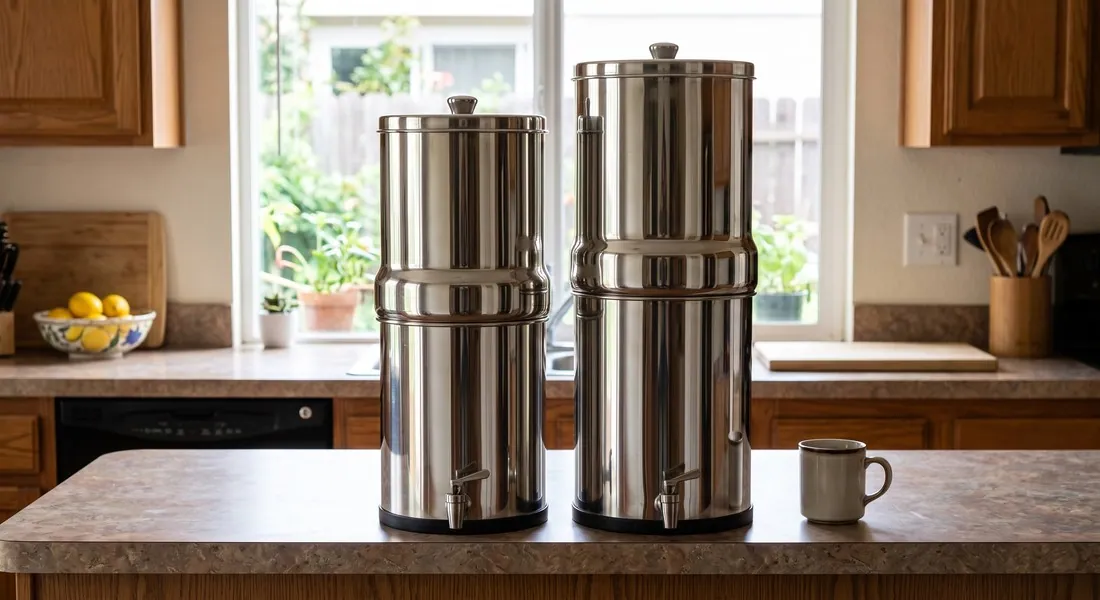
Beginning in late 2022 and into 2023, the Environmental Protection Agency issued Stop Sale, Use or Removal orders across the Berkey supply chain. The dispute is about the silver embedded in the Black Berkey elements: the EPA classified them as unregistered pesticide devices under FIFRA, the federal pesticide law, because a product making antimicrobial claims falls under that statute and has to be registered accordingly. New Millennium Concepts, the brand owner, sued in August 2023 arguing its elements are water filters and not pesticide devices. The district court dismissed the case on standing, and the fight has continued through the appellate courts since. Separately, the specific contaminant-reduction claims that made the brand famous were never independently certified by a third party such as NSF.
The practical consequence for anyone with a Berkey on the counter: authentic Black Berkey replacement elements have not been in production since the stop-sale, and pre-existing stock ran out. Filters listed on Amazon, eBay, and Walmart today as Black Berkey elements may well be counterfeit — Berkey itself warns buyers about counterfeit elements and publishes a guide to telling them apart. If you have been quietly reordering yours from a marketplace every year or two, that habit was sound for most of the last decade and is not sound now.
Nothing here says your existing system is bad, and if you own one there is a straightforward answer: put somebody else’s elements in it. Cross-compatible ceramic sets fit these housings and are sold openly, which is what the elements section above is about.
The orders are about how the elements are classified under federal pesticide law; they are not a finding that the water these systems produce is unsafe. A stop-sale order is not a recall, and the stainless housing on your counter is unaffected by any of it — it is the replacement elements that are the problem, and the elements are the one part you were never actually locked into. But it does mean that we will not send you to buy Berkey elements, and it means that if you are shopping for a gravity filter today, the sensible move is to choose on certification rather than on reputation.
Which brings us to what to call this thing. There is no good reason to keep using a trademark as a category name when the category has a real one. The words to search and to look for on a box are “gravity-fed water filter” or “gravity countertop water filter.” That is what the product is. Several manufacturers make stainless gravity systems, including elements that fit the housings people already own, and some carry certification the original never did.
🛒 What to Look For — Five Things

1. Decide which of the two tiers you are actually in
This is the whole decision and everything else is detail. The taste tier is an entry stainless system under a hundred dollars, certified to NSF/ANSI 42 and usually 372 — better-tasting water, no chlorine smell, reduced disinfection byproducts, lead-free housing, and a piece of equipment that will still be on the counter in thirty years.
For a great many households on decent municipal water, that is genuinely the right answer and spending more buys nothing. The health tier is a system whose elements are certified to NSF/ANSI 53, and often 401 as well, naming the specific contaminants you are worried about. It runs two-fifty to four hundred. You move up to it because your water report told you to, not because the carton was persuasive.
2. Read your own water report before you read any product page
Free, annual, required by law, and it settles tier one versus tier two in about ninety seconds. Buy against the report. On a private well there is no report and the equivalent step is a certified laboratory test — which matters more on a well, not less, because nitrate and bacteria are well problems and carbon does not touch nitrate.
3. Stainless steel, and check which parts
Both tiers should be 304 stainless in the chambers — it outlives the buyer, takes heat and cold without complaint, does not craze or hold odors, and is why eight-year-old units look like new ones. Worth a glance at the spigot too: some budget systems fit a plastic tap to a stainless body, and the spigot is the part you touch several times a day.
4. A spigot you can work with one hand
The small detail that decides whether this is a pleasure or an irritation at eighty. A lever or push-tap beats a small round knob for the same reason every other fixture on our easy-grip page does. A sight-glass spigot that lets you see the level saves lifting the lid to check, and it is common even on the cheap systems now.
5. Elements you can still buy in five years
This is the lesson of the whole Berkey affair and it applies to every filter you will ever own. A system is only as good as its replacement supply. Before buying, check that elements are currently in stock from more than one legitimate seller, and strongly prefer housings that accept elements from more than one maker — the standard-size chambers do, which is what makes the upgrade path from the taste tier to the health tier possible without replacing the whole unit. There is a fuller account of this in the elements section, including why a washable element outlasts a disposable one. A filter you cannot re-element is an ornament.
The upgrade path, since it is the best-kept secret here: because most stainless gravity chambers take standard-threaded elements, you can start with an inexpensive system and later put better-certified elements into the same housing. Ceramic candle elements carrying NSF/ANSI 42, 53 and 372 certification fit the common sizes. So the cheap system is not a dead end — it is the chassis, and the elements are the part that determines what it actually does.
And the ten-dollar habit that keeps it honest: write the date on a piece of tape on the underside of the lid every time you change elements. Capacity is quoted in gallons but most makers also give a time limit — commonly six to twelve months — and the time limit usually bites first. Nobody counts gallons; a date does the job.
🛒 Buy It at Fifty

Almost nothing you buy for a kitchen is still working in thirty years. The appliances have boards in them. The plastic goes brittle. The model gets discontinued and the part that failed is the part nobody makes anymore. That is the ordinary fate of household equipment, and it is the reason this site exists.
A gravity filter is one of the small number of exceptions, and it is worth understanding why. It has no motor, no electronics, no pump, and no seals under pressure. Its working parts are two cylinders that several different companies make to the same fitting. It is a stainless bucket with a standard hole in it, and a stainless bucket with a standard hole in it does not become obsolete — which is the same reason your grandfather could buy a discontinued water heater without worrying about it.
And the argument for collecting it at fifty just got easier, because the price of admission fell through the floor. This used to be a three-hundred-dollar decision that people put off for years. At under a hundred it is a Tuesday. It pays for itself against bottled water inside three months and then keeps paying, every day, quietly, for as long as you keep the house.
Buy stainless. Buy against your own water report rather than the carton. Buy a system whose elements you will still be able to get. Then write the date under the lid and go about your life.
❓ Plain Answers
The short version of this page, one question at a time — the answer is always the first line.
How does a gravity water filter work?
A gravity water filter lets water run from an upper chamber down through filter elements into a lower chamber, with no pump, no plumbing and no electricity. Clean water collects in the bottom and comes out a spigot.
What is the difference between NSF 42 and NSF 53 water filters?
NSF/ANSI 42 covers only taste, odor and particulates, while NSF/ANSI 53 covers contaminants with a health effect, such as lead, cysts and volatile organic compounds. A 53 certification covers only the specific contaminants named in that product's claim.
Can I use a gravity water filter during a boil water notice?
No, a gravity water filter is not a boil-water notice remedy, so follow the notice and boil the water. Filters certified for microbiological purification are a separate, narrower category, and even those do not override a public health advisory.
Do gravity water filters remove fluoride?
Not the standard elements. Fluoride needs a separate add-on element on the systems that offer one. Those add-on elements wear out far faster than the main ones — commonly around a thousand gallons against several thousand — so budget for replacing them. Check that the add-on is certified for fluoride reduction, not just “tested to” a standard.
Can I use a gravity water filter on well water?
Get the well water tested by a certified laboratory first, then buy a filter certified for what the test finds. A private well has no utility report, and well problems — bacteria and nitrate especially — are exactly the ones an ordinary carbon element does not handle. A gravity filter can improve taste and remove what its elements are certified for, but it does not make an untested well safe.
Can you still buy Black Berkey filters?
Authentic Black Berkey replacement elements have not been in production since the EPA stop-sale orders that began in late 2022, and pre-existing stock ran out. Elements sold on marketplaces under the Black Berkey name may be counterfeit — Berkey itself warns buyers about counterfeits and publishes a guide to spotting them. Cross-compatible ceramic elements fit the same housings.
How much money does a gravity filter save over bottled water?
Against bottled water in jugs, an entry-level gravity filter pays for itself in about ten weeks and saves roughly $4,000 over ten years at a gallon a day. Gravity elements run about $40 a year. These figures are approximate and prices move.
Can you clean a ceramic water filter element?
A ceramic filter element can be cleaned by scrubbing the outside with a sponge or clean abrasive pad under running water, with no soap. A carbon block cannot be cleaned, and once it is full it is spent.